 Lorraine Williamson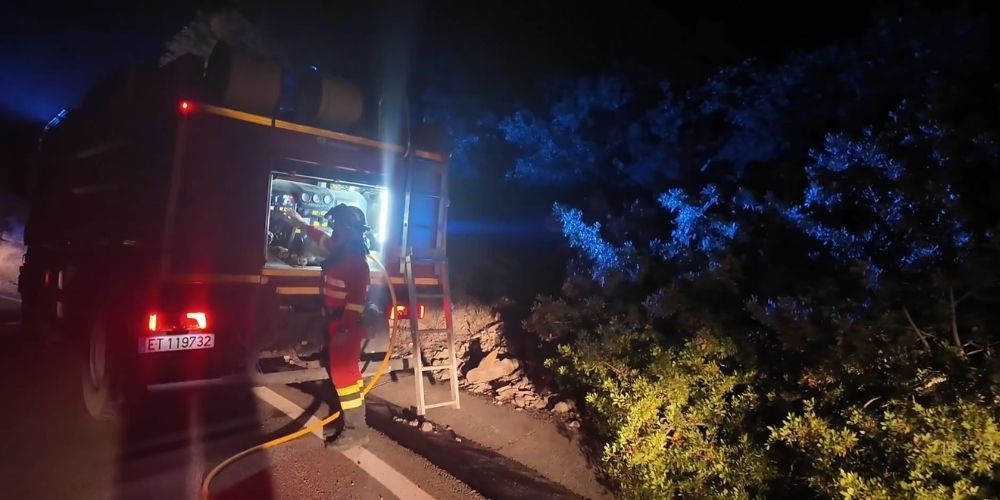
The devastating wildfire in Almería did not advance overnight, raising hopes that it could be formally declared stabilised within hours after burning approximately 6,600 hectares.
Much of the perimeter has now been secured, while more than 600 people have been allowed to return to communities evacuated during the emergency. However, the fire has already claimed 12 lives, and the search and identification operation remains unresolved.
Firefighters, the Unidad Militar de Emergencias and other emergency teams continued working through Saturday night, extinguishing flare-ups and using drones to identify remaining hot spots around El Chive, Lubrín, El Marchal, Bédar and Los Gallardos.
More favourable winds and higher humidity helped crews prevent the flames from spreading further. The improved conditions have allowed the operation to move from containing the fire towards a more direct attack on the remaining active areas.
More than 600 people return to evacuated areas
Residents have been authorised to return to Los Castaños, Almocaízar and Alfaix, as well as the campsite at Los Gallardos. The confinement order imposed on Lubrín has also been lifted following the improved overnight situation.
Around 1,400 people were moved from homes, residential developments, campsites and other accommodation during the worst stages of the emergency. Those who have not yet returned are staying in second homes or hotels in the surrounding area.
The authorities have stressed that residents should only enter evacuated areas once formal permission has been given. Some roads, tracks and isolated homes continue to be checked for fire damage and remaining hot spots.
Guardia Civil officers have inspected approximately 250 properties in the affected area and found that the vast majority remain intact despite the scale and speed of the fire.
Is the Almería wildfire now under control?
The wildfire has not yet been officially classified as stabilised or controlled. However, it did not advance overnight, much of its perimeter has been secured, and officials believe stabilisation could be declared during Sunday if conditions remain favourable.
A fire is considered stabilised when it is no longer spreading freely, and its perimeter is developing within the control lines established by firefighting teams. It must then be declared controlled before it can eventually be classed as extinguished.
Crews therefore remain deployed throughout the area, dealing with reactivations, reinforcing the perimeter and examining difficult terrain around rural communities and isolated properties.
Eight formal missing-person reports
The number of formal missing-person reports connected to the fire has risen to eight. This is separate from the wider list of 23 people initially described as temporarily unlocated after relatives contacted the authorities seeking information.
Officials have urged caution when comparing the two figures. Some people on the broader list may have left the affected area without immediately contacting family members, while a formal disappearance report requires a separate police process.
The Guardia Civil is continuing to check vehicles, homes and burned areas while cross-referencing information from relatives, hospitals and accommodation providers.
Identification of the 12 victims continues
The Guardia Civil’s criminalistics service has obtained genetic profiles from all 12 people known to have died in the fire. Formal identification has not yet been completed because relatives are travelling to Spain to provide samples for comparison.
Several victims are believed to be foreign nationals. Four people found inside a right-hand-drive vehicle were reported to be British, although the authorities had not formally confirmed their identities or nationalities by Sunday morning.
The identification process will also help determine whether any of the people formally reported missing are among those who died.
Authorities remain in contact with the governments of the United Kingdom and Belgium, while consular teams are assisting citizens and families affected by the disaster. Source
Five patients remain seriously ill
A total of 18 people have received medical attention following the fire. One patient remains in a very serious condition in intensive care at the Hospital Universitario Torrecárdenas in Almería, while four others are being treated in a serious condition at the Virgen del Rocío hospital in Seville.
Other patients were treated for burns, smoke inhalation and injuries sustained during evacuation or while attempting to escape the flames.
The higher total includes everyone treated by health services during the emergency, rather than only those originally listed as injured during the first hours of the fire.
Fire burned rapidly through several municipalities
The wildfire began near Los Gallardos on Thursday before spreading towards Bédar, Antas, Lubrín and surrounding rural areas. Strong winds, very dry vegetation and steep terrain allowed it to travel rapidly across thousands of hectares.
The flames crossed roads and threatened homes, campsites and isolated properties, forcing large-scale evacuations and temporary closures on the A-7 and other routes.
Investigators are examining whether a fallen electrical cable or installation close to the road may have started the fire. No definitive cause has yet been established, and the Guardia Civil investigation remains open.
The priority on Sunday is to secure the remaining sections of the perimeter, locate anyone still missing and complete the identification of those who died. Even if the blaze is declared stabilised, crews are expected to remain in the area for several days to prevent further flare-ups.