 Lorraine Williamson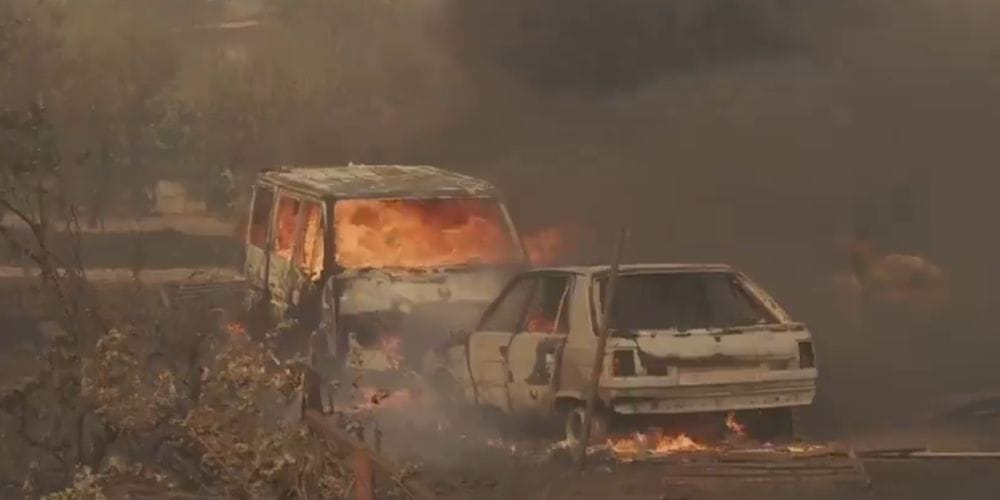
The wildfire emergency across Madrid and Ávila intensified sharply on Friday evening, with more than 55,000 people evacuated or confined. In Madrid, around 25,000 people had been moved from their homes, and a further 20,000 were ordered to remain indoors, while more than 10,000 people were affected in Ávila by the latest evening count.
The fires that began near San Martín de Valdeiglesias and Villa del Prado have merged into a single large front. However, the Burgohondo fire in Ávila was still moving in a different direction and had not joined the Madrid blaze at the time of the latest update.
Officials warned that the Madrid fire was being pushed north by strong winds, placing El Escorial and San Lorenzo de El Escorial among the areas of greatest concern. Further evacuations could be ordered if the flames continue advancing overnight.
New evacuations ordered west of Madrid
Fresnedillas de la Oliva, Robledo de Chavela and Zarzalejo were evacuated during Friday afternoon, while Navalagamella was also included in the latest emergency measures. They joined communities already cleared around Villa del Prado, Aldea del Fresno, Navas del Rey, Colmenar del Arroyo, Chapinería, San Martín de Valdeiglesias and Pelayos de la Presa.
People in areas affected by smoke have been asked to remain indoors, shut windows and doors and avoid unnecessary travel. The Community of Madrid is continuing to publish evacuation, confinement and public-safety information through its official emergency page.
A double telecommunications failure also left 16 communities without service, adding to the difficulty of contacting residents and coordinating the response. Anyone in the affected area should keep mobile phones charged whenever a signal and power supply are available.
Firefighters unable to attack leading fronts directly
The Madrid fire reached its most intense stage on Friday evening, with several leading fronts described as beyond direct suppression capacity. Crews were concentrating on protecting lives and property while attempting to slow the fire from safer positions.
Authorities said the situation could improve after midnight if wind speeds ease. A wind reduction would allow more ground crews to work closer to the flames and strengthen containment lines before aerial operations resume on Saturday morning.
Four additional firefighting aircraft from Italy and Greece are expected to join the response on Saturday, alongside reinforcements from six Spanish regions. The European support was requested after the Government activated the Union Civil Protection Mechanism.
Ávila blaze remains separate but dangerous
The Burgohondo fire has burned more than 9,000 hectares and developed a perimeter of approximately 71 kilometres. More than 10,000 people in Ávila had been evacuated or confined, including residents of Burgohondo, Villanueva de Ávila, Hoyo de Pinares, parts of Cebreros and accommodation near the Valle de Iruelas nature reserve.
Navaluenga and El Tiemblo remained confined, while residents of a care home in El Tiemblo were transferred to Cebreros. Although the fire had not crossed into Madrid, its speed and proximity to populated areas continued to make it one of the most serious active incidents.
One arrested over suspected cause of Burgohondo fire
The Guardia Civil has arrested one person and placed a second under investigation over the start of the Burgohondo blaze. Investigators believe a spark was produced while heavy machinery was being used in an area where such work had been prohibited because of the extreme fire risk.
The two people are suspected of offences relating to a forest fire and damage to natural resources and the environment. The investigation is being handled by the Guardia Civil’s environmental protection service, Seprona, following an inspection of the suspected origin point and the initial findings.
Roads and communications remain disrupted
Major restrictions continued on roads including the M-501 between Navas del Rey and San Martín de Valdeiglesias and the M-507 between Villa del Prado and the N-403. Closures may change quickly as flames move and emergency vehicles require access.
Drivers should not approach evacuated communities or attempt to bypass barriers. Anyone travelling through western Madrid, eastern Ávila or neighbouring parts of Toledo should check the live DGT traffic map immediately before setting out.
National emergency remains in force
The fires remain under a national emergency declaration, with the Ministry of the Interior directing the response and the Military Emergency Unit coordinating operations on the ground. The measure allows personnel and equipment from central, regional and local authorities to operate under a single command.
The declaration applies to the affected areas of Madrid and Ávila rather than the whole of Spain. It was introduced because of the simultaneous fire fronts, the direct danger to communities and the exceptionally difficult weather conditions set out in the official emergency order.
A difficult night ahead
Emergency crews are preparing for further changes in the direction of the flames as Friday turns into Saturday. Their immediate priorities are preventing loss of life, protecting El Escorial and San Lorenzo de El Escorial and stopping the Madrid fire from spreading into additional populated areas.
Residents should follow ES-Alert messages and instructions from emergency services immediately. Medication, identification, chargers and essential belongings should be kept ready in case evacuation orders are extended.
Wildfire risk remains extremely high across parts of central Spain. Current conditions can be checked through AEMET’s official forest fire danger map.