 Lorraine Williamson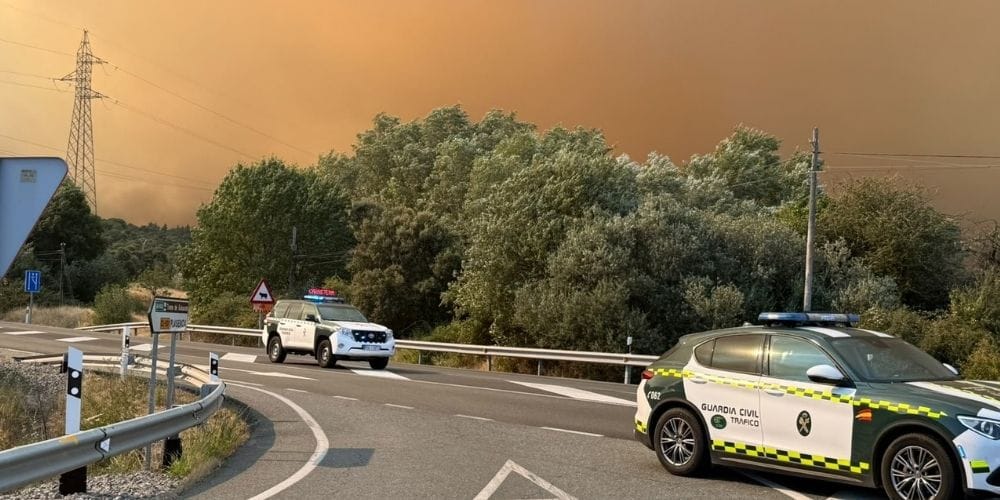
Smoke from a cluster of major wildfires has spread across Madrid, leaving the sky visibly hazy even many kilometres from the flames. The wider emergency has now forced more than 85,000 people to evacuate or remain indoors across Madrid and Ávila. Meanwhile, the fires have burned around 25,000 hectares and continue to advance without control, according to the latest figures available at 3.30 pm.
Madrid City Council has confirmed a deterioration in air quality across the region, including within the capital itself. The fires have increased levels of particulate matter and other pollutants, creating a risk well beyond the communities closest to the fire zone, according to the city’s official air-quality notice.
Smoke reaches the capital
The smoke plume has travelled eastwards across the Madrid region, turning the sky grey or brown in parts of the capital and reducing visibility in some areas. A smell of burning may also be noticeable far from the active fronts.
Being able to see or smell smoke does not mean the fire is close. However, the fine particles carried in wildfire smoke can irritate the eyes and respiratory system and may aggravate asthma, chronic lung disease and heart conditions.
Children, older people, pregnant women and anyone with respiratory, cardiovascular or allergic conditions are being advised to take particular care. People who can see smoke or ash should avoid strenuous outdoor activity, close windows and doors and switch off ventilation or air-conditioning systems that draw air from outside, under the current regional safety guidance.
Evacuations continue to rise
The emergency operation expanded again on Saturday as flames moved towards new communities in western Madrid and the Valle del Tiétar in Ávila. Cenicientos, Cadalso de los Vidrios and Las Rozas de Puerto Real were among the latest Madrid areas affected by evacuation orders.
In Ávila, seven municipalities in the Alto Tiétar were ordered to evacuate as a precaution, including Sotillo de la Adrada, La Adrada, Casillas, Casavieja, Santa María del Tiétar, Piedralaves and Navahondilla. The operation affects a large summer population because many second homes and holiday properties are occupied at this time of year.
Madrid alone had around 35,000 evacuees and 20,000 people confined by Saturday afternoon. Thousands more had been moved or told to remain indoors in Ávila, pushing the overall figure beyond 85,000.
Madrid fires combine into the Sierra Oeste blaze
The fires that began around Villa del Prado, San Martín de Valdeiglesias and Almorox have joined to form a single large incident now being referred to as the Sierra Oeste fire. The blaze has affected a broad area of western Madrid and neighbouring Toledo.
The Burgohondo fire in Ávila remained physically separate at the latest detailed update, although the two emergencies are now being managed through a unified operational command. Officials remain concerned that changing winds could bring the fronts closer together.
The unified response is intended to speed up decisions and coordinate resources across regional boundaries. A total of 2,737 personnel, 426 ground units and 21 aircraft were involved in the operation on Saturday, supported by resources from ten autonomous communities and European partners.
International reinforcements join the operation
Firefighting aircraft from Greece and Italy are joining the response through the European Civil Protection Mechanism. Portugal is also sending more than 100 military personnel to support operations in Ávila.
The Government says its immediate priority is protecting lives and populated areas rather than attempting direct attacks in sections where the flames remain beyond safe suppression capacity. The emergency is being led at national level under a unified system involving the Ministry of the Interior, the UME, regional authorities and local services, as set out in the Government’s Saturday update.
Prime Minister Pedro Sánchez said the immediate priority was “protecting lives, defending population centres and fighting the flames”, with all levels of government coordinating resources for the emergency response and the accommodation of evacuees and people ordered to remain indoors. He added that the Spanish Government would also support the reconstruction and recovery of the affected communities once the immediate firefighting phase had passed, in a statement published on X.
A brief window for firefighters
Crews were able to make progress overnight as temperatures fell, humidity rose, and winds weakened. The fires advanced less rapidly and lost some intensity, giving ground teams a chance to reinforce defensive lines.
The outlook remains uncertain. Wind direction and strength are expected to determine whether that progress can be maintained, while the possibility of dry thunderstorms could create further problems.
Prime Minister Pedro Sánchez described the weekend as a possible “window of opportunity” for bringing the fires under greater control. Officials have nevertheless warned that new instructions and evacuation orders may still be issued at short notice.
Roads and public transport disrupted
Several roads in western Madrid remain reserved for emergency traffic or closed because of the fires. Restrictions have affected routes including the M-501, M-507, M-512 and M-533, while several intercity bus services are not operating normally.
Anyone planning to travel through western Madrid, eastern Ávila or nearby areas of Toledo should avoid unnecessary journeys and check conditions immediately before leaving. The most reliable live information is available through the DGT traffic map.
People should not travel towards reservoirs, recreation areas or fire-affected communities to view the smoke or take photographs. These journeys can obstruct emergency vehicles and place additional pressure on already stretched services.
What to do if smoke is affecting your area
Remain indoors where possible, particularly if the smoke is dense or you belong to a vulnerable group. Keep windows and doors closed and avoid exercise outside until conditions improve.
If going outside is unavoidable, an FFP2 mask may reduce exposure to fine particles. Ordinary surgical masks are less effective against wildfire smoke.
Seek medical help if you develop severe breathing difficulties, chest pain, confusion, persistent wheezing or a marked deterioration in an existing condition. Call 112 in an emergency.
The crisis remains fast-moving
The scale of the smoke over Madrid shows how far the effects of a wildfire can travel, even when the capital itself is not directly threatened by flames. Air quality may continue to change as the wind shifts and different fire fronts intensify or weaken.
Residents should rely on official alerts, keep mobile phones charged, and be ready to follow any evacuation or confinement order immediately. The situation was continuing to develop at the time of the latest update.