 Lorraine Williamson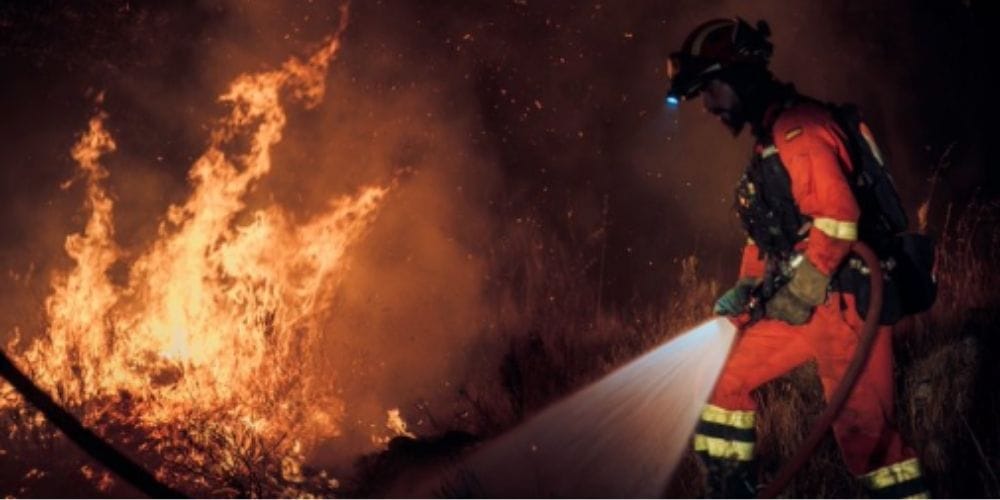
More than 20,000 people had been evacuated across Madrid and Ávila by early Friday afternoon as uncontrolled wildfires continued to threaten towns, residential developments and vulnerable care facilities. Around 19,000 people were affected in the Community of Madrid and a further 1,500 in Ávila, according to the latest confirmed figures.
The fires at San Martín de Valdeiglesias and Villa del Prado have merged, creating a larger front west of the capital. Emergency officials are also concerned that the blaze could eventually converge with the Burgohondo fire across the provincial boundary in Ávila.
Spain’s Ministry of the Interior has declared an emergency of national interest because of the simultaneous fires, adverse weather conditions, widespread evacuations and direct threat to populated areas. The declaration covers Villa del Prado and San Martín de Valdeiglesias in Madrid, together with Burgohondo in Ávila, and places the response under the highest civil protection level.
Evacuations expand across western Madrid
Fresh evacuation orders were issued for Navas del Rey, Colmenar del Arroyo and Chapinería during Friday morning, affecting thousands of additional residents.
They joined people already moved from Villa del Prado, Aldea del Fresno, San Martín de Valdeiglesias and Pelayos de la Presa. Residents in the San Ramón and Jaracruz developments were instructed to remain indoors, while the López Rumayor care home was confined as a precaution.
Hundreds of residents were also transferred from care homes and a centre for people with disabilities in the affected municipalities. Emergency medical teams have mainly treated people with existing health conditions at preventive care stations.
Fires remain outside full control
Although overnight firefighting work helped slow parts of the fires, the main Madrid fronts remained neither fully contained nor under control at noon on Friday.
At least 16 teams from the Community of Madrid fire service, forest firefighting units and forestry agents were working around San Martín de Valdeiglesias. Authorities urged residents to avoid the area, keep windows closed where smoke was present and prepare essential belongings in case evacuation orders were extended through the official emergency response.
The newly merged fire is particularly challenging because it covers a wider area and can change direction quickly in strong winds. Firefighters are attempting to protect communities lying ahead of the front while preventing further spread towards the Ávila border.
National Government assumes control
The emergency declaration means Interior Minister Fernando Grande-Marlaska is responsible for directing and coordinating the overall response.
Operational command has been assigned to the head of the Military Emergency Unit, the UME. Resources from central, regional and local authorities can now be managed through one command structure, including firefighters, aircraft, emergency medical teams, police and civil protection personnel.
The measure does not amount to a nationwide state of alarm and does not automatically impose restrictions elsewhere in Spain. It applies to the emergency affecting Madrid and Ávila and is intended to improve coordination across administrative boundaries under the official emergency order.
Spain has also activated the European Civil Protection Mechanism and requested at least four fixed-wing firefighting aircraft. Greece has offered two Canadair planes to assist the operation.
Burgohondo remains a major concern
In Ávila, the Burgohondo fire has affected areas around Navaluenga, El Tiemblo and the Valle de Iruelas nature reserve.
Around 1,500 people had been evacuated, including residents of accommodation and developments near El Burguillo. People in Burgohondo, Navaluenga and El Tiemblo have also received instructions to remain inside their homes when required.
Crews managed to establish a perimeter around much of the Burgohondo fire overnight and secure part of it. However, concern remains focused on its southern edge, where the terrain descends towards the Valle del Tiétar.
The simultaneous emergencies on both sides of the Madrid–Ávila boundary have placed considerable pressure on firefighting resources. The Burgohondo incident remains included in Castilla y León’s official wildfire data.
Roads closed across the affected area
The M-501 was closed around San Martín de Valdeiglesias, including sections between Navas del Rey and Pelayos de la Presa. The M-541 between Pelayos de la Presa and San Martín de Valdeiglesias was also shut.
Further restrictions affected routes around Villa del Prado and other municipalities threatened by the fires. Drivers should not attempt to bypass barriers or enter roads being used by firefighters and evacuation vehicles.
Closures may change at short notice as fire fronts move. Anyone planning to travel through western Madrid, eastern Ávila or neighbouring parts of Toledo should check the current DGT traffic map immediately before leaving.
Strong winds complicate the response
Strong and shifting winds are among the most serious problems facing emergency crews. Wind can push flames across containment lines, carry burning material into previously unaffected areas and change the direction of a fire with little warning.
High temperatures, low humidity and dry vegetation have created dangerous conditions across large parts of Spain. The combination makes fires easier to ignite and harder to bring under control once they begin spreading.
Residents and travellers can check the latest conditions through AEMET’s daily forest fire danger map.
Health warning over wildfire smoke
Wildfire smoke may travel far beyond the flames and can contain fine particles capable of entering the respiratory system. Exposure may cause coughing, eye or throat irritation, headaches and breathing difficulties, while also aggravating existing heart and lung conditions.
Children, older people, pregnant women and those with chronic illnesses are among the most vulnerable. People affected by heavy smoke should remain indoors where possible, close windows and doors and reduce unnecessary outdoor activity.
Anyone experiencing serious breathing problems, chest pain, confusion or a significant worsening of an existing condition should seek medical assistance. Spain’s Ministry of Health has published further wildfire health guidance.
Situation remains changeable
Emergency crews are facing a critical period as they attempt to contain the merged Madrid fire and prevent further spread towards Ávila.
Residents in affected and neighbouring communities should keep mobile phones charged and have medication, identification and essential belongings ready. Evacuation, confinement and road closure instructions should be followed immediately.
The situation may change quickly throughout Friday. Information from emergency services, ES-Alert messages and local authorities should take priority over unverified reports circulating on social media.