 Lorraine Williamson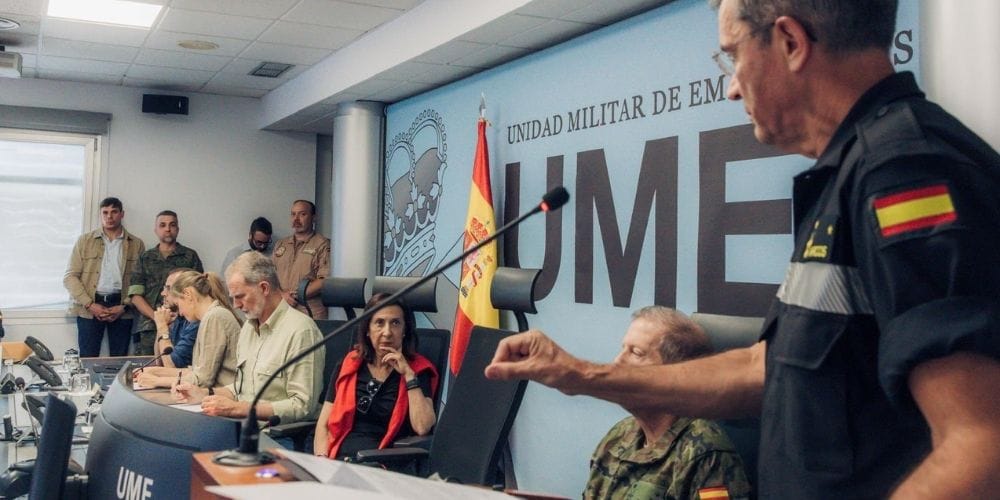
Spain’s wildfire emergency has spread across several regions, forcing more than 115,000 people to leave their homes or remain indoors as firefighters work to contain vast and unpredictable fire fronts.
Around 100,000 people have been affected by evacuation or confinement orders in Madrid and Ávila. Meanwhile, approximately 16,000 residents have been moved or told to shelter in 15 municipalities around La Vall d’Uixó in Castellón. Smaller evacuations have also been reported in León and Cáceres.
Although cooler overnight temperatures and increased humidity offered crews a valuable opportunity to strengthen control lines, the emergency is not over. Active sections remain across the affected territory, and changing winds could still cause outbreaks or push flames into previously unaffected areas.
Madrid and Ávila fires cover a 200-kilometre perimeter
The principal fire zone stretches across western Madrid and neighbouring Ávila, where separate fires have developed into an exceptionally complex emergency covering a perimeter of more than 200 kilometres.
An estimated 45,000 hectares have burned across the two areas. In Ávila alone, the affected perimeter extends for approximately 112 kilometres, with around 21,000 hectares damaged.
Some sections have now been surrounded and cooled, according to the Unidad Militar de Emergencias, but others remain active. Officials have warned that defining the perimeter does not mean the fire has been completely stabilised or extinguished.
Fifty ground units worked through Saturday night into Sunday morning, using heavy machinery to construct new containment lines. Aircraft returned to the skies after daylight as conditions became more favourable for aerial operations.
Families remain in temporary accommodation
Thousands of displaced residents are being housed in sports centres, municipal buildings and other emergency accommodation across the Madrid region.
More than 3,000 people were receiving direct assistance in shelters by the latest official count. In Las Rozas, around 300 residents from ten affected municipalities remained in a sports centre on Sunday morning after spending several days away from home.
There were early signs of improvement in some localities. The mayor of Navas del Rey said the town had awakened without the heavy smoke seen during previous days and that preparations were being made for residents to return.
Any return will depend on approval from the emergency services. Authorities continue to urge evacuated residents not to approach closed areas or attempt to reach their properties independently.
National emergency expanded towards Toledo
The government declared an emergency of national interest in Madrid and Ávila on Friday, placing the Interior Ministry in charge of coordinating the overall response.
The measure was subsequently extended to Toledo because of the Almorox fire and the danger that the emergency could cross administrative boundaries.
Under Spain’s civil protection legislation, Interior Minister Fernando Grande-Marlaska assumes responsibility for directing and coordinating national, regional and local resources once an emergency of national interest is declared. Operational control has been assigned to the head of the UME. The Interior Ministry said the decision reflected the threat to communities and the scale of the resources required
A unified command has also been established for the Madrid and Ávila fires. The intention is to treat the sprawling emergency as one operational challenge rather than several disconnected incidents.
King Felipe VI visited the UME’s General Headquarters on Sunday, where he was briefed on the latest developments and the coordination of firefighting operations. The headquarters is serving as the central command point for the national response, with incoming information from the affected regions being assessed continuously.
Castellón fire forces 16,000 from homes
The serious fire around La Vall d’Uixó has widened the crisis beyond central Spain.
Approximately 16,000 people across 15 municipalities have been evacuated or confined. The fire has developed a perimeter of around 21 kilometres, creating another major operation for regional and national emergency teams.
The Castellón emergency means the national total of people displaced or confined has risen above 115,000, even before smaller evacuations elsewhere in Spain are included.
Officials have continued to ask residents to obey mobile-phone alerts, keep roads clear for emergency vehicles and avoid travelling towards the affected zone.
European teams join Spanish firefighters
International help has arrived through the European Union Civil Protection Mechanism.
Portugal, Greece and Italy initially committed 176 firefighters and support personnel, 41 vehicles and four Canadair aircraft. Additional support from Turkey has also joined the response, while resources from 11 Spanish autonomous communities and several councils have been deployed.
Portugal supplied the largest ground contingent, including 129 personnel, fire engines, water carriers, ambulances, command vehicles and a bulldozer. Greece and Italy provided Canadair water-bombing aircraft and specialist crews.
The deployment reflects both the geographical scale of the emergency and the pressure placed on Spain’s firefighting resources during an exceptionally severe summer.
Government to declare disaster zones on Tuesday
Prime Minister Pedro Sánchez has announced that the Cabinet will approve, when it meets on Tuesday, 28 July, the declaration of the communities devastated by the fires as areas seriously affected by a civil protection emergency.
The designation, commonly described as disaster-zone status, opens the way for financial assistance and other recovery measures for residents, businesses and public infrastructure affected by the emergency. The precise municipalities included, and the support available, should become clearer after Tuesday’s Cabinet meeting.
Sánchez also renewed his call for a broad national agreement on the climate emergency, arguing that Spain needs a coordinated approach built around prevention, emergency response and reconstruction. The prime minister said such an agreement was necessary for public safety and was also a moral responsibility.
More than 152,000 hectares burned this year
Wildfires have already burned more than 152,000 hectares across Spain in 2026, according to the latest real-time estimates reported by RTVE. That is around six times the area recorded during the corresponding period of 2025.
The figures underline the speed with which this summer’s fires have accumulated. July alone has brought major emergencies in Andalucía, Catalonia, Aragón, Castilla-La Mancha, Castilla y León, Madrid and other regions.
Experts have repeatedly warned that abandoned land, dense vegetation, prolonged heat and extremely dry conditions can combine to create fires that spread faster and burn with an intensity beyond the immediate capacity of emergency teams.
A temporary improvement, not the end of the crisis
Prime Minister Pedro Sánchez said on Sunday that the overnight operation had been positive but warned that difficult hours remained.
More favourable weather has helped firefighters contain or cool parts of the perimeter, and officials said no further evacuations were expected in some areas during the morning. Nevertheless, several active sections remain, and thousands of residents are still unable to return home.
Emergency teams will now concentrate on reinforcing containment lines, preventing renewed outbreaks and assessing when evacuated communities can safely reopen.
Beyond the immediate effort to contain the fires, attention will now turn to the scale of the damage and the assistance available to affected communities. Tuesday’s Cabinet decision will begin that recovery process, while Sánchez’s proposed national climate pact is likely to become a significant political debate once the immediate emergency subsides.
The figures and restrictions may continue to change throughout Sunday. Residents in affected areas should follow instructions from the emergency services, local councils and Spain’s 112 alert systems.