 Lorraine Williamson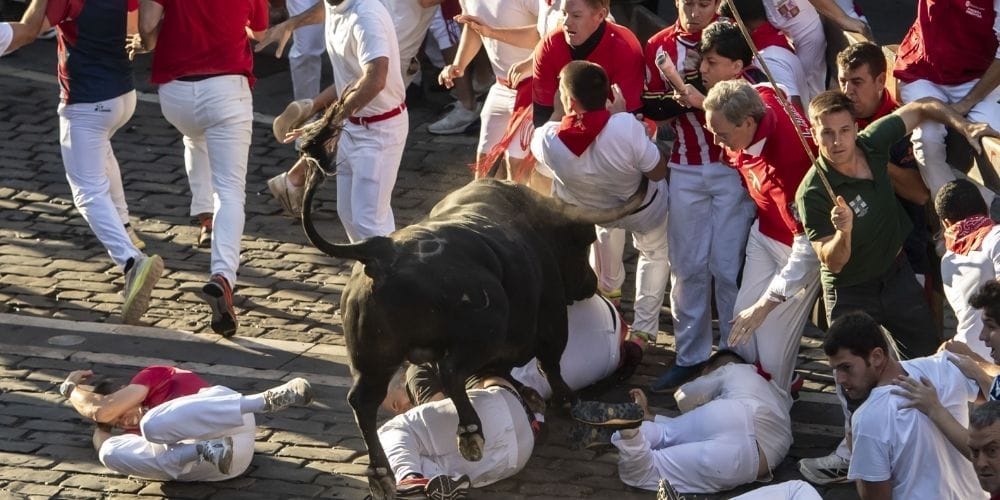
Two runners were gored, and ten people were taken to hospital after a fast and dangerous final bull run brought the 2026 San Fermín encierros to a dramatic close in Pamplona on Tuesday morning.
The Jandilla bulls completed the route in two minutes and 25 seconds, charging at runners and causing several falls and pile-ups. Early reports suggested three people had suffered horn wounds, but the final medical update reduced that figure to two.
Horn wounds to the thigh and chest
An 18-year-old man from Navarra suffered a horn wound to the thigh near Pamplona Town Hall. The second runner, a 46-year-old man from Guadalajara, was gored in the chest in the Telefónica section of the route.
Both were among ten people transferred to the Hospital Universitario de Navarra. The other casualties included runners treated for injuries to the head, shoulder, elbow, ribs, knee, and lower back. An 86-year-old British man was admitted with wounds to his hand, elbow, and eyebrow.
Jandilla bulls charge at runners
The herd initially moved together, but two black bulls pushed ahead of the guiding steers on the Cuesta de Santo Domingo. One began swerving towards runners as it entered the Plaza Consistorial before charging into several people approaching the Mercaderes corner.
Further danger followed on Estafeta when a red bull stumbled over a fallen runner. Its horn narrowly missed the man’s body but tore his shirt, while the fall contributed to a pile-up behind him.
The herd became increasingly stretched along the route, leaving runners exposed to animals arriving separately rather than as one compact group. Another bull fell in the Telefónica section, where the chest goring occurred away from the main television cameras.
How many people were injured in the final San Fermín bull run?
Ten people were taken to hospital following the eighth and final encierro. Two suffered wounds caused by bulls’ horns, while the remaining eight were treated for injuries caused by falls, collisions and heavy blows.
The final report replaced several provisional figures issued immediately after the race. Early reports listed nine casualties and, briefly, three horn wounds, before health officials confirmed ten hospital admissions and two gorings.
More than 70 injured across eight runs
More than 70 runners were injured across this year’s eight encierros, with 67 requiring treatment at the Hospital Universitario de Navarra. Five men were admitted with horn wounds during the festival.
Those injured ranged in age from 20 to 86. Most suffered contusions, dislocations, and other trauma caused by falls, crowding, and collisions along the narrow route.
Four runners injured during earlier encierros remained in hospital on Tuesday morning. They included a 30-year-old man seriously gored in the face on Saturday, along with men receiving treatment for a fractured hip, a pneumothorax, and injuries to the back and knee.
Every run completed in under three minutes
All eight encierros this year were completed in less than three minutes. Tuesday’s race lasted two minutes and 25 seconds, while the longest was Saturday’s run with the José Escolar bulls, which took two minutes and 36 seconds.
Despite its speed, Tuesday’s encierro produced some of the festival’s most dangerous images. Jandilla has a long history of fast, aggressive runs in Pamplona, with its bulls responsible for 33 horn injuries across 25 appearances.
A Jandilla bull also caused the most recent death during a San Fermín encierro. Daniel Jimeno, a 27-year-old from Madrid, was fatally gored during the 2009 festival.
San Fermín closes with the Pobre de Mí
Tuesday’s run ended the morning encierros, but celebrations will continue throughout the final day of San Fermín. The festival formally closes at midnight, when crowds gather in the Plaza Consistorial carrying candles and singing the traditional Pobre de Mí.
The ceremony marks the end of nine days of celebrations that began with the Chupinazo on 6 July. Pamplona’s red neckerchiefs will then be removed until the festival returns next summer. Source