 Lorraine Williamson
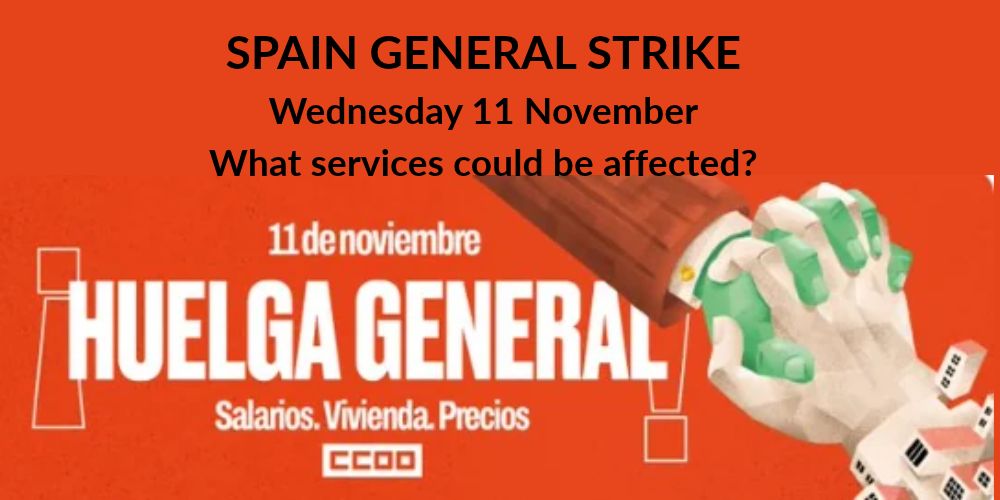
Spain is preparing for a nationwide general strike on Wednesday 11 November, with workers across the public and private sectors called to walk out over wages, housing affordability and the rising cost of living. The industrial action could affect transport, education, healthcare and businesses, although the extent of disruption will depend on participation and the minimum services established by the authorities.
The strike will run for 24 hours, beginning at midnight on Tuesday night and continuing throughout Wednesday. It has been called by several major trade unions, including CCOO, UGT, CGT and CNT, and applies to workers across Spain rather than a single industry or profession.
The nationwide scope of the action is confirmed in Spain’s Official State Gazette (BOE), which sets out arrangements to maintain essential electricity supplies during the stoppage. Workers in businesses operating overnight or rotating shifts may also be covered by arrangements extending beyond the usual midnight-to-midnight period.
Why are workers going on strike?
The central demands concern higher wages, affordable housing and measures to address the increasing cost of everyday living. Unions argue that many working households are struggling to meet essential expenses, particularly in areas where rents and property prices have risen faster than earnings.
CCOO and UGT are seeking general wage increases of between 4% and 7%, alongside a rise of at least 7% in Spain’s statutory minimum wage. They argue that better pay is essential to restoring purchasing power and reducing the financial pressure on workers and their families.
Housing has become one of the most prominent issues behind the mobilisation, reflecting growing concern about access to affordable accommodation. The unions maintain that the housing crisis is closely connected to employment conditions because even people in full-time work are finding it increasingly difficult to secure somewhere to live.
The strike was formally registered with the Ministry of Labour in October, with several unions subsequently confirming their participation. According to RTVE’s coverage of the planned demonstrations, protests are also planned in cities across Spain on Wednesday.
Which services could be affected?
Unlike industrial action confined to one sector, a general strike can involve employees throughout the economy. Public transport, schools, healthcare facilities, government offices, shops and private businesses could all experience disruption if sufficient numbers of workers participate.
However, the nationwide strike does not mean that every workplace will close or that all public services will stop operating. The impact will vary between regions, employers and individual facilities, while essential services must comply with minimum staffing requirements established by the relevant authorities.
Public transport is among the services most likely to attract attention because disruption can affect commuters, school journeys and people travelling to appointments. Bus and other local transport arrangements may differ between municipalities and operators, making it important for passengers to check the information issued in their area.
Spain’s authorities have also established arrangements to protect essential energy supplies during the stoppage. The BOE order covering the electricity sector requires the necessary staffing and operational arrangements to maintain supply and protect the safety of installations and personnel.
Renfe confirms minimum train services for Wednesday
Rail passengers face particular uncertainty because Wednesday’s general strike falls between two separate days of industrial action by train drivers. Renfe has confirmed that the Ministry of Transport has established minimum services for 11 November, allowing a proportion of scheduled trains to operate despite the walkout.
According to Renfe’s official announcement on 9 November, Cercanías commuter services will operate at a minimum of 75% of their usual level during peak periods and 50% at other times. The designated peak periods are 6.00 am to 9.00 am, 1.30 pm to 3.30 pm and 6.30 pm to 8.30 pm.
For Media Distancia regional services, the minimum level has been set at 65%, while high-speed and long-distance trains will operate at 73% of normal services. Rail freight has been assigned a minimum service level of 26%, reflecting the broader effects of the strike on the railway network.
These percentages indicate the minimum services established by the authorities, rather than a guarantee that individual journeys will run without delays. Passengers should check their specific train before travelling, particularly if they have onward connections or appointments that cannot easily be rearranged.
Three consecutive days of potential railway disruption
Wednesday’s general strike comes during a particularly difficult week for rail passengers, with the train drivers’ union Semaf separately calling industrial action for Tuesday 10 and Thursday 12 November. Although the stoppages fall on consecutive days, they are distinct industrial disputes and have different minimum service arrangements.
This means passengers should not assume that the same reduced timetable will apply throughout the three days. Anyone travelling between Tuesday and Thursday should consult the relevant operator’s announcements for the date and route concerned.
The combination of industrial action and the severe weather forecast for parts of Spain could make journeys particularly challenging this week. Travellers should allow additional time where possible and monitor both transport announcements and official weather warnings before setting off.
Will schools and healthcare services remain open?
Schools and healthcare facilities fall within the wider scope of the general strike, but the impact will depend on staffing arrangements and the rules established in each autonomous community. Some schools may operate normally, while others could experience staff shortages or changes to their usual activities.
Parents should check communications from their children’s schools, particularly where school transport or other supporting services are involved. A nationwide general strike does not automatically mean that schools will close, and any confirmed closures should be communicated by the relevant education authorities or individual establishments.
Healthcare providers are required to maintain essential services, although routine appointments and non-urgent activities could be affected where staff take part in the walkout. Patients with hospital appointments, medical tests or consultations scheduled for Wednesday should check directly with their healthcare provider if they have concerns about possible disruption.
The same advice applies to administrative appointments at town halls, government offices and other public bodies. Some offices may remain fully operational, while others could experience delays or reduced staffing depending on participation in the strike.
Employers challenge the planned walkout
The general strike has also prompted criticism from employers’ representatives, who have questioned the timing and political implications of the action. CEOE president Antonio Garamendi has indicated that the employers’ organisation intends to challenge the legality of the strike.
Employers argue that some of the demands extend beyond traditional workplace disputes, particularly given the proximity of Spain’s general election scheduled for 29 November. The unions reject the suggestion that the action is primarily political, insisting that wages, housing affordability and living costs are legitimate concerns affecting working people.
The dispute reflects growing tensions over wages, housing affordability and the cost of living in Spain. With the strike scheduled for Wednesday, attention now turns to how many workers will participate and the extent of disruption across the country.