 Lorraine Williamson
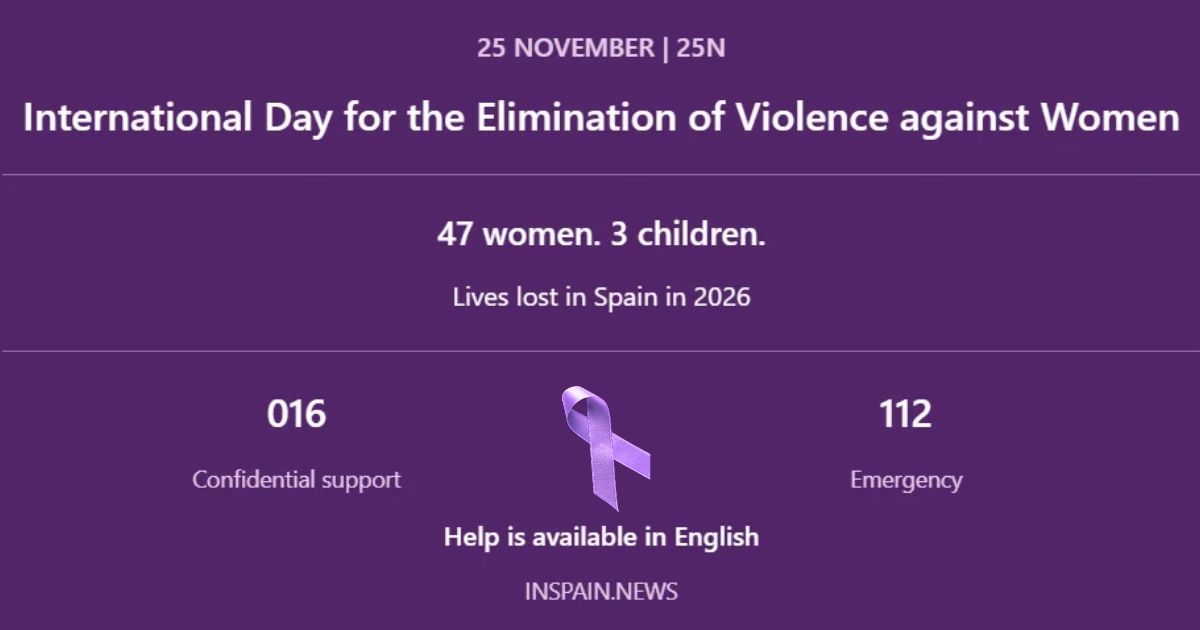
Spain marks the International Day for the Elimination of Violence against Women today, Wednesday 25 November, against a backdrop of 47 women and three children killed by gender-based violence so far this year. Thousands of people are expected to take to the streets, while campaigners continue to call for better prevention, stronger protection and greater support for survivors.
Known in Spain as 25N, the annual international day brings together survivors, women’s organisations, families, public institutions and members of the wider community. Behind the demonstrations and purple ribbons lies a problem that extends far beyond the cases that make national headlines.
On Tuesday, the Council of Ministers approved an institutional declaration reaffirming Spain’s commitment to tackling violence against women and girls in all its forms. The government also called for a collective response involving public institutions and society as a whole.
Almost 1,400 women killed since records began
Since Spain introduced official records of women killed by current or former partners in 2003, 1,388 women have lost their lives. This year’s toll is the highest recorded at this point in the calendar year since 2023.
The latest confirmed victim was a 37-year-old woman who was allegedly killed by her partner in Villarrobledo, in the province of Albacete, on 19 November. According to figures reported by El Plural, there had been no previous reports of gender-based violence against the suspected perpetrator.
Children are also among those affected. So far this year, 38 minors have been left without their mothers, according to official figures reported by RTVC.
The official death toll relating to partner or former-partner violence does not encompass every form of violence against women. Sexual violence, trafficking, forced marriage and other forms of abuse also require specialised responses.
When abuse leaves no visible injuries
Violence against women is frequently associated with physical assault. However, abuse can take many forms, some of which may go unnoticed for years by friends, relatives and colleagues.
Controlling access to money, monitoring mobile phones, restricting contact with family members, making threats and repeatedly humiliating a partner can all form part of an abusive relationship.
Digital technology has created further opportunities for controlling behaviour. Tracking someone’s location without consent, demanding access to private messages or threatening to distribute intimate photographs can leave victims feeling that they have no safe space, even when physically separated from their abuser.
Spain also recognises the problem of violencia vicaria, a form of abuse in which perpetrators harm or threaten children as a means of inflicting suffering on their mothers.
Spain’s streets turn purple for 25N
Demonstrations, public gatherings and commemorative events are scheduled throughout the country today, including in Madrid, Barcelona, Valencia and Seville. Smaller municipalities are also organising activities, workshops and tributes to women who have lost their lives.
Equality minister Ana Redondo is due to attend an institutional event at the ministry’s headquarters before joining a demonstration in Valladolid this evening.
This year’s commemorations come just four days before Spain’s general election on 29 November. Women’s safety, equality policies and the provision of resources for victims have also featured in the wider political debate.
However, today’s events extend beyond party politics, bringing attention to the everyday experiences of women living with abuse and the barriers they face when seeking help.
More than 106,000 active cases under police monitoring
The scale of the problem becomes clearer when looking beyond the number of deaths. According to the Government Delegation against Gender Violence, 106,623 complaints were registered during the first six months of 2026, while 19,636 protection order proceedings were initiated.
At the end of September, Spain’s VioGén police monitoring system had 106,972 active cases, an increase of 1.9% compared with the same month last year. The largest proportion involved women aged between 31 and 45, although cases affect women across all age groups.
The government’s September statistical report provides further insight into the number of women requiring ongoing police monitoring and protection.
Spain introduced comprehensive gender-based violence legislation in 2004, establishing a framework that brought together policing, specialist courts, prevention programmes and assistance for victims. More than two decades later, the figures underline the continuing need for these services.
Help is available in English and other languages
For foreign residents in Spain, language barriers, financial dependence and uncertainty about residency rights can make seeking assistance particularly difficult. Some women may also be geographically isolated from family members or the support networks they had in their home countries.
However, victims do not need to speak Spanish to access specialist assistance. The Ministry of Equality operates a free, confidential nationwide service providing information, emotional support and legal guidance.
The official 016 support service can be contacted through several channels:
Telephone: 016, available 24 hours a day in 53 languages, including English.
WhatsApp: 600 000 016 (messages only).
Email: 016-online@igualdad.gob.es.
Online chat: violenciagenero.igualdad.gob.es.
Immediate danger: Call 112.
Legal advice is available between 8.00 am and 10.00 pm every day, while general information and immediate emotional support are available around the clock.
Calls to 016 do not appear on telephone bills, although they may remain visible in the call history on some devices. Anyone concerned that their communications are being monitored should use a safe device wherever possible.
Regional protection and support services
Alongside Spain’s national support network, autonomous communities provide specialist services for women experiencing violence. These can include psychological assistance, legal advice, emergency accommodation and longer-term support for victims and their children.
Services and contact numbers vary between regions. Anyone unsure where to seek assistance locally can contact 016 for information and referrals to appropriate resources.
Another nationwide resource is AlertCops, the official mobile application connecting users with the Policía Nacional and Guardia Civil. Its functions include direct messaging with police and an SOS feature.
You do not have to be a victim to seek advice
Recognising abuse in someone else’s relationship can be difficult, particularly when the person concerned has become increasingly isolated. Changes in behaviour, unexplained anxiety, restricted access to money or a partner constantly monitoring their whereabouts may be reasons for concern.
Friends, relatives, neighbours and colleagues can also contact 016 for professional guidance. Listening without judgement, maintaining contact and avoiding actions that could place the victim at greater risk are important considerations.
Women do not have to make a formal police complaint before contacting 016 for information about their options.
While today’s demonstrations will bring the issue into public view, the need for awareness and assistance continues throughout the year. Knowing where to turn, recognising the signs of abuse and ensuring that information is available in different languages can help people access support before a situation becomes an emergency.
If you or someone you know is experiencing violence or abuse in Spain, confidential assistance is available on 016. In an emergency, call 112.