 Lorraine Williamson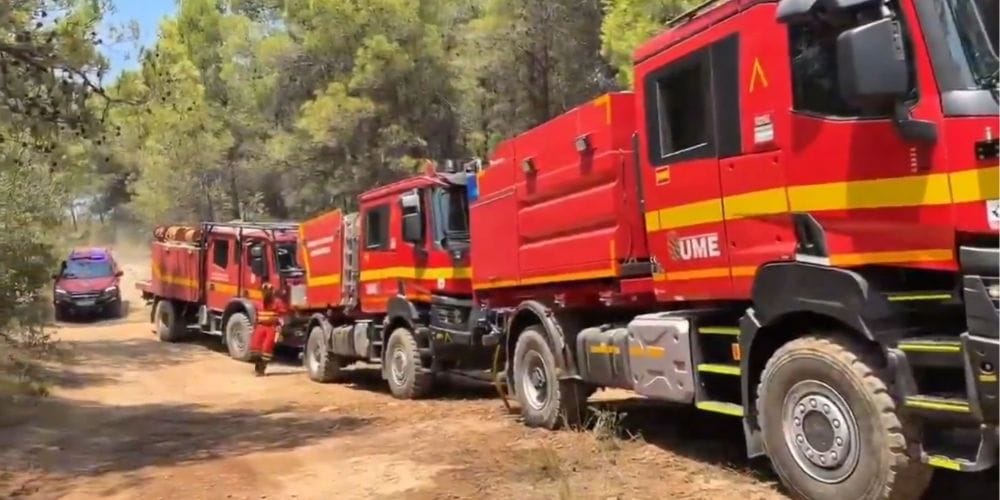
Spain has ended the national emergency declaration covering the major wildfires in Madrid and Ávila after containment lines held and the immediate threat receded. The wider crisis is far from over, however, as intense heat fuels serious fires elsewhere, with attention now turning to Zamora.
Prime minister Pedro Sánchez announced on Thursday that Madrid and Ávila would return from operational level three to level two, placing management of the fires back in the hands of the regional authorities. The blazes remain active and under surveillance, despite the improvement that allowed the national coordination phase to end. The government confirmed the change following Sánchez’s visit to the command post in Navaluenga.
Crews are continuing to secure the affected ground, extinguish hotspots and watch for flare-ups along the Madrid and Ávila perimeter. A fire can be described as stabilised when it is no longer spreading freely, but that does not mean it has been controlled or extinguished.
The emergency brought together resources from across Spain and beyond, including regional forest brigades, the Military Emergency Unit, Civil Protection, police, health services and specialist teams. International assistance was also deployed through the European Civil Protection Mechanism and bilateral agreements as the flames spread across administrative boundaries.
Zamora becomes the new centre of the emergency
The most serious concern on Friday morning was in Fermoselle, Zamora, where a rapidly advancing fire had burned an estimated 11,000 hectares in about 24 hours. Fourteen communities were evacuated and residents in Fermoselle and Fariza were ordered to remain indoors as crews confronted a fire perimeter stretching for approximately 75 kilometres.
Castilla y León remained Spain’s worst-affected autonomous community, with several fires at the highest regional danger level in Zamora and León. Difficult terrain, high temperatures and shifting winds continued to complicate efforts to contain the flames.
The changing situation illustrates how quickly Spain’s wildfire emergency can move from one region to another. Resources released from stabilised fires may be redeployed, but crews must remain behind to patrol the ground and ensure apparently dormant areas do not reignite.
Fourth heatwave prolongs extreme fire danger
The fires are coinciding with Spain’s fourth heatwave of the summer. AEMET’s special weather notice covers the river valleys of the south-west, the Ebro Valley, north-eastern depressions and the Canary Islands, with the episode expected to continue until at least Sunday 2 August. The agency has placed the probability of the heatwave continuing at 70%.
Temperatures are forecast to remain particularly high across inland Andalucia on Friday, while exceptionally dry vegetation means a spark can develop into a fast-moving fire within minutes. Hot nights also reduce the opportunity for the land to cool and can make it more difficult for exhausted crews to consolidate gains made during the day.
Authorities have urged residents and visitors to obey restrictions around woodland, rural tracks and affected roads. People should avoid any activity capable of creating a spark and follow regional emergency services for local evacuation, confinement and travel instructions.
Firefighters move from attack to constant surveillance
Aircraft, helicopters and ground crews remain central to the response, supported by drones and thermal imaging used to identify hotspots that may not be visible from the ground. The technology helps incident commanders assess the direction and intensity of a fire, but it cannot replace the personnel working close to the flames.
Firefighters, UME members, forestry workers, pilots, police, Civil Protection volunteers, medical teams and local authorities have worked through extreme conditions to protect communities. Even where the most visible flames have disappeared, many remain on duty for days to cool the ground and prevent another outbreak.
The government has already declared 211 areas affected by civil protection emergencies across 14 autonomous communities, including the recent fires in Madrid, Ávila, Toledo and Castellón. The designation opens the way for financial and administrative support, although specific assistance and application procedures will depend on the damage recorded and the measures approved for each area. The declaration was agreed by the Council of Ministers this week.
For Madrid and Ávila, leaving the national emergency phase is an important step towards recovery. Across Spain, though, the combination of prolonged heat, dry terrain and simultaneous outbreaks means emergency services remain prepared for the situation to change again with little warning.