 Lorraine Williamson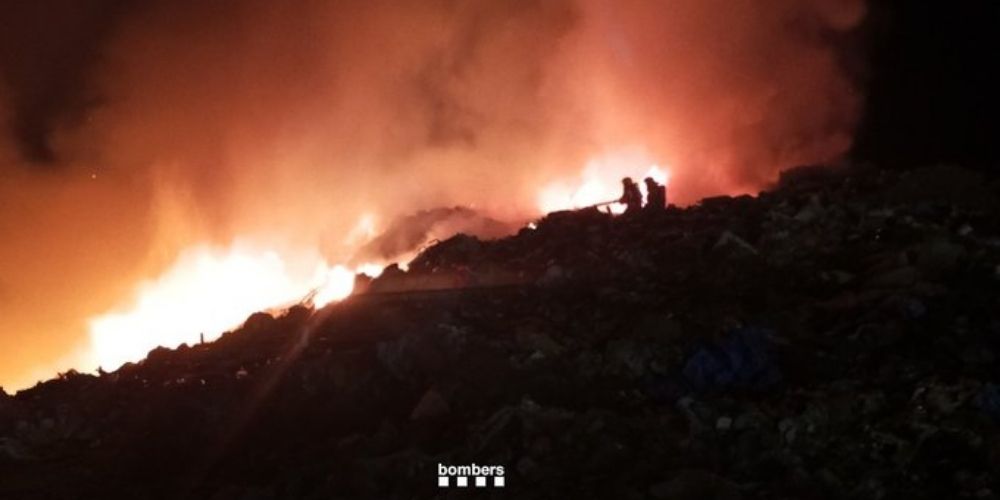
A major wildfire in Girona’s Les Gavarres area has continued into Saturday after forcing both confinement orders and precautionary evacuations in parts of the Costa Brava and Baix Empordà.
The fire began on Friday near La Bisbal d’Empordà and spread through mainly forested land towards the protected Les Gavarres area. The Generalitat’s official Friday evening update put the provisional affected area at around 1,280 hectares, while later overnight and Saturday morning reporting from Catalan emergency coverage put the burned area at around 2,300 hectares. Figures may continue to change as crews assess the perimeter.
Confinement and evacuation are not the same
Most people affected by the emergency measures have been told to stay indoors rather than leave their homes. The Generalitat said seven municipalities were under confinement orders on Friday evening: Calonge i Sant Antoni, Castell d’Aro, Platja d’Aro i s’Agaró, Cruïlles, Monells i Sant Sadurní de l’Heura, Forallac, La Bisbal d’Empordà, Llagostera and Santa Cristina d’Aro. The official update said around 40,000 people were covered by those confinement instructions at that stage.
Confinement means people should remain inside, close doors and windows, avoid unnecessary movement and wait for official instructions. The Generalitat stressed that confinement is often the safest measure during a wildfire, especially when smoke, flames, changing wind and road access make movement more dangerous.
However, there have also been evacuations. The Generalitat confirmed that a reception centre was opened in Santa Cristina d’Aro, at Espai Ridaura, for around 70 people who had been moved from affected areas. This included residents from the Vall Repòs urbanisation and children from a holiday camp in Romanyà de la Selva, who were transferred to the municipal sports pavilion for the night, with support from the Red Cross.
Homes affected in Calonge
One of the most serious overnight developments was the fire reaching urbanised areas around Calonge. Catalan public broadcaster 3Cat reported on Saturday morning that flames had affected homes in a Calonge urbanisation, with no injuries reported at that stage.
Spanish reporting also said one house and a masia had burned, with other properties suffering damage to gardens or fences. Because that level of property detail was coming from live reporting rather than the latest written Generalitat update, it should be treated as developing information until fully confirmed by the authorities.
Firefighters work to hold the perimeter
Bombers de la Generalitat continued working through the night and into Saturday with the aim of stabilising the fire perimeter. La Bisbal d’Empordà council said firefighters were working intensively with the objective of having the perimeter stabilised by Saturday midday.
The official Generalitat update said more than 200 firefighters, 88 vehicles and 12 aerial resources had been deployed, with off-duty firefighters also activated. The fire generated a pyrocumulus cloud and was complicated by secondary fire spots, high propagation speed, urbanised areas in the possible path of the flames, changing winds and the simultaneous outbreak of other fires.
By Saturday morning, 3Cat reported that firefighters had managed to stabilise around 70% of the right flank. That flank remains important because wind changes later in the day could make the fire more difficult if the perimeter is not secured.
Roads closed and travel discouraged
Authorities are asking people not to travel into the fire zone, especially from the Barcelona metropolitan area towards second homes or summer activities in the Costa Brava and Girona area. The aim is to avoid putting more people at risk and to keep roads clear for emergency vehicles.
The Catalan Traffic Service listed road closures linked to the fire, including the C-66 at Palafrugell, the GI-660 between La Bisbal d’Empordà and Calonge, and the GIV-6612 between Llagostera and Calonge. Road restrictions may change quickly, so residents and visitors should check official traffic information before setting off.
This is especially relevant on a summer Saturday, when many people would normally travel towards the Costa Brava for weekends, second homes, campsites, beaches and rural stays.
Possible cause under investigation
The cause of the fire remains under investigation. The Generalitat said initial indications pointed to the use of a radial saw near a road, and that Mossos d’Esquadra had identified and detained one person. The official update also said those tasks were suspended because level 3 of the Pla Alfa was active due to very high fire risk.
During periods of very high fire danger, sparks from machinery, discarded cigarettes, barbecues, agricultural work and other negligent actions can start fires that spread quickly in dry vegetation and wind.
Heatwave raises wider fire risk
The wildfire comes as Spain heads into another period of very high and persistent temperatures. Protección Civil has maintained an alert for high temperatures from Sunday, July 5, at least until Tuesday, July 7, with Monday expected to be the peak day. The alert says the heatwave will especially affect the south-western quadrant, the Ebro valley, north-eastern depressions and the valleys of the Pyrenees.
AEMET’s special warning says fire danger will rise generally to very high levels because of high temperatures, possible storms, strong gusts from Monday and the accumulated water deficit from June. The warning also says Sunday will mark the start of the heatwave period, with temperatures expected to remain very high and persistent across large parts of Spain.
Protección Civil has asked the public to respect the countryside and avoid behaviour that could start a forest fire, including throwing cigarette ends, leaving rubbish or using machinery in risky conditions. Anyone who sees a column of smoke should call 112 immediately.
Advice for residents and visitors
Anyone in the affected part of Girona should follow official instructions from Protecció Civil, Bombers, Mossos d’Esquadra, local councils and traffic authorities. Do not rely on old social media posts, as confinement orders, access restrictions and road closures can change quickly.
People under confinement orders should stay indoors, close doors and windows, keep pets inside, turn off ventilation that brings outside air into the property where possible, keep phones charged and wait for official confirmation before leaving.
Anyone planning to travel to the Costa Brava this weekend should check official emergency and traffic updates before moving. If authorities ask people to avoid the area, that advice should be followed even if accommodation, second homes or leisure plans have already been arranged.
This remains a developing emergency, and further updates are expected during Saturday as crews work to stabilise the fire before the strongest heat of the weekend arrives.