 Lorraine Williamson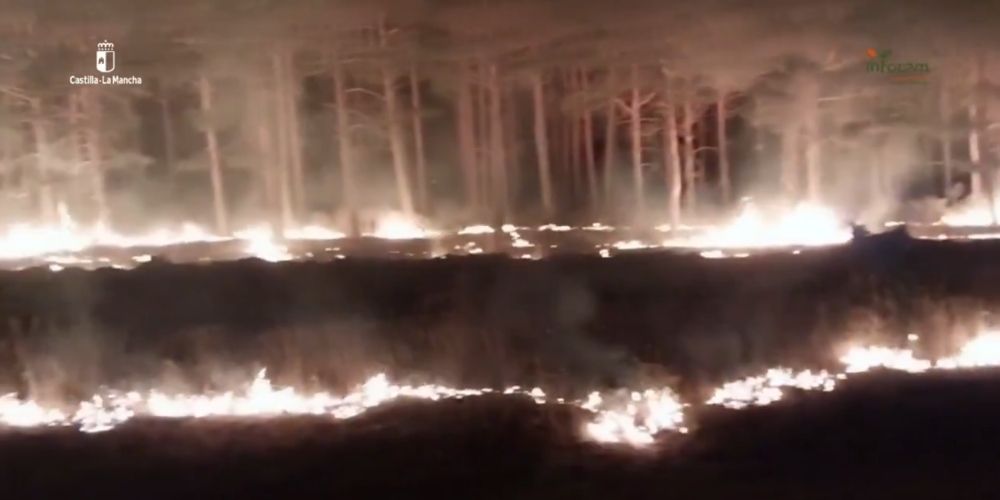
Wildfires are forcing fresh evacuations across central and eastern Spain as the country enters another period of extreme heat, placing already stretched emergency services under renewed pressure.
The largest blaze, which began near La Mierla in Guadalajara, has burned more than 26,000 hectares and displaced over 1,000 people, while newer fires in Segovia and Teruel have prompted additional overnight evacuations.
The fires are developing as temperatures climb across much of the country, with exceptionally dry vegetation, low humidity and shifting winds increasing the danger that flames will spread rapidly. Military Emergency Unit personnel have been deployed to several incidents, while residents in threatened communities are being urged to obey evacuation orders without delay.
La Mierla fire remains beyond control
The wildfire that began near La Mierla in Guadalajara’s Sierra Norte remains the most serious active incident in Spain. It has affected more than 26,000 hectares, much of it within or around the Sierra Norte de Guadalajara Natural Park, and forced the evacuation of approximately 1,200 people from dozens of small communities.
Fire specialists have described parts of the blaze as being beyond the immediate capacity of extinction because of its speed and intensity. Flames have reportedly advanced at more than 60 metres per minute in some areas and crossed wide firebreaks that would normally help slow their spread.
The difficult terrain has limited access for ground crews, while dense smoke and unstable winds have complicated the work of firefighting aircraft. The priority remains protecting populated areas and attempting to direct the fire towards zones where vegetation is less continuous, and containment lines can be created.
Fire advances towards the border with Soria
The eastern and north-eastern sections of the La Mierla fire have caused increasing concern because of their proximity to Soria province. Authorities have been preparing communities on the Castilla y León side of the regional border for the possibility that the flames could continue advancing northwards.
Barcones was evacuated as a precaution, while vulnerable residents were moved from a care home in Retortillo de Soria. Emergency arrangements were also activated around Arenillas and neighbouring areas as smoke and the changing direction of the fire increased uncertainty.
The evacuation decisions do not necessarily mean that flames have reached each community. Authorities frequently move residents early because narrow roads, elderly populations and rapidly changing fire behaviour can make a later evacuation much more dangerous.
Eight communities evacuated near Brieva in Segovia
A separate wildfire that began near Brieva in Segovia province forced the evacuation of eight communities as flames spread through dry countryside on Monday evening.
Residents were moved from Tenzuela, Losana de Pirón, Carrascal de la Cuesta, La Cuesta, Aldeasaz, Berrocal, Caballar and Santo Domingo de Pirón. The fire has affected approximately 3,000 hectares and remains at level two on Castilla y León’s wildfire emergency scale.
Authorities sent an ES-Alert message to mobile phones in the affected area, while several provincial roads were closed to protect the public and allow emergency vehicles to operate. Around 40 firefighting resources, including ground crews, bulldozers and aerial units, have been involved in the response.
The fire’s rapid movement has been driven by wind and dry vegetation, with concern that it could continue towards Turégano and nearby wooded areas. A coordination centre has been established to manage the operation and determine when residents can safely return.
Molinos evacuated as Teruel fire spreads
In Aragón, a wildfire that began near Ejulve in Teruel province has burned approximately 1,000 hectares and forced the evacuation of Molinos. The operation affects around 230 registered residents as well as people staying in the village for the summer.
An ES-Alert warning was issued during the night, and evacuees were directed towards accommodation and assistance in Alcorisa. Several isolated farm properties had already been cleared before the wider evacuation was ordered.
The fire is burning in the Sierra de Majalinos, an area affected by a major wildfire in 2009. Although some vegetation was reduced by the earlier blaze, authorities believe the current fire still has considerable potential to spread because of difficult terrain, changing winds and very low humidity.
The Government of Aragón activated operational level two of its wildfire emergency plan and requested support from the Military Emergency Unit. The A-1702 road remains closed over a substantial section between Ejulve and the surrounding mountain area.
Other Aragón fires improve but remain under observation
The latest Teruel fire comes after several days of major emergencies elsewhere in Aragón. The Orés blaze in Zaragoza’s Cinco Villas area has been stabilised following the evacuation of multiple communities, while the fire near Plan in Huesca remains active but is reported to be under greater control.
Residents have been allowed to return to some communities affected by the Orés fire, although firefighting crews continue to patrol the perimeter and cool remaining hotspots. Stabilised does not mean extinguished, and rising temperatures could cause apparently dormant areas to reignite.
Aragón’s fire-danger forecast places almost the entire region under red alert, indicating a high probability of intense fires that may be driven by wind, terrain and potentially convective behaviour. Dead vegetation is described as highly or completely available to burn across most of the region.
Heatwave raises danger across Spain
The new fires coincide with the beginning of Spain’s third heatwave of the summer. Temperatures are forecast to rise sharply through Wednesday and Thursday, with readings above 40°C expected across large parts of the south, centre and east.
Extreme heat dries vegetation further, lowers humidity and places additional physical pressure on firefighters working in heavy protective equipment. Warm nights also reduce the period during which crews can usually benefit from cooler, more humid conditions.
Possible dry thunderstorms create another concern. Lightning can start new fires, while strong and unpredictable gusts may rapidly alter the direction of an existing blaze even when little useful rain reaches the ground.
AEMET’s daily fire-danger maps should be checked before travelling to rural areas. The agency calculates risk using weather forecasts alongside vegetation, land use and soil-moisture conditions, and large areas of Spain are expected to face high or extreme danger during the heatwave.
What residents and visitors should do
People in or near an affected area should follow official emergency channels, local authorities and the 112 service rather than relying solely on messages shared through social media. Evacuation and confinement instructions can change quickly as winds shift or roads become unsafe.
Anyone ordered to evacuate should take identification, essential medication, water, a mobile phone and charger, but should not delay departure to collect unnecessary belongings. Windows should be closed, air-conditioning systems turned off where instructed, and access routes left clear for emergency vehicles.
Visitors should not travel towards wildfire areas to take photographs or observe the flames. Roads that appear open on navigation apps may already be closed, and additional traffic can obstruct firefighters and residents trying to leave.
Barbecues, agricultural burning and any unauthorised use of fire should be avoided completely. Cigarettes must be extinguished properly, while vehicles should never be parked over tall, dry vegetation because hot exhaust components can start a fire.
Anyone who sees smoke or flames should move to safety and call 112, giving the clearest possible location. People should not attempt to fight a forest fire themselves unless it is extremely small, they have a safe escape route and emergency services have already been contacted.
A worsening start to the heatwave
The fires in Guadalajara, Segovia and Teruel show how quickly the emergency situation can change when heat, wind and dry vegetation combine. Several incidents that began in relatively isolated areas expanded rapidly enough to threaten villages and require overnight evacuations.
For those displaced by the La Mierla fire, the emergency has already lasted several days, with uncertainty growing over homes, farms, livestock and the extensive natural landscape on which many local businesses depend. The newer fires have now created similar fears in communities further north and east.
Firefighters face another difficult day as temperatures rise and the heatwave strengthens. Even where progress is made around one perimeter, new ignitions or a sudden wind change could place additional communities at risk.