 Lorraine Williamson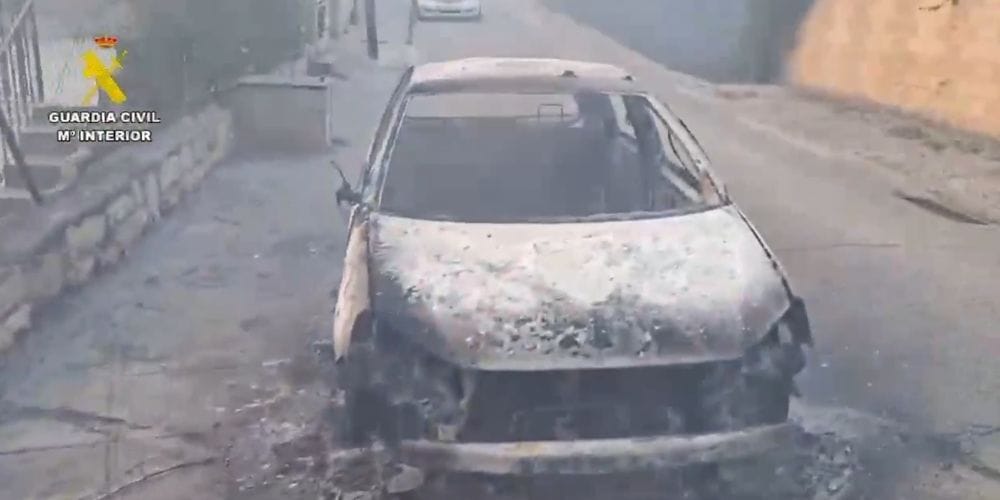
Two rapidly developing wildfires have forced residents from their homes in southern and central Spain as emergency crews continue working through Wednesday night. The entire Huelva village of Villanueva de las Cruces has been evacuated, while a separate fire that began in Almorox, Toledo, has crossed into the Community of Madrid and affected residential areas around Villa del Prado.
The emergencies come during a week of extreme temperatures and exceptionally high fire danger across much of Spain. Roads have been closed, emergency level two has been activated in both affected areas, and the Military Emergency Unit has been mobilised to support firefighters at the Madrid–Toledo border fire.
Entire Huelva village evacuated
All 382 residents of Villanueva de las Cruces were ordered to leave their homes on Wednesday evening as a wildfire in the El Cerro del Andévalo area expanded following a change in wind direction
The fire had affected an estimated 1,200 hectares by Wednesday night. Residents were evacuated as a precaution because the altered wind increased the possibility that flames or smoke could approach the village.
Emergency accommodation and assistance were organised for those unable to stay with relatives or friends. Firefighters continued tackling the blaze from the ground after darkness brought aerial operations to an end.
The evacuation affects the full permanent population of the municipality. Authorities have not confirmed when residents will be able to return, and the decision will depend on the overnight behaviour of the fire and whether containment work can prevent further expansion.
Emergency level two activated in Huelva
The regional emergency plan was raised to operational level two because of the potential threat to people, property and essential infrastructure. This level allows Andalucía to request additional resources from the national Government where necessary.
Plan Infoca firefighters, environmental agents, fire engines and heavy machinery have been involved in the operation. Aircraft had also worked on the fire before sunset, when low visibility made continued flying unsafe.
Night-time conditions can sometimes help firefighters because temperatures fall and humidity rises. However, the current heatwave has brought unusually warm nights, reducing the improvement crews would normally expect after dark.
Emergency services are likely to spend the night strengthening defensive lines around Villanueva de las Cruces and preventing the fire from moving towards further populated areas.
Almorox fire crosses from Toledo into Madrid
A second serious wildfire began near Almorox in Toledo shortly before 5.00 pm on Wednesday and spread rapidly towards the neighbouring Community of Madrid.
Residents of El Pinar in Almorox were evacuated, while people in El Romillo were initially told to remain confined inside their homes. The fire was classified at emergency level two because of its proximity to residential areas and its potential to require resources beyond those available locally.
An ES-Alert warning was sent to mobile phones in the affected area. The N-403 was also closed between Almorox and Cadalso de los Vidrios as flames and smoke made travel unsafe and emergency vehicles moved into the zone.
El Encinar del Alberche evacuated door to door
After crossing into Madrid, the fire forced the evacuation of El Encinar del Alberche and confinement measures in Villa del Prado
Guardia Civil patrols reportedly went from house to house to ensure residents left the area. Villa del Prado itself was placed under confinement instructions, with residents told to remain indoors, close windows and doors, and avoid travelling.
People were advised not to attempt to reach the evacuated urbanisation or return for belongings. The Guardia Civil warning you saw is entirely relevant and supports the urgency of the evacuation operation.
Emergency teams also ordered evacuations around Ribera del Alberche, Rincón del Alberche and a nearby campsite in Aldea del Fresno as the fire continued to threaten the Madrid side of the regional border.
The Community of Madrid activated operational situation two of its INFOMA wildfire plan and established an advanced command post in Cenicientos to coordinate firefighters, police, forest agents and national resources.
Homes reportedly reached by flames
Madrid’s Government delegate said that around 30 properties had been reached or overtaken by the fire in the area around El Encinar del Alberche. Some homes were reported to have suffered severe damage, although a full assessment will not be possible until emergency teams can enter safely.
No injuries or smoke inhalation cases had been confirmed at the time of the latest update. However, authorities warned that the number of affected properties could rise as information arrives from areas firefighters have not yet been able to inspect.
The fire is particularly dangerous because it is burning at the point where forest vegetation meets homes and urbanisations. These urban–forest interface fires can spread quickly between trees, gardens, vehicles and buildings while producing dense smoke that makes evacuations more difficult.
Military Emergency Unit deployed
The Military Emergency Unit was deployed from its Torrejón base to support the response to the Almorox fire.
Firefighters from both Castilla-La Mancha and Madrid are working on the incident, alongside forest agents, Guardia Civil officers and local emergency services. Ground teams will continue through the night, while aircraft are expected to return after sunrise if conditions permit.
Strong winds remain one of the greatest concerns. Gusts can push flames across roads and containment lines, while burning embers may travel ahead of the main fire and ignite new areas.
The movement of the fire across an autonomous community boundary also requires close coordination between two regional administrations. Resources must be allocated according to where the greatest danger develops rather than where the blaze originally began.
Roads closed around the fire
The M-403 was closed near the Villa del Prado junction, as stated in the Guardia Civil channel update. Other closures and access restrictions have also affected the N-403 and roads around the urbanisations and nearby municipalities.
Navigation applications may not show emergency closures immediately. Drivers should therefore follow Guardia Civil and regional emergency information rather than attempting to find alternative routes through rural roads.
People who are not directly affected should stay away from the area. Additional traffic can obstruct evacuation routes and delay fire engines, ambulances and heavy machinery.
Residents who have been confined should remain indoors unless emergency services issue new instructions. Doors and windows should be closed, air-conditioning systems drawing in outside air should be switched off, and pets should be kept inside.
Overnight firefighting will be critical
The hours after sunset are crucial at both the Huelva and Madrid–Toledo fires. Without aircraft, ground crews must rely on fire engines, bulldozers and teams working on foot to establish control lines and protect populated areas.
Lower temperatures may slow the flames, but the benefits could be limited by dry vegetation and warm air left by the heatwave. Any increase in wind could rapidly change which communities or roads are most threatened.
Residents should keep mobile phones charged and loud enough to hear further ES-Alert messages. Those close to an active fire should prepare identification, essential medication, water and necessary items in case authorities order another evacuation.
People should not wait to see flames before leaving when instructed. Smoke, fallen trees and traffic congestion can make roads unusable well before the main fire reaches a community.
Fire danger remains extreme on Thursday
AEMET’s wildfire-risk forecast continues to show high or extreme danger across large parts of mainland Spain.. The agency calculates the risk using predicted weather alongside soil moisture, vegetation and land use.
Thursday is expected to bring another day of intense heat, with conditions remaining especially difficult across central, southern and eastern Spain. High temperatures, low humidity and wind can allow a small ignition to develop into a fast-moving wildfire within minutes.
Anyone travelling through the countryside should check for restrictions before setting out. Barbecues, machinery that could create sparks and parking vehicles on dry grass should be avoided completely during these conditions.
Two developing emergencies
The Huelva fire and the Almorox–Villa del Prado blaze remain active and could change significantly overnight. The priority in both emergencies is protecting residents while firefighters attempt to prevent further expansion.
In Villanueva de las Cruces, an entire village is waiting to learn when it can safely return. Near Madrid, residents face the additional concern that flames have already reached a number of homes.
Further figures on burned land, damaged properties and the number of evacuees are likely to be revised on Thursday morning. Until then, people in the affected areas should follow instructions from 112, Guardia Civil, Plan Infoca, Infocam and Madrid’s emergency services.