 Lorraine Williamson
Spain’s Transport Minister, Óscar Puente, has revealed new details about the circumstances leading to Wednesday’s devastating train collision near Urda, Toledo. His account raises serious questions about decisions taken at the railway control centre after a technical failure brought several high-speed trains to an automatic halt.
The minister said a failure in the railway’s safety system was followed by authorisation for a Renfe AVE to continue its journey, despite restrictions that should have prevented it from resuming normal running. The train subsequently collided with a stationary Iryo service, in a disaster that has claimed at least 68 lives.
The information, outlined during Puente’s Wednesday afternoon press conference and reported by RTVE, represents a significant development in the investigation. Although the minister has questioned the decision to allow the AVE to proceed, investigators have not yet established the full circumstances or determined responsibility for the collision.
What caused the Toledo train crash?
According to the transport minister, the sequence of events began at approximately 8.30 am this morning, when a computer failure affected the LZB railway safety system on the Madrid–Andalucía high-speed line. The fault disrupted approximately 63 kilometres of track, causing six trains to stop automatically as a precaution. The system is designed to supervise train movements, monitor permitted speeds and intervene when operating conditions become unsafe.
With the automated safety system unavailable, railway traffic controllers at Adif’s control centre in Madrid were responsible for managing train movements under alternative operating procedures. The Renfe AVE involved in the collision was among the services affected by the initial stoppage, according to RTVE’s account of the accident. What happened during the following minutes has become a central focus of the investigation.
Why was the AVE allowed to continue?
At approximately 8.36 am, the Adif control centre authorised the AVE to resume its journey, even though the LZB system remained unavailable and a red signal was in force. Under the procedures described by Puente, the train should have continued only under restricted operating conditions, rather than returning to normal running. The minister described the decision to authorise its movement without those restrictions as inexplicable.
One of the procedures used when normal signalling is unavailable is known as marcha a la vista, which requires a driver to proceed cautiously and remain able to stop if an obstruction is encountered. According to Europa Press, citing Ministry of Transport sources, the instruction given to the AVE was contrary to the applicable railway operating regulations. The train continued for approximately 25 kilometres before colliding with the stationary Iryo service at around 8.53 am.
These details raise questions about the information available to railway controllers, the instructions communicated to the driver and the procedures followed after the safety-system failure. Investigators must also establish whether any additional technical or operational circumstances contributed to the collision. The minister’s account provides an initial explanation of the sequence of events, but it is not a final investigative finding.
Is human error being investigated?
The possibility of human error has emerged as a major line of inquiry, particularly concerning the authorisation given to the AVE after the initial stoppage. Puente has questioned why the train was permitted to resume normal running while the safety system remained unavailable, but responsibility cannot be established solely from the information released at his press conference. The investigation must determine precisely what happened inside the control centre and whether established safety procedures were followed.
According to Cadena SER’s reporting, the Guardia Civil has questioned the railway controller who authorised the train’s movement. The questioning forms part of the wider investigation into the collision, which is also examining technical records, communications and the sequence of instructions issued before the accident. Any conclusions about negligence or individual responsibility will depend on the evidence gathered by investigators.
How does the LZB railway safety system work?
LZB, an abbreviation of the German term Linienzugbeeinflussung, is a continuous train-control system used on parts of Spain’s high-speed railway network, including the original Madrid–Sevilla line. It communicates information about permitted speeds and train movements directly to equipment inside the driver’s cab, allowing trains to operate safely at speeds that would make conventional trackside signals difficult to rely upon. The system can automatically intervene when a train needs to slow down or stop.
When LZB becomes unavailable, railway operations must be managed through alternative safety procedures until the system is restored or movements can be authorised safely. In today´s accident, the initial automatic stopping of several trains indicates that the protective mechanism responded to the reported technical failure. The investigation is now examining the decisions taken afterwards, particularly the circumstances in which one train was permitted to continue towards another that remained stationary.
Madrid–Andalucía high-speed rail services remain disrupted
The collision has caused extensive disruption to rail services connecting Madrid with Andalucía, affecting passengers travelling to destinations including Sevilla, Córdoba and Málaga. Infrastructure operator Adif confirmed that traffic on the Madrid–Andalucía high-speed line had been interrupted following the accident near Urda, in the province of Toledo. The damage to the railway infrastructure and the continuing emergency operation mean services cannot resume until the necessary recovery work and safety checks have been completed.
Passengers with existing reservations should consult their operator directly before travelling, as cancellations and alternative arrangements may differ between Renfe, Iryo and OUIGO. Adif is also providing information about the condition of the railway network through its official service-status page. Travellers should check the latest announcements rather than assume that all operators will restore services on the same date.
Rescue operations continue as Spain mourns the victims
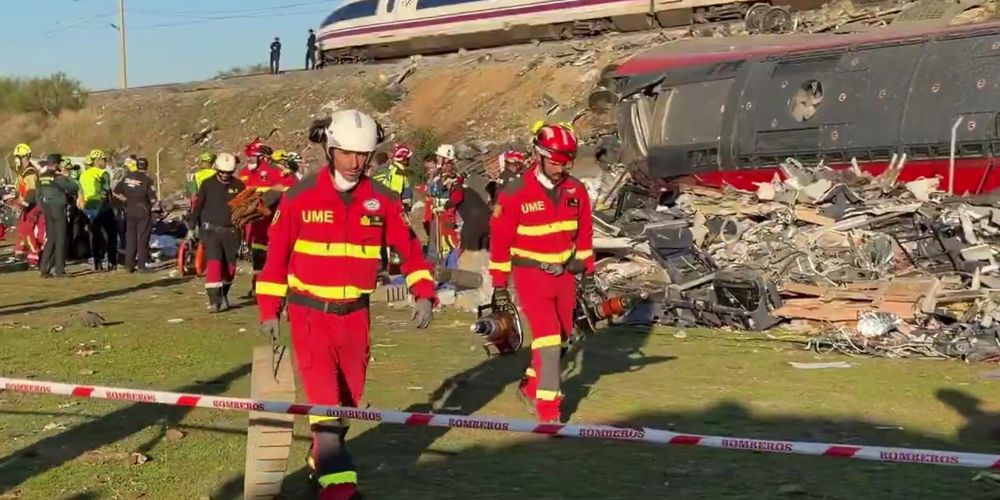
Emergency teams have continued working at the scene throughout the evening, with specialist military personnel assisting in the search of damaged carriages. Spain’s Military Emergency Unit (UME) confirmed that 200 personnel and 70 operational resources had been deployed, including canine search teams and specialists trained to locate people trapped in wreckage. After damaged carriages were stabilised, rescue teams began examining their interiors.
At least 68 people have died in the disaster, according to RTVE’s reported casualty figures, while numerous injured passengers have required hospital treatment. The scale of the tragedy has prompted expressions of solidarity from institutions throughout Spain, with national and regional authorities offering support to the victims and their families. Further casualty information will depend on official confirmation as rescue and identification work continues.
Prime Minister Pedro Sánchez visited the emergency command post and promised a thorough investigation into the circumstances of the collision. In his public statement, he said the government’s immediate priority was supporting those affected and praised the emergency services for their work. He also pledged that any negligence or failures identified during the investigation would be made known and addressed.
The investigation now faces two closely connected questions: why the railway safety system failed and why the AVE was authorised to resume its journey before normal operating conditions had been restored. Establishing the answers will be essential not only for determining responsibility for Wednesday’s disaster, but also for assessing whether further safeguards are needed across Spain’s high-speed railway network.