 Lorraine Williamson
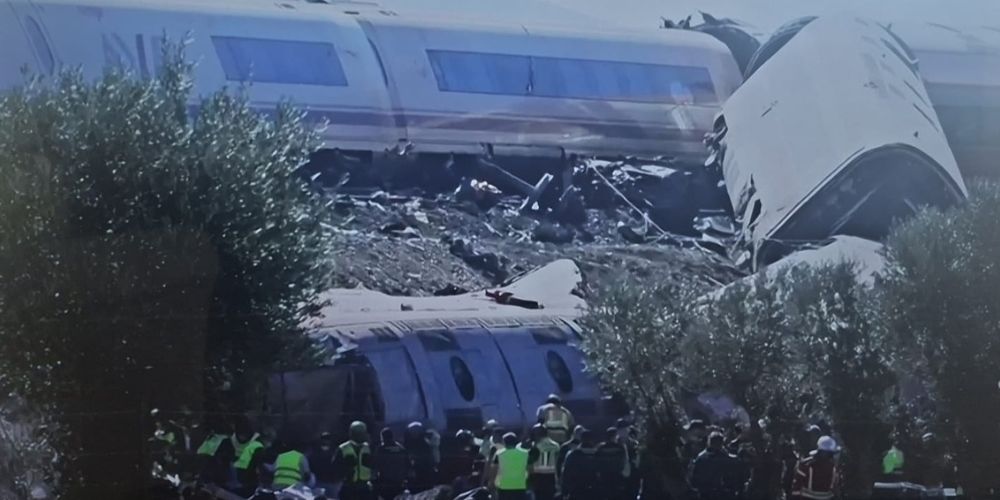
At least 64 people are reported to have died after two high-speed passenger trains collided near Urda, in Spain’s Toledo province, on Wednesday morning (28 October 2026). Dozens more have been injured, with emergency teams carrying out a major rescue and recovery operation.
The figure of 64 has been reported in afternoon television coverage. However, the latest independently verified statement from the Castilla-La Mancha government put the death toll at 30 and warned that it would rise. The full number of victims has yet to be formally established.
The collision occurred at approximately 8.54 am on the Madrid–Sevilla high-speed railway and involved a Renfe AVE and an Iryo service. Several carriages derailed, with some falling down an embankment, while rail traffic between Madrid and Andalucía was brought to a halt.
What happened in the Toledo train collision?
The accident occurred at kilometre 118 of the Madrid–Andalucía high-speed line, between Mora y Orgaz and Urda, in the province of Toledo. Both trains were operating on the Madrid–Sevilla corridor when the collision took place.
Initial reports indicate that the Renfe AVE struck the rear of an Iryo train that was stationary on the tracks. The force of the impact caused carriages to derail, leaving passengers trapped in damaged sections of the trains and prompting an extensive emergency response.
There were approximately 544 passengers aboard the two services, with 397 travelling on the Renfe AVE and 147 on the Iryo train, including a baby. These figures have been reported by RTVE in its account of the accident.
Emergency teams respond as casualty figures rise
Emergency teams have been working throughout the day to reach passengers inside the damaged carriages, and transport injured people to hospital. The scale of the disaster became increasingly clear as rescuers gained access to the wreckage, with the number of reported fatalities rising during the morning and early afternoon.
Castilla-La Mancha government spokesperson Esther Padilla confirmed that all injured passengers had been evacuated from the trains and that recovery teams were continuing their work. She appealed for blood donations to support hospitals treating those hurt in the collision.
Firefighters, Guardia Civil officers, Civil Protection teams and specialist medical personnel have been deployed, supported by emergency helicopters and mobile intensive-care units. Hospitals in Castilla-La Mancha and neighbouring regions have also prepared additional resources to assist with the response.
Castilla-La Mancha activates emergency plan
The regional government activated its territorial emergency plan, known as PLATECAM, shortly after the collision. At 10.30 am, it raised the response to operational level 2 and requested assistance from Spain’s Military Emergencies Unit (UME).
The escalation allows additional specialist resources to be mobilised and provides a coordinated structure for rescue operations, medical care and assistance to those affected. A forward command post has been established to support the emergency services working at the accident site.
The Castilla-La Mancha government has also established a dedicated information line for relatives and others directly affected by the collision, as families seek news of passengers who were travelling on the two trains.
Former minister Fátima Báñez among passengers
Former Spanish employment minister Fátima Báñez was travelling aboard the Iryo train involved in the collision, according to Spain’s main employers’ organisation, CEOE.
Báñez served as Minister of Employment and Social Security between 2011 and 2018 and is currently president of Fundación CEOE. She was reportedly travelling from Madrid to Sevilla to attend a business event when the accident occurred.
CEOE confirmed that it was awaiting information about her whereabouts, while representatives of the Partido Popular were also attempting to contact her. At the time of the latest independently verified reports, her condition had not been confirmed.
Madrid–Andalucía high-speed rail services suspended
The accident has caused major disruption to rail services connecting Madrid with Andalucía, with high-speed traffic suspended on the affected line. Trains travelling towards Sevilla, Córdoba, Málaga and other destinations have been stopped or cancelled, leaving passengers seeking alternative arrangements.
Rail infrastructure operator Adif confirmed that the collision occurred between a Renfe service and an Iryo train operating on the Madrid–Sevilla corridor. It said trains on the affected route were being held at stations and advised passengers to contact their rail operators for further information.
Adif has established assistance points at Madrid-Puerta de Atocha Almudena Grandes, Sevilla-Santa Justa, Córdoba-Julio Anguita and Málaga-María Zambrano stations. Travellers intending to use the Madrid–Andalucía high-speed line are advised to check their journeys before setting out.
The latest disruption information is available through Adif’s official network status page.
Assistance numbers for passengers and families
Dedicated telephone lines have been established by rail operators and regional authorities to provide information and support for those directly affected by the accident.
- Renfe victims and families: 900 10 10 20
- Iryo victims and families: 900 001 403/655 28 69 75
- Adif assistance: 900 00 14 02
- Castilla-La Mancha emergency information: 900 122 112
The telephone numbers are intended primarily for passengers and relatives seeking assistance. Authorities and operators have asked people who are not directly affected to avoid calling unnecessarily, so that the lines remain available to those who need them.
The railway assistance numbers have been compiled by Maldita.es in its verified information guide.
What caused the train collision?
The cause of the accident remains under investigation. Rail infrastructure operator Adif is examining its systems and the sequence of events that led to the collision, including the movements of both trains and the operation of railway safety equipment.
Early reports have suggested that one train had stopped on the line before being struck from behind. Questions have also been raised about signalling and the instructions given to train drivers, but investigators have not yet established whether human error, a technical problem or another factor was responsible.
Transport Minister Óscar Puente has been following developments from Adif’s control centre in Madrid while railway authorities gather information about the accident. No confirmed timetable has been announced for the reopening of the affected section.
Spain responds to the railway tragedy
King Felipe VI has expressed his condolences to the families of those killed in the train collision near Urda, Toledo, and offered his support to everyone affected by the tragedy.
Speaking from the Jaime I military base in Bétera, Valencia, the King also thanked the emergency services responding to the disaster.
The accident is the second major tragedy involving high-speed trains in Spain this year, following the derailment near Adamuz, Córdoba, in January, which killed 46 people. The circumstances of the two accidents are separate, and no connection between their causes has been established.
As rescue and recovery work continues near Urda, attention remains focused on the victims, the injured and the families awaiting information. The final death toll and the circumstances that led to the collision will become clearer as authorities release further findings.
This is a developing story. The figure of 64 deaths has been reported in television coverage but has not yet been independently matched to an official statement. The casualty total, railway disruption, and passenger information may change as new details are confirmed.