 Lorraine Williamson
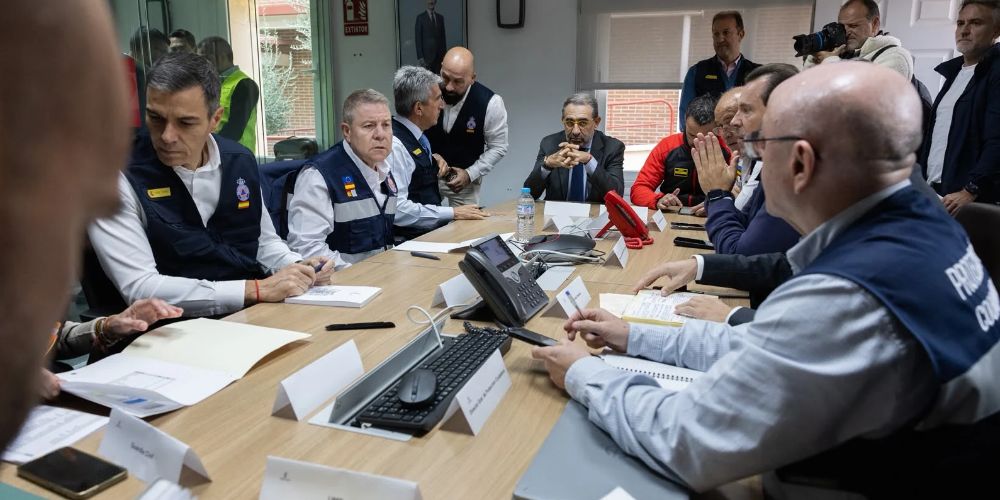
The death toll from Wednesday’s high-speed train collision near Urda, Toledo, has risen to 69 after another critically injured passenger died in hospital. Prime Minister Pedro Sánchez visited the emergency coordination centre on Thursday alongside Transport Minister Óscar Puente, as rescue teams continued their work and families waited for news of missing relatives.
Death toll rises as identification work continues
Castilla-La Mancha president Emiliano García-Page confirmed the revised death toll following Thursday morning’s meeting of the Integrated Operational Coordination Centre (CECOPI), attended by representatives of the national and regional governments.
The latest death was that of a passenger who had been receiving treatment in hospital. García-Page said the authorities were continuing the difficult process of identifying victims, following strict forensic procedures intended to ensure that families receive accurate information.
Heavy lifting equipment remains at the accident site, where emergency workers have been moving damaged carriages and examining the wreckage. García-Page expressed cautious hope that no further bodies would be found, while stressing that recovery operations were not yet complete.
Injured passengers treated in Castilla-La Mancha and Madrid
Hospitals across Castilla-La Mancha, Madrid and Andalucía have treated passengers injured in Wednesday’s train collision. Castilla-La Mancha president Emiliano García-Page confirmed that 50 patients remained hospitalised in his region on Thursday, while Madrid’s regional government reported treating 98 passengers, including four still in intensive care. Eleven people with minor injuries were also treated in Andalucía. The authorities have not yet published a reconciled nationwide figure for those still hospitalised.
Sánchez promises a full investigation and support for families
Speaking after the emergency coordination meeting, Pedro Sánchez said the government would continue working to establish precisely what happened and strengthen railway safety to prevent a similar disaster.
He described the response as involving several responsibilities: supporting victims and their families, investigating the causes of the collision and providing material compensation to those affected. He also thanked emergency workers, healthcare professionals and psychological support teams for their efforts.
Transport Minister Óscar Puente attended the meeting, although the principal public statements were delivered by Sánchez and García-Page. No final conclusion about the cause of the collision has been announced.
Hundreds of emergency personnel remain deployed
The scale of the emergency operation remains considerable. According to the latest figures from Spain’s Interior Ministry, 422 Guardia Civil officers, 143 National Police officers and 102 Civil Protection personnel are deployed in and around the accident area. With a further 250 members of the Military Emergency Unit (UME) previously reported to be involved, the combined deployment across these four services stands at approximately 917 personnel. The operation also includes specialist vehicles, equipment and other emergency resources.
The operation also involves helicopters, drones, specialist search teams, mobile assistance offices and heavy equipment needed to move damaged railway carriages.
García-Page separately thanked the approximately 1,300 personnel mobilised through Castilla-La Mancha’s emergency response. These are different descriptions of the response and should not be added together as though they represented entirely separate groups of workers.
Blood donors respond to the emergency
The regional president also thanked members of the public for an exceptional response to requests for blood donations following the collision.
He said donation levels had reached a record and encouraged people to continue supporting blood services in the coming days, particularly as injured patients may require further treatment.
The response has been one of the few encouraging developments amid the tragedy, with residents joining emergency personnel and healthcare workers in helping those affected.
What is known about the investigation?
Investigators are examining the sequence of events that led to a Renfe AVE train colliding with a stationary Iryo train on the Madrid–Andalucía high-speed line on Wednesday.
An interruption to the LZB railway safety system affected several trains before the collision. Questions remain about the instructions issued by Adif’s control centre and why one train resumed travelling while the other remained stopped.
Óscar Puente has previously described the authorisation to resume movement as an error, but the circumstances and any individual or institutional responsibility remain under investigation. Investigators must also establish precisely what information was available to the people involved at each stage.
RTVE’s examination of the accident outlines the preliminary sequence while acknowledging that important questions remain unanswered.
Spain observes three days of national mourning
Thursday marks the first of three days of national mourning declared following the disaster, covering 29, 30 and 31 October.
Flags are being flown at half-mast as the country remembers those who died, while families continue to face the uncertainty and distress of waiting for identification results.
The Madrid–Andalucía high-speed railway remains closed, with passengers facing cancellations and alternative travel arrangements. RTVE’s continuing coverage is tracking developments as recovery and investigation work continues.