 Lorraine Williamson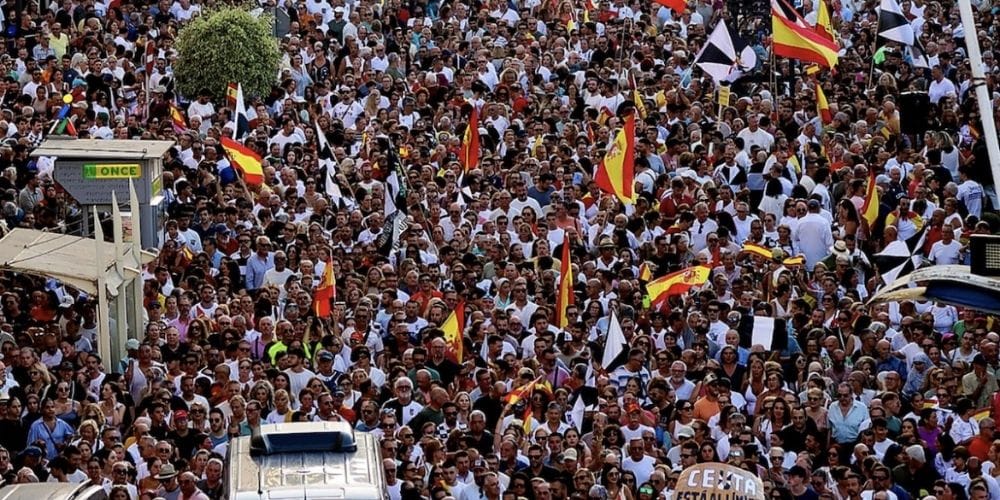
Spain has said people who entered Ceuta irregularly during the recent migration crisis will be returned, as the government faces growing pressure to strengthen security and restore confidence in the autonomous city.
Foreign Minister José Manuel Albares delivered the message during a visit to Ceuta on Tuesday, where he met regional president Juan Jesús Vivas. Albares said Spain and Morocco were working together to accelerate returns and warned people considering an irregular crossing that they would be sent back.
The visit comes almost two weeks after the mass crossings of 30 and 31 July placed extraordinary pressure on Ceuta’s border, accommodation and public services.
Albares said Morocco had shown a willingness to cooperate on the immediate return of people who had entered irregularly. He also argued that cooperation between Spain and Morocco remained essential to controlling the border and preventing further large-scale crossings.
The foreign minister called on people in neighbouring African countries not to attempt irregular entry into Ceuta, stressing that Spain intended to enforce returns in cooperation with Morocco.
Vivas demands a stronger and safer border
Vivas used Tuesday’s meeting to press the national government for stronger protection of Ceuta’s land and maritime borders.
The Ceuta president said the frontier needed to be reinforced and made more secure, while calling for improved coordination between the different authorities involved in responding to the crisis. He has repeatedly argued that Ceuta cannot be expected to manage the consequences of such a large-scale arrival without substantial support from the Spanish state.
His demands follow a meeting on Monday with Territorial Policy Minister Ángel Víctor Torres, when Vivas called for a migrant detention centre in Ceuta and faster expulsions. The government has also identified the situation of migrant children in the city as a priority.
The government says 1,527 migrant children who arrived during the crisis have now been identified, adding another complex element to the response. Their circumstances are subject to different legal and safeguarding requirements from those governing adult migrants.
Thousands take to the streets
Political pressure has been accompanied by an unusually large public demonstration in Ceuta.
Thousands gathered in the Plaza de la Constitución on Sunday under the slogan Basta ya. Ceuta no se rinde — roughly, “Enough. Ceuta will not give in”.
The demonstration was jointly called by representatives of Ceuta’s Christian, Muslim, Jewish and Hindu communities, who emphasised the city’s tradition of convivencia, or coexistence, while demanding a stronger response to the pressures created by the recent arrivals.
Organisers put attendance at more than 10,000, while Policía Nacional estimated that just over 5,000 people participated. Despite the strength of feeling, the gathering remained peaceful.
Vivas attended the demonstration and described the situation facing the city as unsustainable. The absence of the central government’s delegate also prompted criticism from some protesters.
The demonstration is significant because it was not organised by a single political party or community. Its interfaith character was intended to demonstrate that concerns about the crisis did not have to translate into divisions between Ceuta’s different cultural and religious groups.
Security measures remain reinforced
The continuing concern over further crossings has prompted exceptional measures among Spain’s security forces.
The Guardia Civil and Ceuta’s military command have suspended leave and permits for personnel stationed in the autonomous city. Military personnel already on holiday were instructed to return to their posts, with exceptions considered only in particular circumstances.
Morocco has also reinforced controls around its borders with Ceuta and Melilla amid calls on social media for further attempts at mass crossings.
The measures illustrate the continuing concern in both countries that the immediate crisis may have eased without eliminating the possibility of renewed pressure at the border.
Ceuta crisis reaches the Senate
The political consequences are also moving to Madrid.
Defence Minister Margarita Robles is expected to appear before the Senate on Tuesday 18 August to explain her department’s response during the mass crossings on 30 and 31 July.
The appearance forms part of a wider political dispute over parliamentary scrutiny of the government’s handling of the crisis. Opposition parties have sought appearances from ministers responsible for Defence, Interior and Foreign Affairs, while the government has planned appearances in Congress later in August.
For Ceuta, however, the immediate questions remain practical rather than parliamentary: how quickly people who have no right to remain can be returned, how migrant children will be accommodated and protected, and whether reinforced security can prevent another mass crossing.
Tuesday’s meeting between Albares and Vivas shows that the response has now moved beyond the immediate border emergency. Attention is increasingly turning to what happens to those who remain in Ceuta and how Spain intends to prevent the city facing the same situation again.