 Lorraine Williamson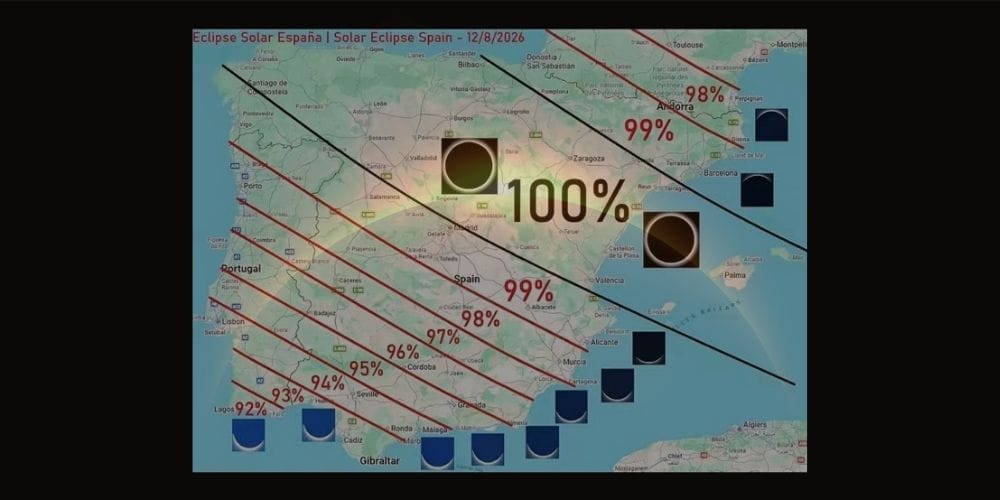
Spain has activated a national command centre to coordinate security and emergency operations ahead of Wednesday’s total solar eclipse, when hundreds of thousands of people are expected to gather across the country’s viewing zone.
The Ministry of the Interior says the operation will monitor conditions continuously before, during and after the eclipse, allowing authorities to respond in real time to problems involving crowds, traffic, public safety or wildfire risk.
The Puesto de Mando Unificado, or Unified Command Post, has been established at Spain’s National Emergency Monitoring and Coordination Centre (CENEM). It brings together teams from Civil Protection and the Secretary of State for Security, alongside representatives from the Policía Nacional, Guardia Civil and Dirección General de Tráfico.
Its role goes considerably further than managing the expected increase in traffic. Officials will have a national overview of incidents developing around observation sites and will be able to coordinate resources as situations change.
A dedicated technological platform has been created specifically for Wednesday’s eclipse. Information from observation areas and participating authorities will feed into the system, giving emergency coordinators a continuously updated picture of conditions across the country.
The government says this should improve the exchange of information between agencies and allow faster decisions if incidents develop.
Crowds, mobility and wildfire risk under scrutiny
The operation has been established because Wednesday’s eclipse will combine several risks rarely experienced simultaneously on this scale.
Large numbers of people are expected to converge on rural locations and designated observation points, many during a period of extreme summer wildfire risk. Authorities are therefore preparing not only for traffic congestion but also for potentially difficult access for emergency vehicles, large concentrations of people and incidents in natural areas.
The Interior Ministry has specifically urged people to take precautions against forest fires and to protect natural spaces likely to experience unusually high visitor numbers. Visitors are also being asked to use established observation areas wherever possible and follow instructions from emergency and security services.
The warning has particular relevance this week as emergency crews continue dealing with major wildfires in several parts of Spain.
DGT prepares for exceptional movement
Traffic remains one of the most significant logistical challenges surrounding the eclipse.
The DGT estimates that between 400,000 and 1.5 million additional road journeys could be generated as people travel towards the path of totality. Around 446,700 additional visitors are expected in Spain between 10 and 16 August, including approximately 164,000 international visitors.
Thirty-six provinces lie within the zone where the eclipse can be seen in totality, stretching across much of northern and eastern Spain and the Balearic Islands. More than 360 safe observation points have been communicated to authorities by Spain’s autonomous communities.
The DGT has classified the eclipse as an event with a high impact on traffic and will monitor roads continuously from its traffic management centres, supported by aerial surveillance and reinforced Guardia Civil traffic patrols.
However, officials believe the period immediately after totality could be particularly difficult. While visitors are likely to arrive gradually throughout the day, large numbers could attempt to leave viewing locations at roughly the same time once the eclipse ends.
Drivers are therefore being encouraged to delay their return where possible rather than joining the immediate rush.
Authorities can impose local restrictions
Although the DGT does not expect general nationwide traffic restrictions, authorities can introduce temporary measures around crowded observation areas.
These could include access restrictions, alternative routes, traffic diversions and capacity controls where roads or observation sites become saturated.
Stopping on carriageways or hard shoulders to watch the eclipse is prohibited. Drivers travelling during the period of darkness should keep their attention on the road rather than attempting to photograph or observe the eclipse, and the DGT advises using dipped headlights as daylight fades.
The national command centre will remain operational throughout the event, bringing together information from traffic, policing and emergency services as Spain prepares for one of the largest astronomical events seen from the country in generations.