 Lorraine Williamson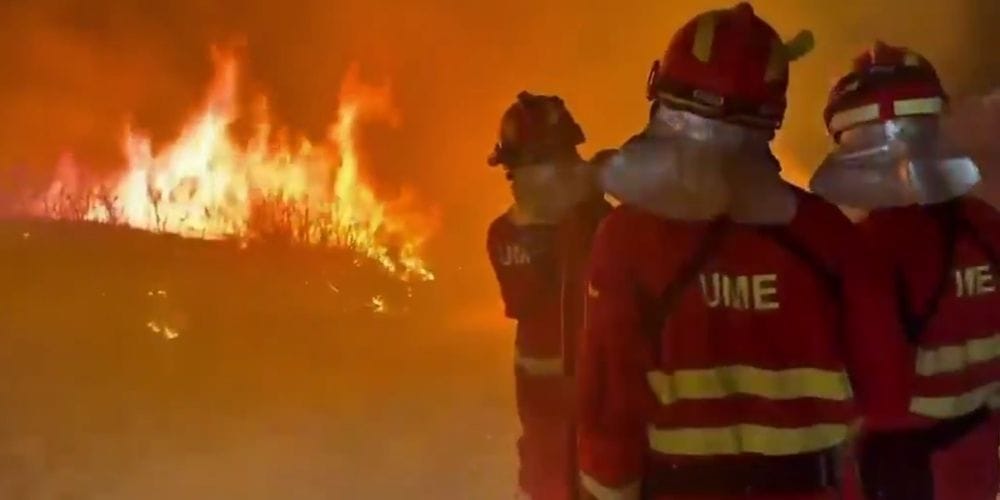
Around 700 residents of Catí in Castellón province have spent the night away from their homes after the Tírig wildfire intensified on Sunday and forced the evacuation of the entire municipality. The blaze has now affected around 684 hectares within a 19-kilometre perimeter, although firefighters reported a much more favourable evolution overnight.
Residents were ordered to leave Catí on Sunday afternoon after the fire’s northern front continued advancing towards the municipality. An ES-Alert was sent at around 16.30, and those unable to stay with relatives or friends were moved to the sports centre in Xert for the night. Cadena SER reported that around 700 residents were evacuated as a precaution while crews concentrated on the northern front of the fire.
The fire remains active and has affected around 684 hectares inside a perimeter of approximately 19 kilometres. Two principal sectors continue to demand attention: the northern front towards Catí and a southern sector around Tírig, with difficult terrain and ravines complicating access for ground crews. The latest operational update put the affected area at 684 hectares and confirmed two main sectors of concern.
Firefighters described the night as “very favourable” after relative humidity rose to around 90%, helping vegetation absorb moisture and reducing the intensity of the fire. Technical burns were successfully carried out in both the northern and southern sectors, and crews reported no significant increase in the affected area overnight. The Monday morning assessment said improved humidity had given crews an important advantage during the night.
Nearly 300 personnel remain deployed
Around 300 personnel are now involved in the operation, supported by 19 aircraft and dozens of ground resources. The deployment includes regional forest firefighters, provincial fire crews, the Military Emergency Unit and state aerial resources.
The Military Emergency Unit (UME) said on Monday morning that it had reinforced protection around Catí as the fire continued to evolve. Military teams are using drones to monitor and track the wildfire, while ground crews are carrying out direct attacks on the fire front in coordination with the Generalitat Valenciana’s emergency services.
Crews are working with the aim of stabilising the fire if Monday’s weather conditions remain favourable. Stabilisation would mean that the blaze is no longer spreading freely, but it would not yet mean the fire is controlled or extinguished.
The large-scale operation is also focused on protecting farms and livestock installations around Catí. More than 60 livestock holdings are located within the municipality, and firefighters have been working to defend those properties while containing the advancing fronts. El Mundo reported that emergency crews were maintaining intensive protection around more than 60 livestock farms in the Catí area.
Catí evacuation follows earlier confinement
The evacuation marks a significant escalation from Saturday, when Catí’s approximately 700 residents were initially ordered to remain indoors because of the advancing fire and smoke.
At that stage, authorities instructed residents to close doors and windows, switch off ventilation and air-conditioning systems and follow official emergency information. The decision to evacuate on Sunday was taken after the northern front moved closer and authorities judged that removing residents was the safest option. EFE reported the earlier confinement and the emergency measures introduced as the fire approached Catí.
No general return to Catí had been announced in the latest Monday morning information. The next decision is expected to depend on the evolution of the fire and the assessment made by the emergency coordination authorities.
Lightning remains the main suspected cause
The fire was one of several outbreaks declared in inland Castellón following intense thunderstorms accompanied by more than 100 lightning strikes.
Authorities have said lightning remains the principal hypothesis for the Tírig fire, although the final cause will be determined by the Guardia Civil’s environmental protection service, Seprona. Other fires declared in Culla and Serra d’en Galceran have since been controlled or stabilised. Emergency officials said the pattern of lightning strikes remains the leading explanation for the outbreak pending the formal investigation.
The Tírig fire remains under Situation 2 of the regional emergency plan, reflecting the need for extraordinary resources and the potential risk to communities and property.
Authorities warn eclipse visitors over wildfire risk in Spain
Weather could help — or complicate the operation
The improved humidity overnight has given crews their best opportunity yet to consolidate the perimeter, but the weather remains a critical factor.
Despite the improved overnight conditions, wildfire danger remains exceptionally high across the region. On Monday morning, Emergències 112CV placed the entire Comunitat Valenciana at Extreme pre-emergency level for forest fire risk, urging anyone who sees fire or smoke to call 112 immediately.
Castellón province remains under warnings for potentially intense rain, hail and strong winds. While rain and higher humidity can assist firefighters, sudden gusts associated with thunderstorms can rapidly change the direction and intensity of a wildfire. The latest Monday update warned that storms and wind remain an important factor in the operation.
For the residents of Catí, Monday’s priority is whether conditions improve enough to allow a safe return home. For firefighters, the objective is equally clear: use the favourable overnight conditions to stabilise the blaze before any new change in wind or weather reverses the progress made.