 Lorraine Williamson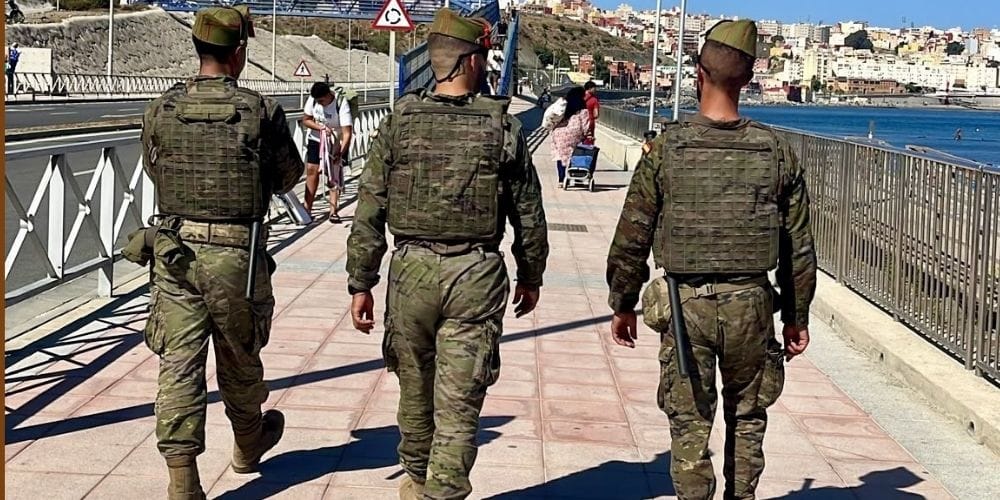
A Spanish Army sergeant has been injured after stones were thrown at military personnel deployed in Ceuta, in the second attack on soldiers in the autonomous city in three days. Four Moroccan nationals have been arrested following the incident, which comes as Ceuta continues to deal with the consequences of the mass border crossings at the end of July. A demonstration planned for Saturday night has meanwhile been cancelled amid concerns that extremist groups could join the protest and encourage violence.
The latest attack happened during the early hours of Saturday close to a petrol station near the rear entrance to the Murallas Reales, on Avenida Martínez Catena.
According to police sources, four people threw stones at soldiers who were in the area as part of the security operation currently under way in Ceuta. One of the stones struck a sergeant, causing injuries described as minor.
A pursuit followed and ended at El Chorrillo beach, where a Guardia Civil Rural Security Group patrol joined the operation. Three suspects were initially detained, while a fourth fled towards the beach before being located.
The four arrested are Moroccan nationals who are in Spain irregularly, according to police sources. Three adults remained at the National Police headquarters on Saturday. Meanwhile, the fourth detainee, reported by the Spanish Troops and Sailors Association to be a minor, has been referred to the appropriate judicial authorities.
Second attack on soldiers in three days
Saturday’s incident follows a much larger confrontation in Benzú on Thursday morning.
On that occasion, a group estimated at between 30 and 40 people surrounded a military vehicle carrying four soldiers and threw large stones at it. All four soldiers required medical attention and 12 Moroccan nationals were subsequently arrested.
The repeated incidents come as military personnel, National Police and Guardia Civil officers maintain an increased presence across Ceuta following the arrival of tens of thousands of migrants from Morocco on 30 and 31 July.
Police union JUPOL has also raised concerns about bottles containing hydrochloric acid, known in Spain as agua fuerte. The union told RTVE that some migrants had allegedly used the substance to prepare improvised devices in plastic bottles and said bottles had been thrown towards protesters and military personnel during recent disturbances.
At present, these claims come from the police union rather than an announced conclusion from an official police investigation. They should therefore be treated as allegations while authorities establish exactly what was used in the incidents.
Saturday night protest cancelled
A demonstration planned for Saturday night has been cancelled by its organisers after they learned that groups described as ultras could be travelling to Ceuta.
The organisers said they wanted to prevent people who might encourage violence from joining the protest. The decision follows several days of demonstrations by residents demanding action over the continuing migration crisis.
Some of the demonstrations have remained peaceful, but others have been followed by serious disturbances. On Thursday, groups reached areas where migrants were staying, with shelters and belongings destroyed or burned and police intervening to prevent further confrontations.
EFE reported earlier on Saturday that no further organised demonstrations were initially expected over the weekend following several consecutive days of protests. Residents have nevertheless told the agency that spontaneous gatherings remain possible.
Crime rises as residents describe growing unease
A clearer picture is also emerging of the effect the crisis is having on everyday life in Ceuta.
RTVE reports that the Government Delegation estimates crime in the city has increased by around 5%. There have now been 17 recorded alleged sexual assaults during the crisis, seven of which Interior Minister Fernando Grande-Marlaska said are classified as rape.
The available information also provides important context about the victims. Most are reported to be migrant minors, rather than local women, an important distinction amid claims and rumours circulating about the situation in Ceuta.
Marlaska told Congress on Friday that the victims of the sexual offences were mainly vulnerable women. Prosecutor General Teresa Peramato had previously reported 16 alleged sexual assaults involving 17 victims, 16 of them female and the majority minors. The later Interior Ministry figure puts the number of recorded alleged sexual assaults at 17.
The situation varies considerably across the city. RTVE reports that central areas continue to have busy terraces and shops and a degree of normal daily activity, while neighbourhoods close to areas where large numbers of migrants are gathered, including Benítez and El Trampolín, are experiencing considerably greater disruption and concern.
That distinction is important. Ceuta as a whole has not shut down, but residents in some of the areas most directly affected describe difficulties moving around, road closures and large numbers of people sleeping outdoors or searching for food.
Thousands still awaiting accommodation
The government estimates around 5,000 migrants remain in Ceuta, approximately 1,500 of them minors.
Health Minister Mónica García said on Saturday that around 3,800 people are now in temporary reception spaces. The government expects another 1,000 places to become available during the coming week and hopes everyone requiring accommodation can be rehoused within two to three weeks.
The government’s specialist committee on Ceuta agreed on Friday on a new list of temporary accommodation sites. It also unanimously condemned violence and stressed that food and humanitarian assistance must be able to reach vulnerable people.
Spain has also requested additional European assistance from Frontex, Europol and the EU Agency for Asylum. Permanent changes to border security announced on Friday include extending the Tarajal and Benzú breakwaters, introducing maritime containment barriers and increasing drone and underwater surveillance.
The developments show the difficult balance facing authorities almost a month after the mass crossings. Residents in affected neighbourhoods are demanding the restoration of normal daily life, thousands of migrants still require accommodation and individual processing, and security forces are trying to prevent further violence involving either migrants or groups targeting them.
Saturday’s second attack on military personnel adds to those security concerns, although the cancellation of the planned night-time demonstration may reduce the immediate risk of another large confrontation.