 Lorraine Williamson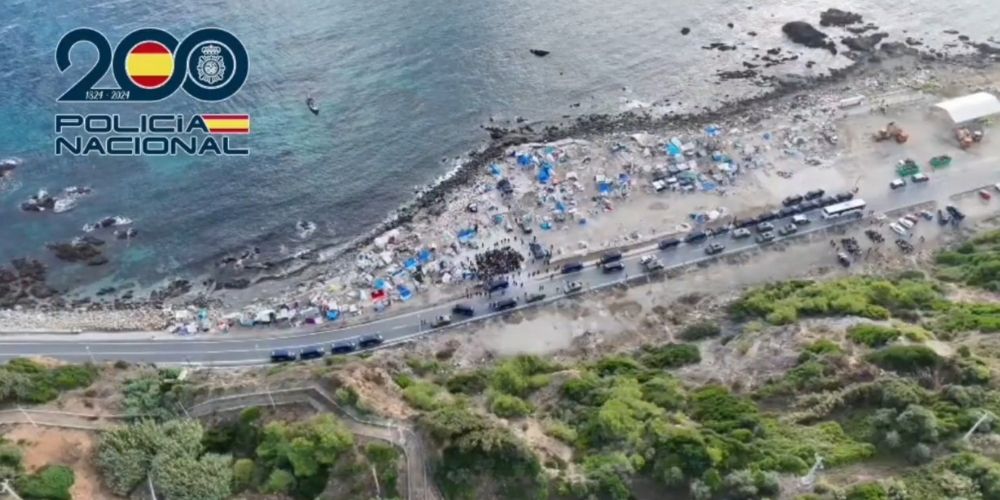
Spanish police have cleared the last major migrant encampment on Ceuta’s coastline, removing approximately 500 people from the El Guano site during an operation on Sunday, 11 October. More than 350 officers were involved as buses transported migrants to reception and identification facilities across the autonomous city.
The operation marks the conclusion of a series of clearances following the mass arrivals from Morocco at the end of July. However, the Spanish government has acknowledged that work remains to address the situation of migrants still sleeping outdoors in Ceuta’s streets and neighbourhoods.
The operation began at around 7.30 am at the site of the former El Guano factory, close to the Playa del Trampolín. Police intervention units were joined by other security personnel as officers began moving people from the makeshift settlement and municipal workers dismantled the remaining shelters.
According to police sources cited by Europa Press, approximately 500 people were removed from the encampment. The operation involved more than 350 officers, making it one of the largest deployments during the recent series of clearances.
Eleven buses used to transfer migrants
RTVE reported that eleven buses were used to transport migrants from El Guano to facilities including the Centro de Atención Temporal de Extranjeros (CATE), the Loma Colmenar area and police headquarters. The final bus departed during the afternoon, after which machinery began removing the remaining structures from the site.
Adults were taken for identification and immigration procedures, while minors were directed towards the relevant authorities responsible for their protection. The final breakdown of those transferred, including how many were children, has not yet been officially confirmed.
Some migrants reportedly left the area before or during the operation, moving towards other parts of Ceuta rather than entering the reception process. Their circumstances highlight the continuing challenge facing authorities despite the clearance of the coastal settlements.
Government declares coastal clearances complete
Spain’s Minister for Territorial Policy, Ángel Víctor Torres, confirmed on Sunday that the operation had brought an end to the large migrant encampments along Ceuta’s coastline. The government had previously set 15 October as its target for clearing the settlements, a deadline it has now met four days early.
Torres said the authorities had fulfilled their commitment to restore normal conditions along the city’s coastal areas. He nevertheless acknowledged that further operations would be necessary in neighbourhoods where migrants continue to sleep outdoors.
The minister also reported that nearly 12,000 people had returned to Morocco since 10 August. That figure covers the wider period of the migration crisis and should not be confused with the number of people affected by Sunday’s operation.
Two months of pressure on Ceuta
Ceuta has faced considerable pressure on its reception and accommodation services since large numbers of people crossed from Morocco at the end of July. Makeshift settlements developed along the coastline, with authorities progressively clearing sites at Benítez, Trampolín and other locations before Sunday’s operation at El Guano.
In an official update published on 8 October, the Ministry of Territorial Policy reported that 11,026 people had returned to Morocco since 10 August, including 10,513 voluntary returns and 513 expulsions. The same update recorded 2,827 unaccompanied children and adolescents in the city’s protection system, illustrating the scale of the continuing humanitarian response.
The ministry also reported the expansion of state reception capacity, alongside family reunifications and transfers of minors to other autonomous communities. These arrangements remain important as authorities address the needs of people who have left the coastal settlements.
Clearance comes before royal visit
Sunday’s operation took place two days before King Felipe VI and Queen Letizia are scheduled to visit Ceuta on Tuesday 13 October. The royal visit has attracted considerable attention as the city continues to deal with the consequences of the summer migration crisis.
The timing of the clearance has been widely reported in Spanish media, but authorities have not established a direct connection between the operation and the royal visit. The government had already announced its target of clearing the coastal settlements by 15 October.
For the people transferred from El Guano, the immediate question is what accommodation and protection arrangements will follow. Although the coastal encampments have now been dismantled, the wider situation in Ceuta remains unresolved.