 Lorraine Williamson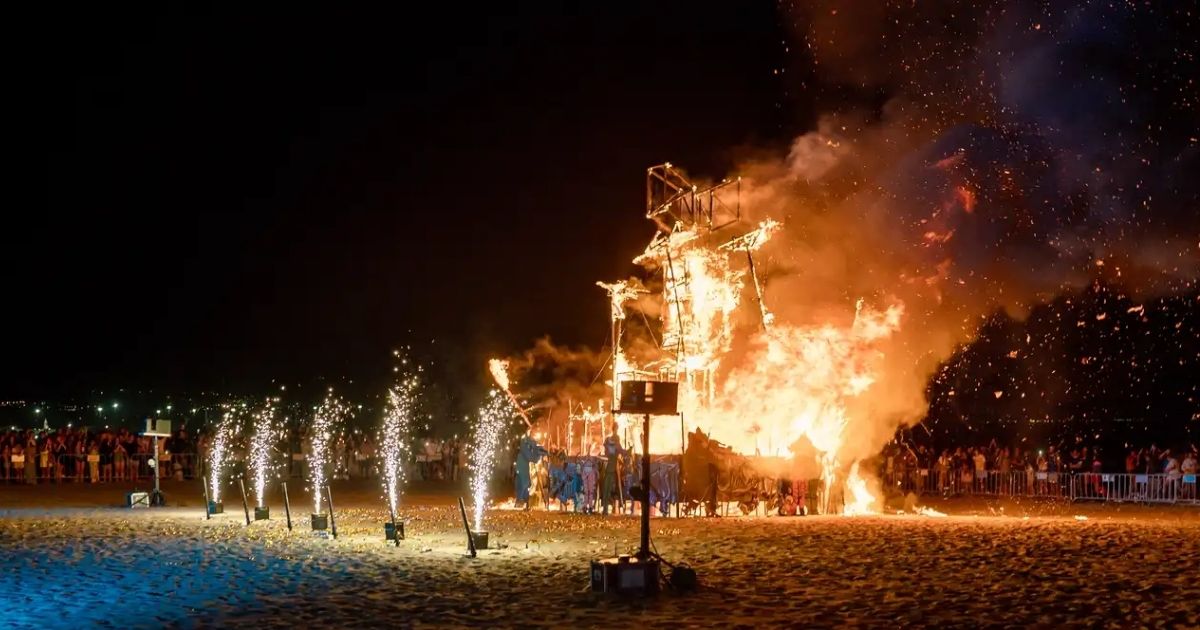
Across Spain, the night of San Juan marks the moment when summer stops being a date on the calendar and becomes something people feel in the streets, on the beaches and around the fire.
Celebrated on the night of 23 June into 24 June, San Juan in Spain blends ancient solstice rituals, Christian tradition, beach gatherings, bonfires, fireworks, herbs, food and midnight swims. In some places, it is loud and crowded. In others, it is intimate, local and full of superstition.
But the idea at the heart of the celebration is quite similar across the country: leave something behind, welcome something new, and step into summer with fire, water and a little bit of magic.
What is San Juan in Spain?
San Juan, or Saint John’s Eve, is celebrated on the night before the feast day of Saint John the Baptist.
In Spain, however, the celebration carries older roots linked to the summer solstice, fire, purification and renewal. The Christian calendar gave the night its name, but many of the rituals still feel connected to nature: burning away the old, washing in the sea, gathering herbs and making wishes for the months ahead.
The result is one of Spain’s most atmospheric summer nights.
On beaches, in town squares and in neighbourhoods, people gather with friends and family. There may be music, food, fireworks, candles, bonfires or simply the quiet tradition of putting your feet in the water at midnight.
Fire as a symbol of renewal
Fire is the image most closely associated with San Juan in Spain.
In many places, bonfires are lit as a symbol of purification. People traditionally burn old objects, written wishes or symbolic representations of the things they want to leave behind.
In Málaga, the city’s tourism office describes the night as a beach celebration where bonfires and midnight rituals mark the arrival of summer.
The same theme appears in many coastal areas: fire burns away the bad, the old or the unlucky, while the new season begins.
That does not mean every beach allows open fires. In many municipalities, bonfires are now tightly controlled or banned in certain areas because of safety, cleaning and environmental rules. Anyone planning to celebrate should check local council guidance before lighting anything.
Water, wishes and midnight swims
If fire represents what people leave behind, water often represents what they hope to receive.
In many coastal areas, people go into the sea at midnight. Some simply swim. Others jump over waves, wash their face, make a wish or walk backwards into the water, depending on local tradition.
Along the Mediterranean coast, the midnight swim is one of the best-known San Juan rituals. Valencia’s tourism office highlights the city’s beach celebration, especially on La Malvarrosa and El Cabanyal, where people gather to welcome summer by the sea.
The symbolism is simple but powerful: fire clears the way; water renews.
For many people, it is less about strict ritual and more about atmosphere. Families, groups of friends and visitors gather on the sand, wait for midnight, then step into the water together.
Jumping flames, written wishes and walking backwards into the sea
Some of the most personal San Juan rituals are also the simplest.
In many places, people write down something they want to leave behind — a worry, a bad habit, a difficult year or an old version of themselves — and burn the paper in the fire. Others write wishes for the months ahead, keeping them private or symbolically offering them to the flames.
Jumping over small bonfires is another tradition associated with luck, protection and renewal, although it should only ever be done where fires are officially allowed and safely controlled. In some areas, people jump three, seven or nine times, depending on local custom.
Water rituals vary too. Some people enter the sea at midnight, jump over waves, wash their face, or walk backwards into the water as a way of leaving the past behind and stepping into summer renewed.
These traditions are especially familiar along parts of the Andalucian and Mediterranean coast, but the wider symbolism of fire, water, wishes and renewal appears in different forms across Spain.
Alicante turns San Juan into a major festival
While much of Spain celebrates San Juan as one magical night, Alicante turns it into one of the country’s great summer festivals.
The Hogueras de San Juan, or Fogueres de Sant Joan, take place from 20 to 24 June and are officially recognised as a Festival of International Tourist Interest. Spain’s official tourism portal describes Alicante’s celebration as a spectacular display of music, colour, fireworks and fire.
The city fills with satirical monuments, street celebrations, mascletàs, parades and fireworks. The festival ends with the burning of the hogueras, when the elaborate structures are set alight in a dramatic close to the celebration.
Alicante’s version of San Juan is not only about midsummer. It is also a statement of local identity, creativity and noise — in the best Spanish fiesta sense of the word.
Sant Joan in Catalonia
In Catalonia, Sant Joan is one of the most important nights of the year.
The celebration often includes fireworks, firecrackers, beach gatherings, music, and the traditional coca de Sant Joan, a sweet festive cake usually eaten with cava. Barcelona’s beaches can become crowded, while towns and villages across Catalonia hold their own revetlles, or open-air evening celebrations.
The day after, 24 June, is a public holiday in Catalonia. It is also a holiday in the Valencian Community and Galicia in 2026, according to Spanish holiday calendars reported by Spanish media.
For visitors, this matters because transport, shops and local services may run differently in regions where 24 June is a holiday.
Galicia and the magic of San Xoán
In Galicia, San Juan becomes San Xoán, and the celebration carries a particularly strong sense of magic and folklore.
Bonfires, sardines, music and gatherings are part of the night, but Galicia is especially known for its herbs of San Xoán. Traditionally, aromatic plants are collected, placed in water overnight and used the next morning to wash the face as a form of protection and renewal.
Galician celebrations also often include references to meigas, or witches, and rituals designed to protect against bad spirits. Cadena SER’s Galicia coverage describes the night as one of the region’s emblematic celebrations, marked by hogueras, music, sardines, queimada and traditional herbs.
This is one of the reasons San Juan feels different depending on where you are in Spain. The basic elements may be familiar, but the local character changes completely from region to region.
Andalucia and the beach-night atmosphere
In Andalucia, San Juan is strongly associated with beach gatherings, especially along the Mediterranean coast.
In Málaga, Marbella, Estepona, Almería, Granada’s coast and other seaside areas, people often gather on the sand with food, music and friends. Whereas, in some places, the night includes bonfires, symbolic burnings or municipal events. In others, restrictions mean the celebration is more about being together by the sea than lighting fires.
Some towns burn figures or júas, representing things people want to leave behind. Others focus on music, fireworks or midnight bathing.
Because rules vary by municipality, the practical advice is simple: check local council information before heading to the beach with candles, barbecues, fireworks or plans for a bonfire.
Not every San Juan celebration is on the coast
Although beach celebrations are the most famous, San Juan is not only a coastal festival.
In inland towns and northern cities, the night may be marked with bonfires, dances, local processions, music or neighbourhood gatherings. San Sebastián, for example, has its own traditional San Juan bonfire celebration, connected to the summer solstice.
In Castilla y León, Aragón, Madrid, Extremadura and other regions, local towns also celebrate San Juan in their own way, sometimes as a municipal holiday, sometimes as a neighbourhood tradition.
That is part of the charm of San Juan in Spain. It is a national feeling, but not a uniform event.
What to know before going to a San Juan beach party
San Juan is beautiful, but it can also be busy, noisy and unpredictable.
Beaches can fill quickly, especially in major coastal cities such as Alicante, Valencia, Barcelona and Málaga. Public transport may be extended in some places, while roads and beach access points may be restricted.
Valencia’s tourism office, for example, recommends using public transport on the night of San Juan, with extra services planned around the city’s beach areas.
It is also worth remembering that a summer celebration can still carry risks. Alcohol, darkness, crowds, fireworks, sea currents and late-night swimming do not always mix well.
A yellow flag does not mean the sea is safe. It means bathing is allowed with caution. If there are strong currents, rough water or rocky areas, it is better to stay out of the sea.
A night to enjoy with care
San Juan is a night of fire and water, but it is also a night when local rules matter.
Many councils issue specific instructions on bonfires, barbecues, fireworks, glass bottles, alcohol, waste, pets, beach access and cleaning schedules. In protected coastal areas, fires may be prohibited completely.
The best way to enjoy the night is to respect the place where you celebrate it. Take rubbish home, avoid lighting fires where they are banned. Keep children away from fireworks and check on anyone who may be affected by heat, crowds or alcohol.
With Spain facing its first heatwave of the summer from Sunday, people attending crowded outdoor celebrations should also take water, use sun protection earlier in the day and avoid arriving already dehydrated.
Welcome to summer
San Juan survives because it is more than a party.
It gives people a reason to gather at the beginning of summer. It turns ordinary beaches, squares and streets into places of ritual. And, furthermore, it connects modern Spain with older beliefs about fire, water, nature and renewal.
For some, it is a night of music and fireworks. For others, it´s a moment to make a wish, wash away the old or step into the sea at midnight.
However it is celebrated, San Juan in Spain remains one of the country’s most atmospheric ways to welcome summer.
Spain ferias and fiestas 2026: the big guide to Spain’s best celebrations month by month