 Lorraine Williamson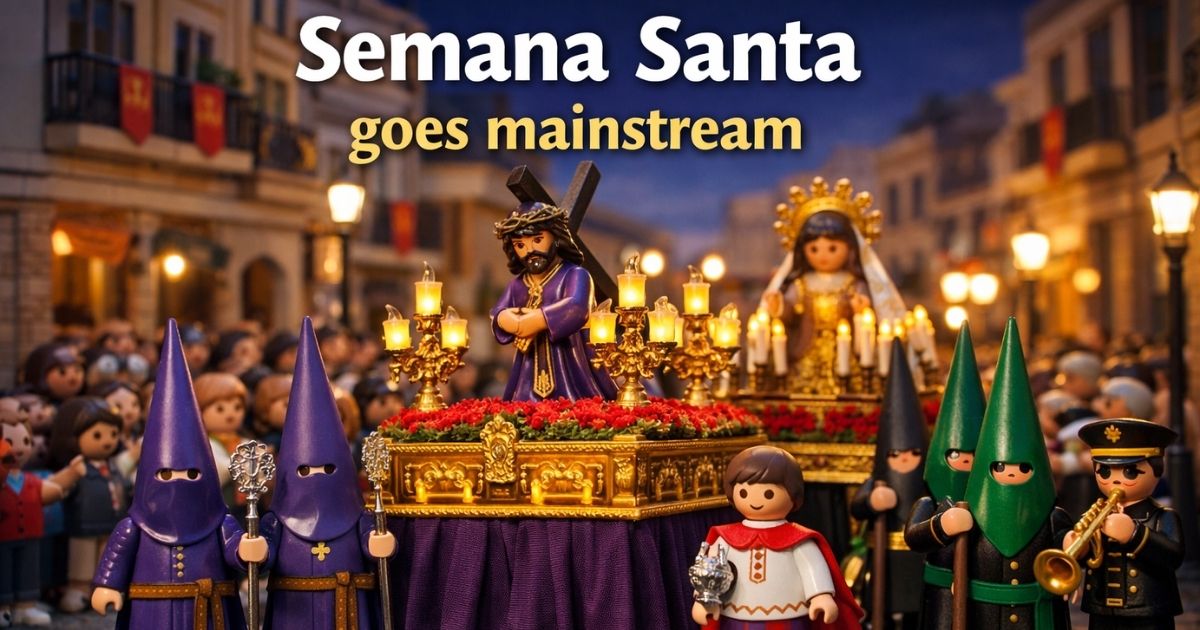
Semana Santa has always filled Spain’s streets with incense, drums, and solemn processions. This year, though, another shift is hard to ignore. Beyond the churches and parade routes, the imagery of Holy Week is spilling into everyday life through Playmobil figures, sticker albums, board games, socks, and even football shirts inspired by brotherhood aesthetics.
What was once kept firmly within religious and ceremonial space is increasingly becoming part of mainstream culture.
From devotion to daily life
That change says something important about modern Spain. For many younger people, Semana Santa is still rooted in faith and family tradition, but it is also becoming a marker of identity, local pride, and belonging. In cities such as Seville and Málaga, the symbols of the cofradías are no longer confined to Holy Week itself. They now appear in wardrobes, collectors’ shelves, and social media feeds, where tradition is being recast in a language that feels more immediate and familiar.
The result is not simply commercialisation in the crude sense. It is also a sign that one of Spain’s oldest traditions has adapted to a new generation without losing its emotional power. Younger followers are engaging with Semana Santa in ways that feel more relaxed and visually driven, blending old rituals with contemporary culture rather than treating them as separate worlds.
Playmobil, trading cards, and football-style shirts
The most striking examples are also the most visual. Cofrade-themed Playmobil figures, customised card games and Holy Week sticker albums have found a growing audience, while clothing brands have turned religious iconography into lifestyle products. Football shirts designed in the style of famous hermandades have become one of the clearest signs that the tradition has crossed into modern consumer culture.
That crossover may seem surprising from the outside, but in much of southern Spain, it makes a certain sense. Brotherhoods already carry a deep sense of loyalty, neighbourhood attachment, and inherited identity. In that respect, the emotional pull is not so different from the bond many supporters feel with a football club. The symbols matter because they stand for memory, family, and place as much as religion itself.
A growing market around Holy Week
Businesses have noticed. Specialist brands are now building products around cofrade imagery, while brotherhoods themselves have become more sophisticated in how they present and promote their image. Social media has helped push that transformation further, giving hermandades a direct way to market merchandise, connect with followers, and extend their presence far beyond the days of procession.
For some organisations, that also means an extra income stream at a time when events, upkeep, and ceremonial life come with real costs. But the deeper story is cultural rather than financial. Semana Santa is proving it can survive modernity not by retreating from it, but by absorbing some of its language, aesthetics, and commercial logic.
No longer just an Andalucia story
Although the trend is strongest in Andalucia, it is no longer confined to Seville or Málaga. Similar ideas are appearing in cities including Valladolid, Zaragoza, and Palencia, often shaped by local traditions and local brotherhood culture. That expansion matters because it shows this is not just a quirky southern fad. It is part of a wider evolution in how Spain presents and consumes tradition.
Spain has seen this pattern before. Flamenco, feria fashion, and regional food traditions have all moved between heritage and lifestyle, between local ritual and national brand. Semana Santa now appears to be following the same path, though in a more delicate and emotionally charged form because of its religious roots.
Why this shift matters
There will be those who see all of this as dilution, even trivialisation. That debate is inevitable whenever something sacred becomes marketable. Yet the current boom also suggests that Semana Santa remains deeply alive. Traditions usually fade when younger generations stop caring. In this case, the opposite seems to be happening. They are not abandoning it. They are reshaping how it is seen, worn, and shared.
And that may be the most revealing part of all. Spain’s Holy Week is not becoming less relevant. It is becoming more visible in places where older generations may never have expected to find it.
Semana Santa day by day
A tradition adapting rather than fading
The rise of cofrade pop culture does not mean Semana Santa has lost its soul. It means a centuries-old tradition is finding new ways to live in modern Spain. From collectible figures to football-style shirts, the symbols may look different, but the instinct behind them is familiar: pride, devotion, memory, and belonging. This Holy Week, those feelings are no longer staying on the route of the procession. They are turning up everywhere.