 Lorraine Williamson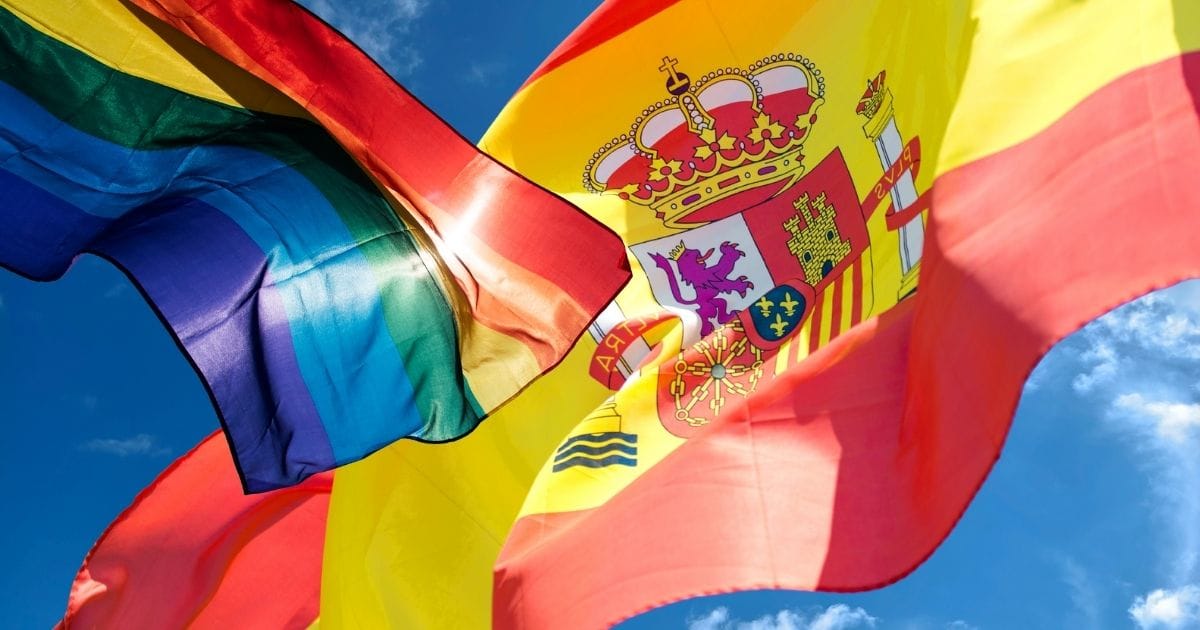
Spain has been ranked Europe’s leading country for LGBTIQ+ legal rights for the first time, overtaking Malta after a decade at the top of the continent’s Rainbow Map.
The LGBTIQ+ rights ranking in Spain comes from ILGA-Europe’s 2026 Rainbow Map, which assesses 49 European countries on laws and policies affecting lesbian, gay, bisexual, trans, intersex and queer people. Spain scored 89%, ahead of Malta on 88%, Iceland on 86%, and Belgium and Denmark on 85%.
The ranking is a significant moment for Spain, which has moved up four places and gained 11 percentage points in a year. However, campaigners warn that strong legal protection does not automatically mean everyone feels safe in daily life.
What readers need to know
Spain now sits at the top of ILGA-Europe’s Rainbow Map for 2026.
The ranking measures legal and policy protections across areas such as equality, non-discrimination, family rights, hate crime, legal gender recognition, bodily integrity and asylum. Spain’s score of 89% places it narrowly ahead of Malta, which had led the ranking for ten years.
El País reports that Spain’s rise reflects the implementation of equality action plans, the creation of an independent authority to address discrimination, the depathologisation of trans identity in the health system and wider regional protection laws.
Why Spain has moved ahead
ILGA-Europe says Spain has followed through on commitments set out in its 2023 LGBTI and trans laws, as well as the 2022 equal treatment and non-discrimination law.
The organisation also points to progress in Spain’s autonomous communities. After national reforms, 15 of Spain’s 17 regions now have LGBTI protections, according to ILGA-Europe’s country summary.
That regional detail matters. Spain’s legal protections do not come only from Madrid. They also depend heavily on autonomous communities, which manage many areas linked to education, health, social services, and public policy.
Spain leads internationally in the fight for rights of the LGBTI community
A European contrast
Spain’s rise comes at a time when LGBTIQ+ rights are under pressure elsewhere in Europe.
According to the 2026 Rainbow Map, France ranks 15th with 60%, while the United Kingdom is 22nd with 44%. Italy is much lower, in 36th place with 24%. At the bottom of the ranking are Belarus, Turkey, Azerbaijan, and Russia.
This wider European picture helps explain why Spain’s position is attracting attention. Its legal progress now stands out against a backdrop of stalled reforms and political pushback in several countries.
Legal rights do not remove everyday risk
Spain’s first-place ranking is important, but it should not be read as a claim that discrimination has disappeared.
El País notes that ILGA-Europe still sees areas where Spain needs to improve. One concern is the slow progress of a national plan to combat hate crimes against LGBTIQ+ people.
That distinction is crucial. Laws can create rights, protection, and redress. But feeling safe at work, at school, in a doctor’s surgery, in a small town or on a night out depends on how those rights are enforced and lived.
The non-binary recognition gap
Another area still missing from Spanish law is recognition of non-binary gender identities.
Countries such as Germany, Austria, Iceland, Malta, and Denmark already offer some form of recognition for people who do not identify exclusively as male or female. Spain has not yet introduced equivalent national recognition.
This is likely to remain part of the debate over Spain’s next stage of equality law. The country’s legal framework is now among Europe’s strongest, but campaigners argue that it still does not cover every identity or experience.
Why the ranking matters for residents and visitors
For foreign residents, students, remote workers and travellers, Spain’s ranking may confirm something many already feel: the country is often visibly open, especially in large cities and coastal areas.
Madrid, Barcelona, Valencia, Málaga, Sitges, Torremolinos and other destinations have long-established LGBTIQ+ communities, Pride events, associations and social spaces. But experiences can vary by region, town, workplace, and personal circumstances.
The ranking is therefore useful as a legal indicator. It is not a guarantee that every person’s experience will be easy or free from prejudice.
Spain’s progress has been political too
Spain’s recent progress has not happened without conflict.
El País reports that the national government has challenged regional attempts to roll back protections, including in Valencia and Madrid, where measures affecting conversion therapy, sexual diversity in schools and gender transition rights became legally contested.
That shows how fragile rights can become when they are pulled into regional and national politics. Spain may be leading Europe on paper, but the direction of future policy will still depend on courts, governments, and public pressure.
A country leading, but still being tested
Spain’s place at the top of the 2026 Rainbow Map is a clear sign of progress. It reflects years of legal change, activism, and institutional reforms.
Yet the next challenge is not simply to protect the ranking. It is to ensure that legal rights translate into safety, dignity, and equal treatment in ordinary life.
For Spain, the message is both positive and unfinished. The country now leads Europe for LGBTIQ+ legal protection, but the work of turning rights on paper into lived equality continues.