 Lorraine Williamson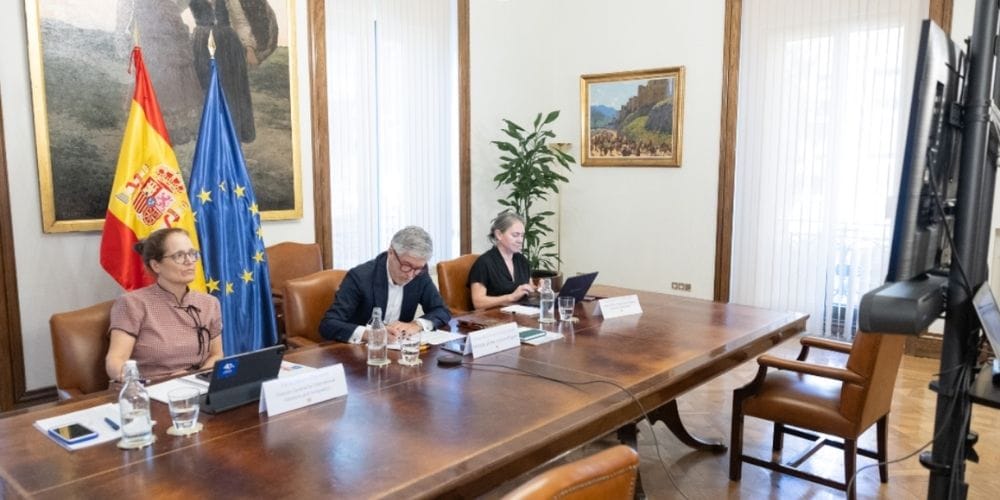
Ceuta is returning to a fragile normality, with most of those who crossed from Morocco now believed to have left the city. The political consequences are intensifying, however, as EU interior ministers meet to discuss border security, migration and the divided European response to the crisis.
Spanish police estimated on Sunday that about 73,500 people had returned to Morocco, although official accounts continue to differ over how many originally entered Ceuta and how many remain. The Government Delegation has put the number still in the city at approximately 2,500, while the Ceuta authorities have given a broader estimate of between 3,000 and 5,000.
Attempts to reach the enclave have slowed to small groups, with shops and public services are gradually returning to normal. Police, military personnel and emergency teams nevertheless remain visible throughout the city, while the temporary floating barrier installed beside the Tarajal breakwater continues to reinforce the coastal frontier.
The Spanish government says every person without a legal right to remain will be returned through the appropriate procedures, with Morocco’s cooperation. Foreign minister José Manuel Albares has defended the decision to maintain diplomatic contact with Rabat, arguing that it allowed the authorities to reduce the border pressure rapidly.
EU ministers confront divisions over Ceuta
Interior ministers from across the European Union are holding an extraordinary informal videoconference on Tuesday 4 August to examine developments in Ceuta. The meeting follows a request from Pedro Sánchez and other European leaders for a coordinated response to pressure at the EU’s external borders.
Spain is expected to seek a stronger declaration of solidarity while challenging governments that responded by imposing or proposing unilateral controls on travel from Spain. Sánchez has accused some countries of reacting through fear, misinformation and domestic political calculation rather than working through European institutions.
The dispute follows a letter backed by 22 European governments calling for tougher protection of the EU’s external borders. France, Portugal, Ireland and Luxembourg were among the countries that did not sign it, placing Ireland in a small group that resisted the most critical collective response to Spain.
European Commission president Ursula von der Leyen has since praised Spain and Morocco for regaining control of the situation. She also called for stronger external borders, improved surveillance and, where considered necessary, physical barriers at vulnerable entry points. Her position was outlined in a letter to Sánchez reported by El País.
Remaining migrants face different legal processes
Those still in Ceuta are not one uniform group. Some may leave voluntarily, while others face individual expulsion proceedings and have the right to present objections. People seeking international protection must have their claims assessed, and separate safeguards apply to unaccompanied children.
Ceuta has registered more than 860 unaccompanied minors following the crossings, placing intense pressure on accommodation and child protection services. Their cases cannot be handled through an automatic collective return, a principle reinforced by the Supreme Court’s ruling that the repatriation of children after the 2021 Ceuta crisis was unlawful because individual legal guarantees had not been observed. RTVE reported the Supreme Court judgment in January 2024.
Among the remaining adults are people from sub-Saharan African countries who say they fled war, persecution or extreme poverty. Their circumstances differ from those of Moroccan citizens who entered during the sudden opening of the frontier, meaning the authorities must establish each person’s nationality and legal position.
Court considers investigation into mass crossing
Spain’s National Court has asked the National Police for a report to help determine whether it has jurisdiction to investigate the events of 30 and 31 July. The preliminary proceedings follow allegations that the mass movement may have involved organised criminal activity or the deliberate use of migration to place pressure on Spain.
The request does not establish that a crime was committed or that the crossing was centrally organised. It is an initial step intended to clarify whether there is sufficient evidence and whether any alleged offences would fall within the National Court’s remit.
Morocco has blamed social media rumours and criminal networks for encouraging people to approach the border. Spanish officials have acknowledged that they did not anticipate the scale or speed of the crossings, leaving unresolved questions about intelligence failures and the actions of Moroccan security forces during the first hours of the crisis.
Misleading geography fuels international confusion
Some international television coverage and social media posts have suggested that migrants entered “northern Spain”. That description is geographically wrong.
Ceuta is a Spanish autonomous city on the North African coast, bordered by Morocco and separated from mainland Spain by the Strait of Gibraltar. It is Spanish and European Union territory, but it has a special border arrangement, and travellers moving from Ceuta to mainland Spain are subject to identity and document checks.
The distinction matters because the images did not show tens of thousands of people entering northern mainland Spain and then travelling freely across the country. and beyond The crossings occurred at a concentrated external border in North Africa, and the overwhelming majority of those involved have since returned to Morocco.
Political crisis outlasts the border emergency
The immediate humanitarian emergency has eased, but Ceuta is still dealing with the deaths, pressure on local services and the legal cases of those who remain. Authorities must also identify victims, support unaccompanied children and establish whether people seeking protection are entitled to remain.
For Spain, attention has now moved to Brussels. The government wants European support without accepting measures that treat the whole of Spain as a security risk, while other member states are demanding stronger controls and firmer return policies.
The outcome of Tuesday’s meeting is unlikely to settle those differences. It may, however, determine whether the EU responds collectively to the Ceuta crisis or allows national governments to continue pursuing separate and potentially conflicting measures.