 Lorraine Williamson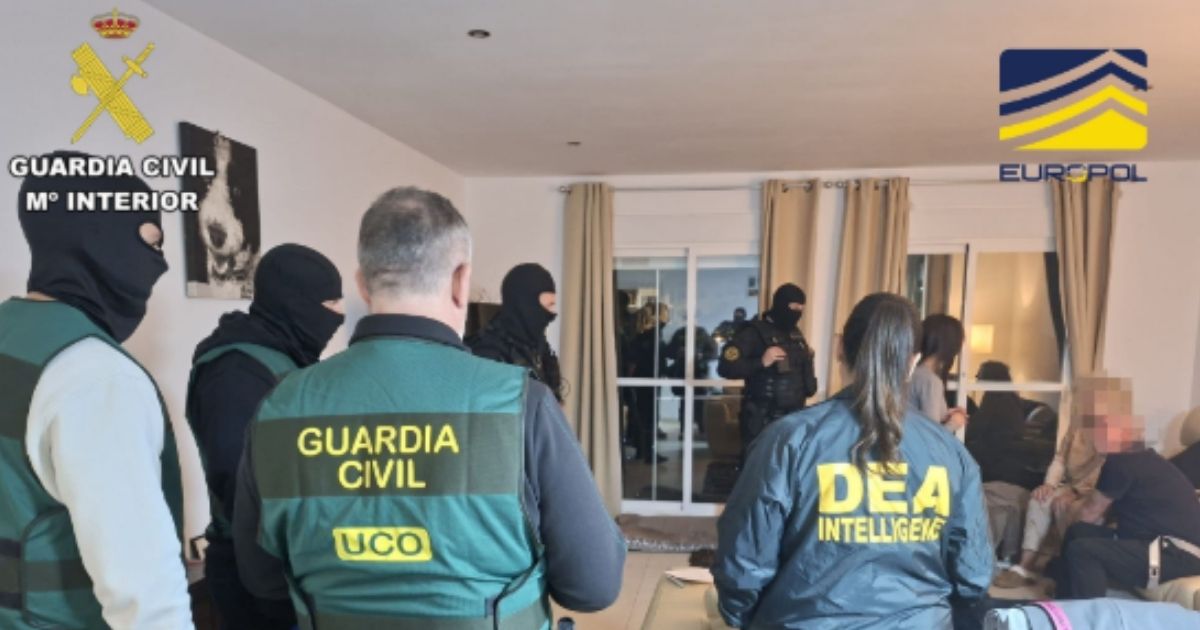
The Costa del Sol has once again found itself at the centre of a major international organised crime case, after Spain’s Guardia Civil said it had dismantled the Spanish structure of the notorious Lyons clan, a violent Scottish criminal network with deep roots in Málaga province.
According to the Guardia Civil, Operation Armorum culminated in 14 arrests across several countries, with 20 more people under investigation in Spain. Officers carried out 18 searches in Spain, mainly on the Costa del Sol and in Barcelona, and seized electronic devices, large amounts of cash, company documents, high-end watches, and cryptocurrency wallets. The force says the network’s Spanish foothold was central enough for Steven Lyons to coordinate much of the group’s illicit activity from the Costa del Sol.
The Costa del Sol was more than a backdrop
Earlier articles covered the first wave of arrests and then Lyons’ Bali detention and transfer. What has become clearer since then is the Spanish dimension: this was not just a Scottish gang with occasional links to Spain, but a transnational criminal organisation that investigators say used the Costa del Sol as a strategic base for money laundering, coordination and networking.
El País reported that Lyons had lived in Spain since 2006 after violence in Glasgow, and that after the fatal shooting of his brother Eddie Lyons Jr. in Fuengirola last May, he left the country for Dubai while allegedly continuing to reorganise and direct the group from there. Guardia Civil also highlights that the May 2025 double shooting in a beach bar in Fuengirola was one of the clearest recent examples of the violence surrounding these clans.
The case also underlines a long-running reality on the coast. For years, the Costa del Sol has attracted legitimate international business, tourism, and investment, but its global connections have also made it attractive to cross-border criminal groups looking for property, shell companies, and easy movement between jurisdictions. In that sense, the Lyons investigation fits a wider pattern Spanish authorities have been trying to break for years. Guardia Civil explicitly linked this case to earlier action against other British and Irish-led organised crime figures operating from Spain.
A three-year probe with international reach
Spanish authorities say the investigation lasted more than three years and was led by the UCO in Málaga under a court in Málaga, with support from Police Scotland, Europol, Eurojust, Turkey’s anti-narcotics police, Dubai police, the UK’s National Crime Agency, and the US Drug Enforcement Administration. Europol said the coordinated action on 27 March targeted the group’s criminal profits, with searches in the Málaga area and Barcelona and asset freezes in Turkey.
That matters because this was not a quick response to one violent episode. It was a long, financial, and intelligence-led investigation into how the clan allegedly operated across borders. Guardia Civil says the network focused mainly on drug trafficking and money laundering, while also using violence and intimidation to protect its interests.
Cadena SER reported that investigators’ preliminary estimate is that the group may have laundered close to €50 million, allegedly through a web of businesses including alcohol import firms, car hire companies, and golf-related ventures. El País also reported that investigators believe the laundering could exceed €50 million, based on shell companies and international financial movements tied to drug proceeds.
Steven Lyons is only part of the story
Steven Lyons remains the headline name, but the wider significance lies in the structure around him. Guardia Civil says he was detained in Indonesia with Spanish support and then transferred to the Netherlands under a European Arrest Warrant issued by Spain. His partner was also arrested in Dubai and described by the force as an active member of the organisation.
Associated Press reported that Lyons was arrested in Bali on 28 March after arriving from Singapore and was being sent on to face Spanish proceedings linked to drug trafficking and money laundering allegations. That development mattered in its own right, but the newer Spanish reporting shifts the focus back to what investigators say had been built on the Costa del Sol before and around that arrest.
Cadena SER says three suspected members of the clan remain on the run, which suggests this case may still have further chapters. Even so, the message from Spanish investigators is already clear: they believe they have broken the clan’s Spanish platform and hit a criminal network that had turned part of the Costa del Sol into a command point for international operations.
Joining up the dots
For readers who saw the first raid story and then the Bali arrest update, this is the piece that joins the dots. It explains why Spain’s role in the case matters, why the Costa del Sol keeps surfacing in major international investigations, and why this operation is being presented as more than just the detention of one fugitive. The real story now is that Spanish authorities say they have dismantled an organised criminal base on the coast after years of work, international coordination and financial investigation.