 Lorraine Williamson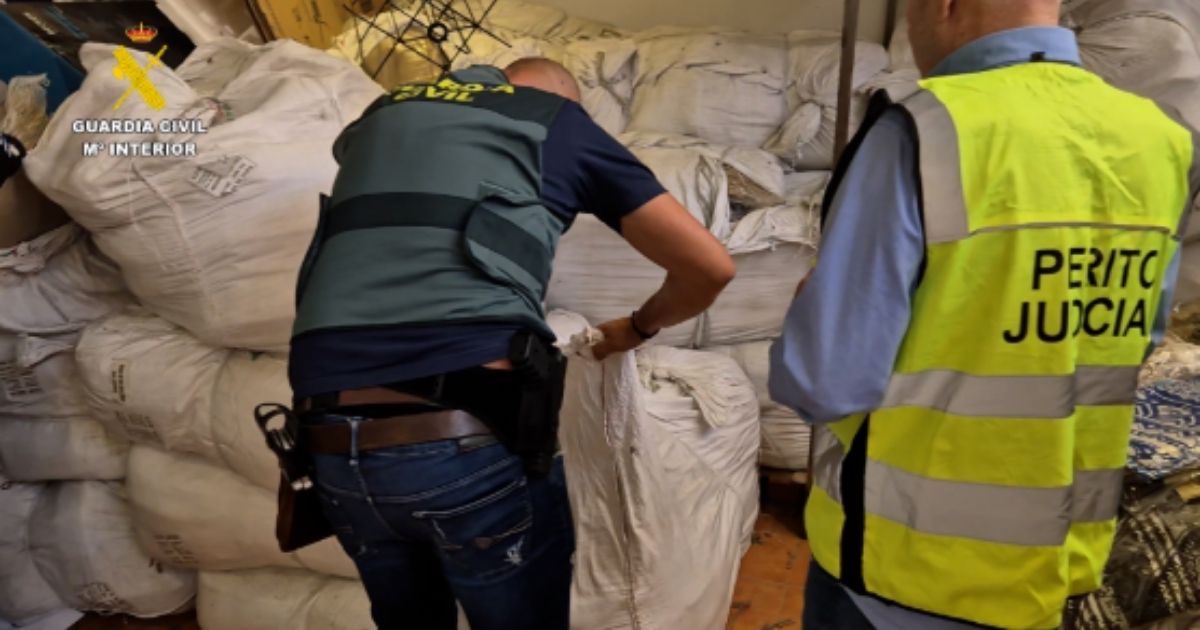
A clandestine workshop in Tenerife producing counterfeit clothing has been uncovered in a Guardia Civil operation that investigators say has exposed a significant production and distribution point for fake goods in the Canary Islands. Officers say they seized 70,000 counterfeit items valued at almost €7 million and investigated 19 people for alleged offences against industrial property.
The operation, known as LABEL, also involved inspections at 20 shops in Tenerife and La Palma. According to Guardia Civil, the network was linked to the sale and distribution of products imitating registered brands, with goods displayed and sold through a mix of commercial premises and storage sites.
A hidden workshop behind the shopfronts
The most striking detail is not the shop count but the alleged production base behind it. Guardia Civil says investigators located a premises in the south of Tenerife being used both as a distribution centre and as a clandestine workshop where fake clothing was manufactured before being sent out for sale in different shops.
Inside, officers found industrial screen-printing machines, presses, laser printers and computer equipment allegedly used to create the counterfeit material. They also seized more than €22,000 in cash, jewellery and several gold bars, with those items valued at over €300,000.
Why this matters beyond brand names
Counterfeit cases are often dismissed as low-level market trading or harmless imitation. Guardia Civil’s description suggests something much more organised. The scale of the seizure, the specialist equipment and the spread across more than one island point to a business model rather than a casual sideline.
A judicial expert specialising in trademarks and industrial property took part in the operation and certified that the seized products were fake. Among the goods identified were clothing, handbags, wallets and belts. After that expert assessment, Guardia Civil said the current market value of the counterfeit items approached €7 million.
Tourist retail and the counterfeit economy
This is one reason the story has wider relevance. Tenerife and La Palma are not only residential islands; they are also major visitor destinations where tourist shopping forms part of the local economy. A counterfeit network operating through retail outlets does not just affect luxury labels. It also undermines legitimate businesses and distorts local commerce.
Guardia Civil made that point directly, saying the operation was part of its wider effort to tackle commercial fraud, the underground economy and the damage caused to both consumers and lawful companies when fake products are sold as if they were genuine.
The scale of the operation
The investigation was carried out by the Fiscal Analysis and Investigation Unit of the fiscal section at Tenerife South Airport, with support from the corresponding borders unit at Tenerife North Airport and territorial fiscal and border patrol officers. That level of coordination helps explain how the operation moved beyond one shop or one warehouse and into what Guardia Civil says was a relevant production and distribution hub.
For readers, the story is also a reminder that counterfeit retail is rarely as simple as a suspect bargain on a shelf. Behind the discount price can be a chain of illicit production, trademark abuse and undeclared cash flow that stretches much further than the storefront.
A warning for consumers as well as traders
Authorities often stress the consumer risk in counterfeit cases, and not only because buyers may be misled. Fake goods can come with no guarantees over origin, safety standards or traceability, and the profits may feed wider illegal activity. Guardia Civil says part of the purpose of this operation is to raise awareness of those consequences.
The broader picture is clear enough. Investigators believe they have dismantled an important fake-goods node in the Canary Islands, but the demand that sustains this trade is still there. That is why cases like this matter. They are not just about labels and logos. They are about what kind of retail economy is allowed to flourish in places that rely heavily on reputation, tourism and trust.
Catalonia counterfeit tobacco seizure nets 20 arrests