 Lorraine Williamson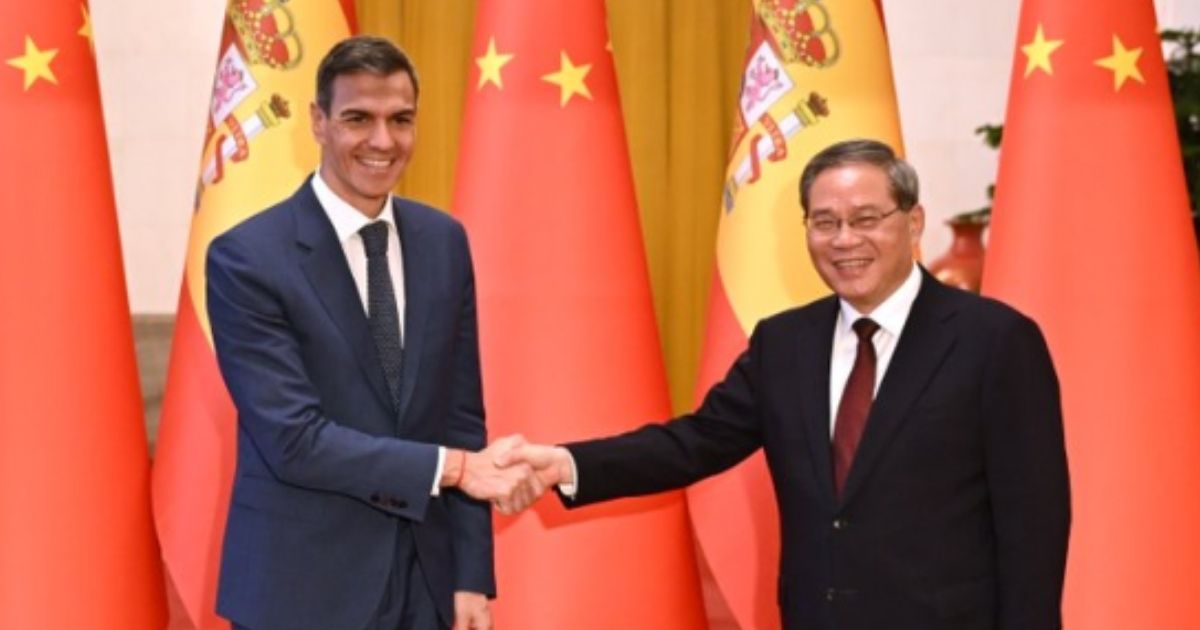
China’s president Xi Jinping has told Pedro Sánchez that Spain is on the “right side of history”, as the two leaders used a meeting in Beijing to call for stronger ties and a defence of multilateralism in an increasingly unstable world.
The phrase gives Sánchez’s China visit a sharper political edge. This was not just a trade meeting. It was a deliberate show of alignment between Madrid and Beijing at a moment when Spain is trying to present itself as an independent European voice on global conflict, trade and international law.
Nineteen agreements signed in Beijing
After the meeting, Spain and China signed 19 agreements, including 10 economic deals, according to Reuters and Spanish national reporting. The aim is to deepen cooperation while helping Spain reduce a trade imbalance that has become increasingly difficult for Madrid to ignore.
Sánchez has been pressing China to open more space for Spanish exports, especially in the agri-food sector, while also encouraging Chinese investment in Spain and Europe. Reuters reported that Spain’s trade deficit with China reached almost $50 billion in 2025, making the economic side of the visit central to Madrid’s agenda.
Spain seeks a bigger role between China, Europe and the US
The visit comes at a delicate diplomatic moment. Sánchez is making his fourth visit to China in four years, while Spain continues to take a more independent line from Washington on several international issues. Reuters has described Spain as one of Europe’s strongest advocates for treating China as a strategic partner, rather than only as a rival.
That position carries risks. It may strengthen Spain’s economic ties with Beijing, but it can also irritate allies who see China through a more adversarial lens. For Sánchez, the calculation appears clear: Spain wants to keep commercial doors open while arguing that global problems cannot be solved without Chinese involvement.
Peace, trade and the “law of the jungle”
Xi’s comment about Spain being on the “right side of history” came as both leaders warned against a return to power politics. Spanish reports said Xi urged cooperation to prevent the international order from sliding into what he called the “law of the jungle”.
Sánchez also used the visit to urge China to play a stronger role in resolving global conflicts, including the Middle East and Ukraine. AP reported that he argued China has unique diplomatic influence and should help defend international law at a time of widening instability.
Why this matters for Spain
For Spain, the China relationship is now about far more than symbolism. It touches exports, investment, energy, infrastructure, food markets and Madrid’s place inside a divided international order.
The challenge is balance. Spain wants better access to China’s market and closer cooperation with Beijing, but it also needs to remain aligned with Europe and manage tensions with Washington. That is why this visit matters: it shows Sánchez trying to position Spain as a bridge between powers, not simply a follower of one bloc.
Whether that strategy brings influence or friction will become clearer in the months ahead. For now, the message from Beijing is unmistakable: China sees Spain as a useful European partner, and Sánchez appears willing to lean into that role.