 Lorraine Williamson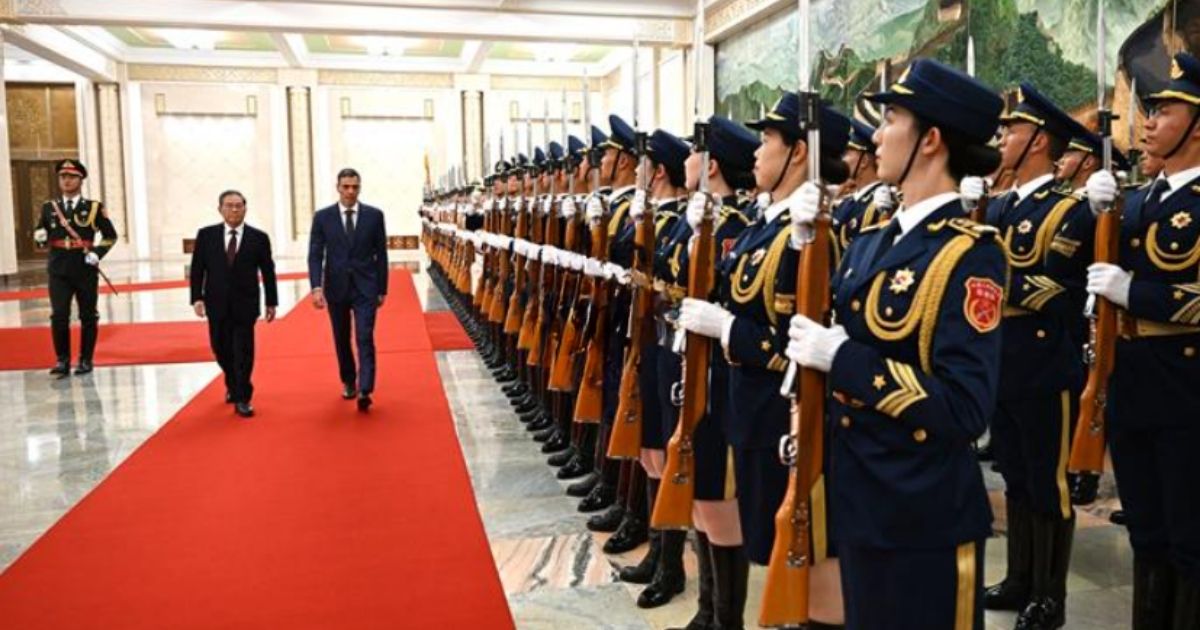
Spain’s latest national security assessment has placed Russia at the centre of Europe’s risk map, while also exposing a more delicate dilemma closer to Madrid: how to manage growing economic ties with China while security concerns remain unresolved.
Spain´s security report 2025, published by the Departamento de Seguridad Nacional, was approved by the Consejo de Seguridad Nacional in April and released this Wednesday, 13 May. It reviews 16 areas of national security, with input from government ministries and the Centro Nacional de Inteligencia.
Its message is clear on Russia. The threat is no longer limited to conventional military pressure or the war in Ukraine. Spain is also watching cyberattacks, sabotage, disinformation, foreign interference, and pressure on critical infrastructure.
At a glance
- Spain’s latest national security report warns of foreign espionage, cyberattacks, and hybrid threats.
- Russia is described as the most intense direct threat to European security.
- China remains a concern for Spanish intelligence, especially around EU and NATO decisions.
- At the same time, Madrid is deepening trade, investment, and diplomatic cooperation with Beijing.
Russia remains the sharper security threat
Spanish media reports on the document say the CNI recorded 108 actions by foreign intelligence services in 2025, down from 121 the previous year. However, the report warns that this does not mean the overall threat has fallen. Instead, more activity is shifting into harder-to-detect “grey zone” operations.
These include cyberattacks, disinformation, sabotage, recruitment through digital channels and the use of intermediaries to make attribution harder.
According to reports based on the document, Russian intelligence services, particularly the GRU and SVR, intensified their activity in Europe during 2025. The aim was not only to gather information, but also to test state responses, create pressure and weaken public trust in institutions.
Elections seen as vulnerable moments
The report also highlights election periods as especially sensitive.
VozPópuli reports that Spain’s security assessment warns of foreign campaigns using cyberattacks, disinformation, hacktivism, hidden financing and political pressure to influence public opinion and democratic processes.
Public administrations remain a key target. Attackers may try to steal credentials, compromise email servers or gain access to more sensitive networks.
For Spain, this matters because the risk is no longer remote. Hybrid operations are designed to be deniable, confusing and hard to prove in real time.
China presents a more complicated picture
China occupies a different place in the Spanish debate.
It is not framed in the same way as Russia. Yet Spanish security analysis continues to identify Chinese interest in EU and NATO decision-making, as well as political, commercial and diaspora-related issues.
That creates a more complicated policy problem. China is a security concern, but also a major trading partner, investor and industrial player.
Spain is therefore trying to walk a narrow line: cautious on intelligence and strategic dependency, but open to cooperation where there is an economic advantage.
Madrid and Beijing are moving closer
That balance was visible during Pedro Sánchez’s April visit to Beijing.
La Moncloa said Spain and China signed 19 agreements during the trip, including a Diplomatic Strategic Dialogue Mechanism designed to give relations a more regular high-level structure.
Sánchez also said Spain wanted a “much closer, much healthier, and much more balanced” economic relationship with China. The government presented the visit as a way to strengthen cooperation while seeking better access for Spanish products and more balanced trade.
The message was pragmatic. Spain wants Chinese investment, but also wants it to create local jobs, technology transfer and stronger Spanish supply chains.
Electric cars show the economic pull
The clearest example is the electric vehicle industry.
Chinese carmakers are looking for ways to produce inside Europe, partly to avoid EU tariffs on Chinese-made electric vehicles. Reuters reported this month that Stellantis and China’s Leapmotor plan to build two electric models at the Zaragoza plant in Spain.
That type of investment is attractive for Spain. It can protect industrial jobs, fill underused factory capacity and place the country at the centre of Europe’s electric car transition.
But it also feeds the wider question running through the security debate. How much strategic dependency is acceptable when technology, industry and geopolitics are now so closely linked?
The Huawei question has not gone away
Huawei remains the most sensitive symbol of this wider dilemma.
The Chinese technology group has long had a presence in Spain’s telecoms sector. It has also faced scrutiny across Europe and the United States because of concerns over sensitive infrastructure, data security and possible state influence.
The debate is not simply about one company. It is about whether countries can separate commercial advantage from security risk when technology infrastructure is involved.
Spain is not alone in facing that problem. The same discussion is taking place across the EU, where governments are trying to protect strategic sectors without cutting themselves off from global trade.
A changing world order reaches Spain
Spain´s security report 2025 shows how much the international risk map has changed.
Russia is viewed as the more direct and destabilising threat. China is harder to classify. It is a competitor, an intelligence concern, a trade partner, and a potential source of investment at the same time.
For Spain, that means national security is no longer only about borders, armies, or police operations. It is also about data, ports, cables, factories, elections, supply chains, and public trust.
Spain’s balancing act is only beginning
The report does not offer an easy answer. Nor could it.
Spain wants to remain anchored in the EU and NATO while also defending its own economic interests in a multipolar world. That means working with China in some areas, while watching risks in others.
Russia may remain the most urgent threat. But China is the longer and more complicated test of Spain’s security strategy.