 Lorraine Williamson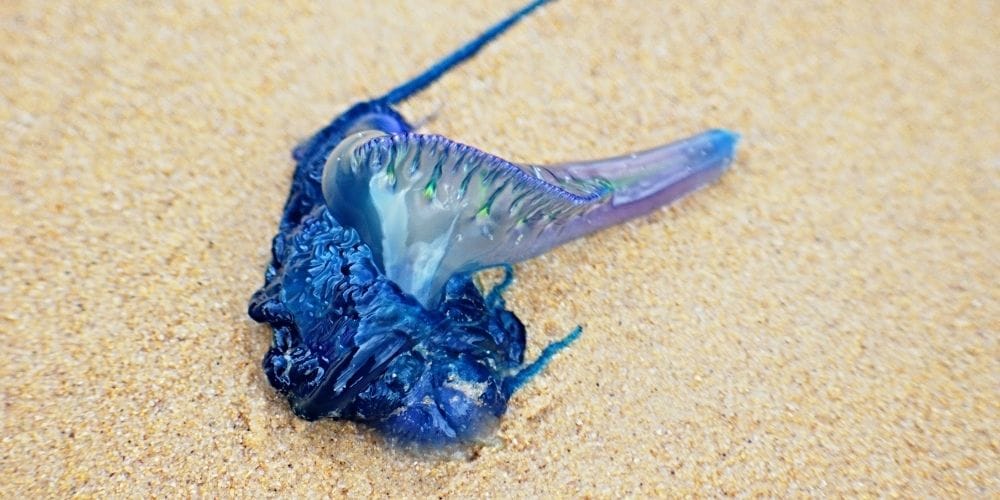
Repeated sightings of Portuguese man o’ war have prompted San Sebastián to change how its beaches are managed, allowing lifeguards to keep bathing areas open when smaller specimens present a limited risk. The distinctive blue-purple organisms have also appeared elsewhere along Spain’s northern coast this summer, bringing renewed warnings for swimmers and anyone walking close to the waterline.
The Portuguese man o’ war, known in Spanish as the carabela portuguesa, is often described as a jellyfish but is actually a colony of specialised organisms working together. Its floating body acts like a sail, allowing winds and surface currents to carry it towards the coast, while its trailing tentacles contain venom capable of causing painful injuries.
Sightings have been particularly persistent along the Basque coast. San Sebastián City Council says most of the specimens found on its beaches have been small, generally measuring less than 10 centimetres across, and that their stings have usually been relatively mild.
That has led the council to apply a more proportionate system rather than closing a beach automatically whenever several small specimens are detected. Lifeguards will now assess the size, number and likely risk, with beach conditions reviewed at least once every two hours.
Red flags reserved for the highest-risk sightings
Under the revised protocol, a yellow warning flag and the separate jellyfish flag will normally be displayed when smaller Portuguese man o’ war are present, allowing people to enter the water with caution.
A red flag and bathing ban will be imposed when the risk is considered greater. The official thresholds include 10 or more large specimens at Ondarreta, 15 or more at La Concha or Zurriola, and two or more near Santa Clara Island.
A closure may also follow a severe whip-like sting if further specimens are seen or the one responsible cannot be removed. After a red flag has been lowered, a beach must move through a yellow-warning period before returning to green. San Sebastián City Council has published the full protocol on its website.
The council stresses that the new system is intended to prevent unnecessary closures while preserving stronger restrictions when swimmers face a significant danger. People should always follow the flags and instructions issued by lifeguards, as conditions can change quickly.
Sightings extend along the Cantabrian coast
The phenomenon is not confined to San Sebastián. Portuguese man o’ war have been reported at several beaches in the Basque Country and Cantabria during the summer, with emergency and lifeguard teams treating numerous people after contact with their tentacles.
Cantabria recorded 236 treatments between the first reported incident on 4 July and 13 July, including 135 in a single Saturday. Beaches affected during that period included El Sardinero in Santander and La Concha in Suances, although the number of incidents varied sharply from one day to the next.
Around 40 stings had also been reported on Basque beaches by mid-July, according to RTVE. Researchers cited by the broadcaster said unusually warm water may be helping the organisms reproduce closer to the Basque coast, while winds and currents continue to influence where they eventually reach land.
Their presence on one beach does not mean neighbouring bathing areas will necessarily be affected. Wind direction, currents and local sea conditions can cause concentrations to appear and disappear within hours.
MedusApp shows recent reports near Spanish beaches
Beachgoers can also consult MedusApp, a free application and website that collects public reports of jellyfish and Portuguese man o’ war sightings.
Users can submit a photograph and location when they spot one in the water or washed ashore. Reports then appear on a public map, with filters available for species, dates and individual beaches. Some records are marked as verified when the photograph, location and timing can be validated.
The map also allows users to report that a beach appears clear, while the app provides species information and guidance on treating stings. Its developers describe it as a citizen-science project that helps researchers study marine distribution while giving the public more timely information. The live map and download links are available through the official MedusApp website.
Because the map depends partly on public submissions, it should be used as an additional guide rather than a replacement for official beach flags, lifeguard instructions, or municipal warnings. A lack of recent reports does not guarantee that the water is clear.
Never touch one, even if it appears dead
Portuguese man o’ war can still sting after washing onto the sand, and detached pieces of tentacle may remain active in shallow water or around the shoreline.
The Ministry of Health advises people not to handle specimens even when they appear dead or fragmented. Anyone who sees one should alert a lifeguard rather than attempting to remove it.
Extra care is needed with children, who may be attracted by the organism’s bright blue and violet colours. People should also avoid games close to the waterline when specimens or tentacle fragments have been reported nearby.
What to do after a sting
Anyone stung should leave the water and seek help from a lifeguard. The affected area should be washed gently with seawater or saline solution without rubbing it.
Fresh water should not be used because it can cause remaining stinging cells to release more venom. Any visible tentacle fragments should be removed carefully with tweezers or a similar object, never with bare hands.
Cold can then be applied for up to 20 minutes using ice enclosed in a plastic bag and wrapped to prevent direct contact with the skin. The wound should not be scratched or exposed to strong sunlight.
Urgent medical assistance is needed if the pain is severe, the person’s condition worsens or symptoms such as breathing difficulties, dizziness, nausea or a broader allergic reaction develop. Children, older people and anyone with allergies or heart problems should be watched particularly carefully. The Ministry of Health publishes full official advice on jellyfish and Portuguese man o’ war stings.
Sightings are likely to continue shifting between beaches as winds and currents change. For swimmers, the safest approach is to check local warnings on arrival, consult recent reports and treat every specimen on the sand or in the water as potentially dangerous.