 Lorraine Williamson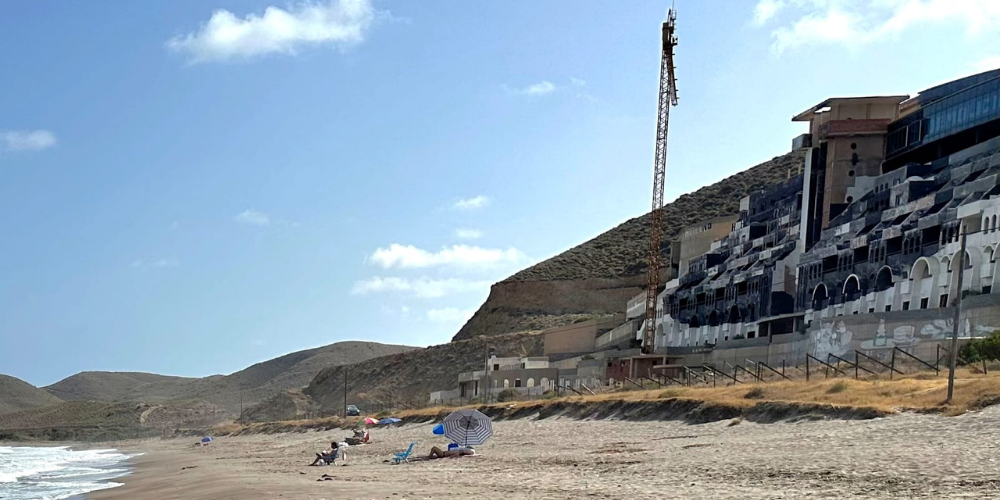
The long-running battle over the unfinished El Algarrobico hotel in Carboneras, Almería, has taken another major step towards demolition, two decades after work was halted beside the protected Cabo de Gata-Níjar Natural Park.
Spain’s central government and the Junta de Andalucía have asked the Andalucian high court to help clear the remaining legal obstacle after Carboneras town council delayed a vote on annulling the hotel’s 2003 building licence.
The latest move follows a fresh legal push over the hotel’s 2003 building licence. The Consejo Consultivo de Andalucía has already concluded that the licence is null, a key step in the process of dismantling the building and restoring the beach. However, the demolition itself remains dependent on the final execution of legal and administrative steps, including the formal cancellation of the licence and coordination between public administrations.
El Algarrobico was planned as a large seaside hotel complex on the beach of the same name, close to Carboneras, in the province of Almería. Construction was halted in 2006 when the building was almost complete, and the case has since become a landmark dispute over planning, coastal protection and the limits of tourist development in Spain.
The hotel sits in one of Andalucía’s most sensitive landscapes. Cabo de Gata-Níjar Natural Park is known for volcanic cliffs, arid hills, protected coastline and rare habitats, making the unfinished building especially controversial. For environmental groups, its removal has long been seen not only as a local issue, but as a test of whether Spain can enforce coastal protection rules after illegal or disputed developments have already been built.
Courts asked to unblock the next step
The issue now sits once again with the Tribunal Superior de Justicia de Andalucía, the region’s high court. Both Spain’s Ministry for Ecological Transition and the Junta de Andalucía have backed the court route after Carboneras town council delayed a vote that was expected to annul the hotel’s licence.
That council vote had been viewed as a necessary step towards finally dismantling the structure. Instead, the postponement created another delay in a case that has already stretched across governments, court rulings and political rows.
According to Spanish reporting, the central government has asked the court to require Carboneras council to hold a new session and cancel the licence. If the council does not comply, the court could be asked to act directly and remove the licence itself, avoiding another long round of local delays.
Greenpeace, which has campaigned against El Algarrobico for years, has also pushed for direct judicial action. The environmental organisation argues that the licence should no longer be treated as a matter open to further political manoeuvring, after years of court decisions and administrative proceedings.
A hotel that became a national symbol
The unfinished hotel is often described in Spain as a symbol of the “ladrillazo”, the building boom that reshaped large stretches of the Spanish coast before the financial crisis. Although many coastal projects were legal, El Algarrobico became a reference point for the most controversial side of that period: large developments promoted in fragile areas, later trapped in legal battles.
The licence was granted in 2003, but later rulings and reviews found serious problems with the development. The land has been treated by courts and environmental campaigners as protected and non-urbanisable, while the hotel’s position close to the shoreline has also raised issues under coastal protection law.
Over the years, the case has passed through different legal routes. There have been rulings on the classification of the land, the validity of the building licence, the role of Carboneras council, and whether the building can be demolished before all administrative steps are complete. That slow, complex path explains why the hotel has remained standing long after work stopped.
The latest legal development is important because the building licence has been one of the main obstacles to demolition. If it is formally annulled and the remaining procedures are completed, the focus can shift from whether the building can be removed to how and when the demolition and environmental restoration will take place.
Restoration of the beach remains the final goal
The end point sought by environmental campaigners is not simply the removal of concrete. It is the recovery of the protected beach and surrounding landscape. Under earlier cooperation arrangements between the Spanish Government and the Junta de Andalucía, demolition, debris removal and environmental restoration would require coordination between the two administrations.
That process is likely to be expensive and technically complex. The structure is large, close to the coast and located in an environmentally sensitive area. Any demolition plan would need to deal not only with dismantling the building, but also with waste management, access, safety and the restoration of the natural terrain.
For residents and visitors in Almería, the case has become part of the identity of the coastline itself. The sight of the unfinished hotel above El Algarrobico beach has long stood in sharp contrast to the wild, open landscapes that draw people to Cabo de Gata.
A dispute that has lasted more than 20 years
The key question now is whether the Andalucian high court will force the licence issue forward and prevent further delay. If the court accepts the route backed by the central government, the Junta and Greenpeace, Carboneras council could be ordered to act quickly, or the court may take direct steps to execute the earlier rulings.
That would not necessarily mean immediate demolition, but it would mark one of the clearest advances yet in a dispute that has lasted more than 20 years. For environmental groups, the legal position is already clear enough: El Algarrobico should come down, and the protected coastline should be restored.
For now, the hotel remains standing. But after years of political hesitation, legal appeals and missed deadlines, the pressure to bring Spain’s most infamous unfinished coastal hotel saga to an end is growing again.