 Lorraine Williamson
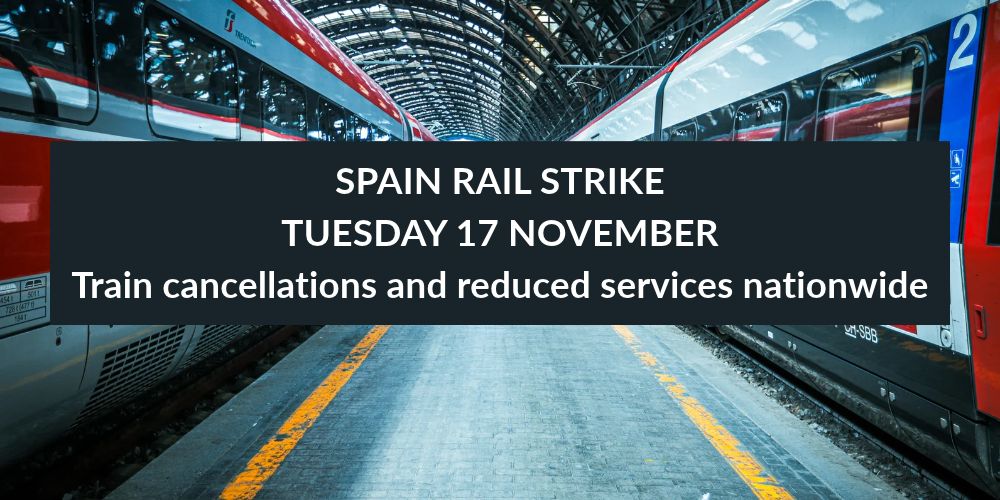
A nationwide railway strike is set to disrupt train services across Spain on Tuesday 17 November, with reduced timetables affecting commuter, regional and high-speed journeys. Unions confirmed on Monday that the action would go ahead despite progress in negotiations with the government, leaving passengers advised to check their trains before travelling.
The industrial action is scheduled to run from midnight until 11.59 pm on Tuesday, affecting Renfe services throughout Spain and potentially disrupting journeys operated by other railway companies. The Ministry of Transport has established minimum service levels, but these do not guarantee that every scheduled train will operate.
Passengers travelling to work, airports or other cities could face cancellations, altered departure times and longer journeys. Renfe has published information about the services expected to run, while travellers using Iryo or Ouigo should check directly with their operators.
How many trains will operate during the strike?
According to Renfe’s official strike announcement, minimum services on most of its network will vary according to the type of train and the time of day. Commuter services will be particularly affected outside the morning and evening rush hours.
The published minimum service levels are:
- Cercanías commuter trains: 75% during peak hours and 50% at other times.
- Media Distancia regional trains: An average of 65%.
- AVE and other long-distance services: 72%.
- Freight trains: 26%.
For Cercanías services covered by the national arrangements, peak hours are defined as 6.00 am–9.00 am, 1.30 pm–3.30 pm and 6.30 pm–8.30 pm. Different regional minimum-service arrangements may apply in Catalonia and the Basque Country, making it important to check individual services rather than rely solely on national percentages.
The reductions mean that a substantial number of trains will not operate as originally scheduled. Passengers should consult the official service lists and check their bookings before setting out.
Why are railway workers striking?
The dispute centres on railway safety, infrastructure maintenance and staffing levels following a series of serious accidents on Spain’s rail network. Unions argue that additional investment and stronger safety measures are needed, alongside improvements in working conditions for employees responsible for operating and maintaining the system.
The demands have become particularly urgent following the fatal railway accidents at Adamuz in Córdoba and Urda in Toledo. Workers say these incidents have exposed longstanding concerns about the condition of infrastructure, maintenance arrangements and the resources available to railway staff.
Talks with the Ministry of Transport have continued, and unions acknowledge that progress has been made. However, representatives say several important commitments have yet to be formally approved and implemented, including measures relating to maintenance investment and staffing.
At a demonstration in Madrid’s Atocha station on Monday, union representatives said the advances were insufficient to justify cancelling Tuesday’s action. They also called for further scrutiny of railway infrastructure, rolling stock and working conditions.
Will AVE, Iryo and Ouigo trains be affected?
The disruption is not confined to conventional Renfe services. High-speed and long-distance passengers may also face cancellations, with reduced operations planned by the country’s principal train companies.
Renfe’s national minimum-service arrangements provide for 72% of its high-speed and long-distance trains to operate. Iryo expects to run 28 of its 40 scheduled trains, while Ouigo plans to operate 17 of its 27 services.
These figures describe the operators’ planned services rather than a guarantee that individual journeys will run without disruption. Travellers should check the status of their particular train, especially when connecting with flights, appointments or other transport.
What happens if your train is cancelled?
Passengers whose trains are cancelled because of the strike should contact the operator that issued their ticket to establish their options. Depending on the circumstances, these may include a refund or alternative transport arrangements.
EU rail passenger rights provide protections when services are cancelled or significantly delayed, although the remedies available depend on the journey and the circumstances. Travellers should retain their booking details, cancellation notifications and receipts for any additional expenses.
For the latest information, passengers can check Renfe, Iryo or Ouigo directly. Renfe’s official strike announcement also includes downloadable lists of the trains scheduled to operate under the minimum-service arrangements.
Madrid–Ávila trains disrupted after freight derailment
What passengers should do before tomorrow
Anyone planning to travel by rail on Tuesday should check their booking tonight and again before leaving home. Allowing additional time, considering alternative transport and monitoring operator announcements could help reduce the impact of cancellations or delays.
The strike is currently expected to proceed for the full day, although negotiations may continue. Any agreement reached before or during the action could change the arrangements, so passengers should follow official updates rather than assume their original timetable remains valid.