 Lorraine Williamson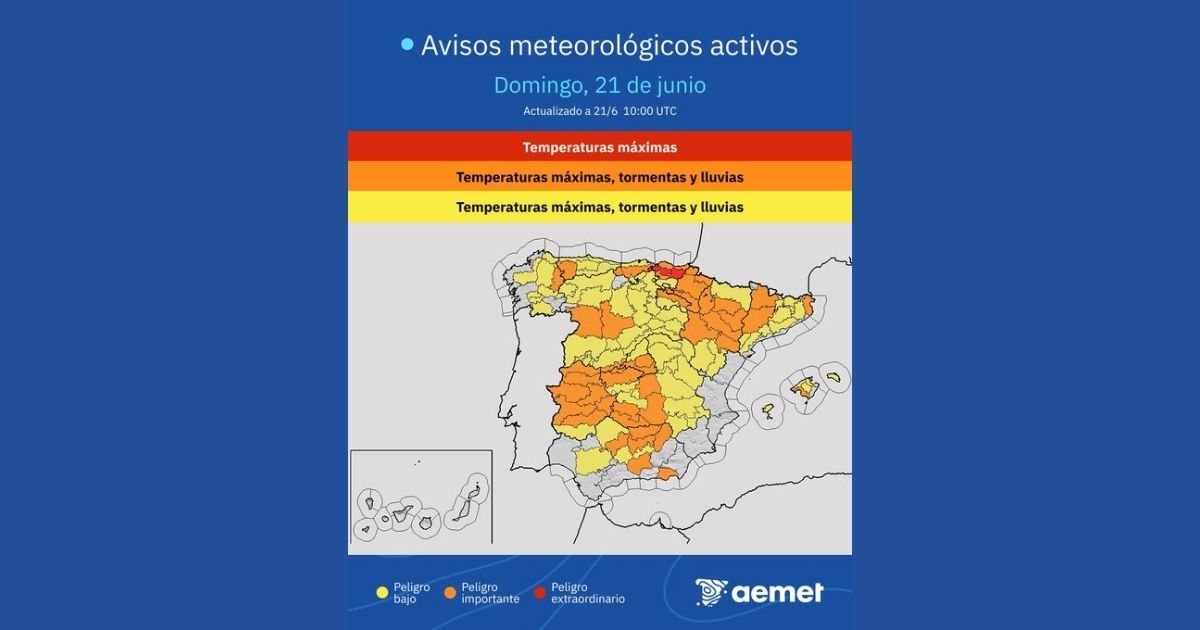
Spain has entered its first official heatwave of the summer, with health warnings, very warm nights and temperatures expected to push June towards record-breaking levels.
AEMET’s special heatwave notice is now active for the Peninsula and Balearic Islands, with the episode expected to last from Sunday 21 June until at least Wednesday 24 June.
The change is important because this is no longer a forecast in the distance. The heatwave has begun, and it coincides with the start of astronomical summer, school holiday movement, beach plans and the build-up to San Juan celebrations across Spain.
Heatwave begins on the first day of summer
Summer officially began in Spain on Sunday, 21 June, and it has arrived with an immediate heat warning.
AEMET says the episode will mainly affect the southwest quadrant of the Peninsula, the Ebro valley, depressions in the northeast, the eastern Cantabrian area and inland areas of the Balearic Islands. The agency expects widespread high temperatures, with many inland areas reaching or exceeding 35C to 37C. In the most affected valleys, maximum temperatures may climb to around 40C or above during the episode.
The heat is expected to intensify further on Monday and Tuesday in several areas, with AEMET warning that the episode may not begin to ease widely until later next week.
June could become Spain’s hottest since 1950
This heatwave is arriving during an already exceptional month.
El País reported on Sunday that Spain is heading into the episode with June already on course to become the hottest since national records began in 1950. The report, citing AEMET meteorologist José Ángel Núñez, said temperatures in the Peninsula are not expected to begin falling until Thursday, first in the west and north before relief reaches Mediterranean areas. The same report said around 21.9 million people, roughly 46% of Spain’s population, are living in areas with medium or high health risk from heat this Sunday.
That means it is now a public health issue, especially for elderly people, babies, young children, pregnant women, outdoor workers and anyone with heart, respiratory or chronic health conditions.
Why the nights matter as much as the afternoons
Heatwaves become more dangerous when the temperature remains high overnight.
During the day, people can often change plans, find shade or avoid the hottest hours. At night, however, homes may not cool down properly, especially in cities, top-floor flats or buildings without air conditioning.
AEMET has warned of very warm nights during this episode. That matters because the body has less chance to recover, and the health impact can build day after day.
Spain’s Ministry of Health says exposure to excessive heat can cause cramps, dehydration, heat exhaustion, sunstroke and heatstroke, with the impact influenced by age, underlying illness and other risk factors.
The Ministry’s current extreme-heat system also works through health-risk zones, known as meteosalud zones, which classify areas according to the level of health risk from heat.
Events already affected by the heat
The heat is also beginning to affect public events.
In Madrid, the planned public screening of Spain’s World Cup match in Plaza de Colón was cancelled because of high temperatures and the activation of heat-risk measures. Spanish reports said authorities advised fans to follow the match in cooler spaces rather than gather outdoors in the afternoon heat. That decision shows how quickly extreme heat can disrupt summer plans, even when the event itself is not directly weather-dependent.
For residents and visitors, the same principle applies to beach trips, walking routes, terraces, outdoor sports, queues, festivals and San Juan preparations.
If an activity means standing in full sun for a long period, travelling at peak heat or spending hours outside with limited shade, it now needs a rethink.
Storms and fire risk add to the warning
AEMET’s Sunday forecast also points to storms and heavy showers in parts of central and northwestern Spain, while the broader heatwave episode is expected to increase wildfire risk. This combination can be complicated. Heat dries vegetation and raises fire danger, while storms can bring lightning, gusty winds and sudden local changes in conditions.
AEMET’s special notice has also warned of the possible occurrence of dry storms or storms with little rain during the heatwave episode.
Anyone heading to rural areas, campsites, reservoirs or natural parks should check local fire restrictions before travelling. Barbecues, discarded cigarettes, fireworks, glass bottles and vehicles parked on dry grass can all create serious risk in hot, dry conditions.
What people should do today
The basic advice is simple, but it matters more during the first serious heatwave of the summer.
Drink water regularly, even if you do not feel thirsty. Avoid strenuous activity during the hottest hours. Close blinds or shutters during the day and ventilate when temperatures fall. Wear light clothing, seek shade and check on older relatives, neighbours or anyone living alone.
Children and pets should never be left in parked vehicles, even for a short time.
People taking medication, working outdoors or managing chronic health conditions should be especially careful. Heat can affect the body quickly, and symptoms such as dizziness, confusion, weakness, headache, rapid pulse or nausea should not be ignored.
If someone appears to be suffering from heatstroke, call emergency services on 112.
San Juan celebrations need extra care
The timing of the heatwave is especially relevant because San Juan celebrations are approaching.
Across Spain, people are preparing for beach gatherings, bonfires, fireworks, midnight swims and outdoor events on the night of 23 June into 24 June. But this year, those celebrations fall during a period of very high temperatures and rising fire risk.
Before heading out, check local council rules on bonfires, barbecues, fireworks, alcohol, glass bottles and beach access. Some municipalities may tighten restrictions because of heat, safety or cleaning concerns.
Night swimming also needs caution. Heat, crowds, alcohol, darkness and sea currents can be a dangerous combination, especially after recent drowning incidents at the start of the summer season.
San Juan can still be enjoyed, but the message this year is clear: respect the fire, respect the water and take the heat seriously.
A heatwave that marks the start of summer
Spain is used to hot summers, but the timing and intensity of this episode make it significant.
The first official heatwave has arrived exactly as summer begins, during a month that may already be heading for historic heat levels. Millions are now living in areas with medium or high health risk, and temperatures are expected to remain extremely high for several days.
For many people, this will mean changing routines rather than cancelling life completely: earlier walks, shaded plans, cooler indoor spaces, more water, fewer risks and extra attention to vulnerable people.