 Lorraine Williamson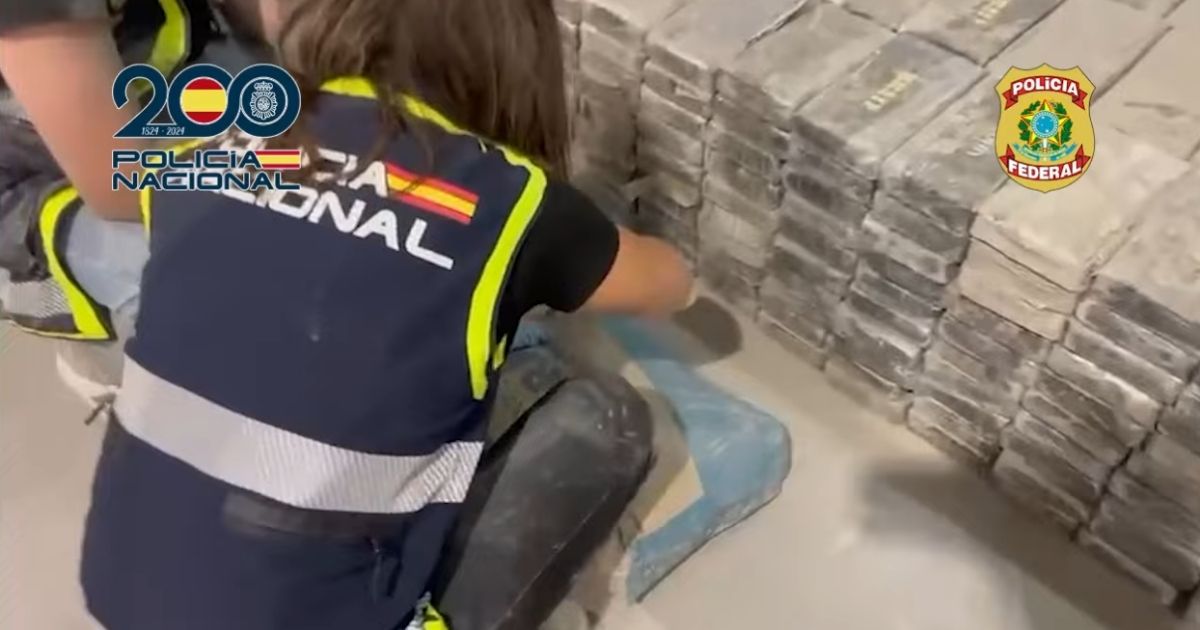
A major Marbella cocaine haul has put the Costa del Sol back in the spotlight after Spanish police seized 1.5 tonnes of cocaine hidden inside sacks of cement in an operation linked to an international criminal network with ties to the so-called mocromafia. The shipment entered Spain through the port of Algeciras before being moved by road to an industrial unit in Marbella.
According to Policía Nacional, five people were arrested in Málaga province during the joint operation with Brazil’s Federal Police. Investigators said the cocaine had arrived from Brazil concealed in a consignment of cement and was later stored in Marbella while members of the network prepared to recover it.
Hidden inside 1,000 cement sacks
Police said the organisation used a company with the appearance of legitimacy, based in the German city of Bremen, to cover the transport of the shipment. The network was allegedly led by a man with links to the mocromafia who was based between the Netherlands and Dubai. Officers said three men living in Germany travelled to the Costa del Sol to retrieve the drugs.
The force said officers traced the stash to a warehouse in Marbella, where they carried out a raid and found 1,500 kilos of cocaine divided into packages and hidden inside 1,000 sacks of cement. The sacks had been marked so that those extracting the drugs could identify which ones contained cocaine.
That detail is part of what makes the case stand out. Spain sees regular large-scale drug seizures, especially around the south, but the concealment method here points to the increasingly sophisticated logistics being used by trafficking networks moving cocaine into Europe through apparently legitimate freight chains.
Marbella once again at the centre of a major drugs case
The Costa del Sol has long been a strategic corridor for organised crime because of its proximity to ports, road links, international connections and large transient population. This latest case underlines how criminal groups are still using Andalucía as a key entry and distribution point, even when the operation itself stretches across several countries.
Those arrested are being investigated for alleged drug trafficking, membership of a criminal organisation and simulation of crime. During the warehouse search, officers also seized a vehicle, a high-end mobile phone and €2,240 in cash.
The investigation remains open. Policía Nacional said two international arrest warrants have also been issued for two other suspected members of the network.
International trafficking
Beyond the headline number, the case highlights a wider shift in how international trafficking groups operate. Rather than relying only on fast boats or direct overland routes, networks are increasingly accused of using legal-looking firms, cross-border supply chains and industrial storage sites to move large quantities with less immediate suspicion. In this case, the alleged route ran from Brazil to Algeciras and then on to Marbella — a reminder that the Costa del Sol remains a high-value logistics point as well as a tourist destination.
For readers in southern Spain, it is another sign that major organised-crime investigations are not confined to ports or open sea interceptions. They can end in ordinary industrial estates, hidden in plain sight.
13 tonnes of cocaine found in bananas