 Lorraine Williamson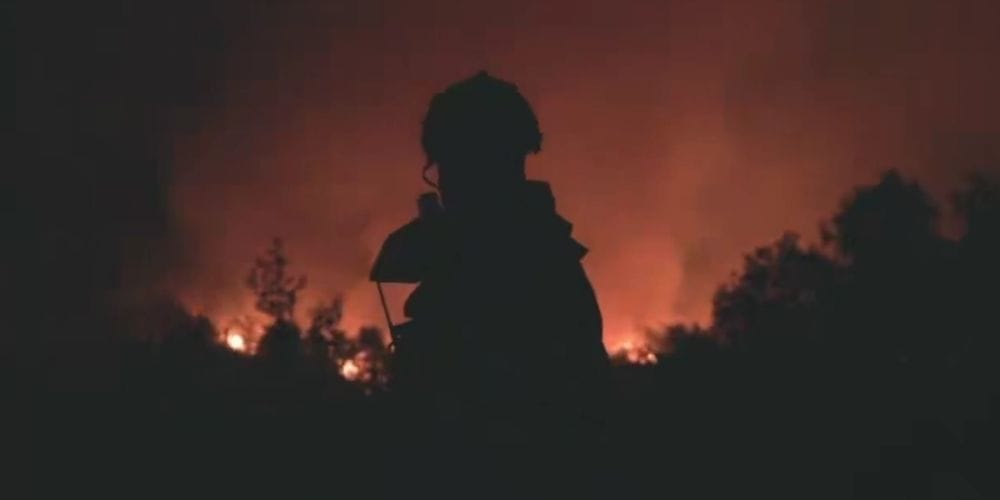
The remains of Aragón’s first kings have been removed from the Royal Pantheon at San Juan de la Peña after the advancing Peñas de Riglos wildfire threatened one of the region’s most important historic sites.
A specialist cultural heritage team entered the Old Monastery alongside the UME and Guardia Civil to recover the royal remains and other vulnerable works before transferring them to the Museum of Huesca for safekeeping.
The emergency operation was carried out on Thursday as flames closed in on the monastery complex. The Government of Aragón said the remains belonged to the first kings of Aragón and members of the royal lineage who had rested in the pantheon, while fragments of historic wall paintings and other cultural assets were also removed.
The intervention followed an earlier operation at the New Monastery, where cultural heritage specialists had already removed artworks and other important objects as the fire approached San Juan de la Peña.
The threat to the complex became particularly acute on Thursday. Flames surrounded the Old Monastery without damaging its structure and approached the New Monastery, according to the latest accounts of the operation.
First kings of Aragón moved to safety
San Juan de la Peña occupies an exceptional place in Aragón’s history. Built partly beneath a vast overhanging rock in the Pyrenees, the Old Monastery became closely associated with the origins of the medieval Kingdom of Aragón.
Its Royal Pantheon contains the remains associated with Aragón’s first three kings: Ramiro I, Sancho Ramírez and Pedro I. The site is regarded as Aragón’s first royal pantheon and remains one of the region’s most important historic and symbolic monuments.
The remains themselves have a complicated history. After decades of archaeological, anthropological and genetic research, remains belonging to the early royal lineage were formally returned to the pantheon in 2018. Researchers had hoped that the creation of genetic records and preserved samples would mean they would not need to be exhumed and handled again.
Eight years later, the wildfire emergency has forced another removal.
There is also a striking historical parallel. The Royal Pantheon was badly affected by a major fire in 1675, after which it was remodelled in the neoclassical style. Nearly 350 years later, fire has once again threatened the site, although emergency crews have so far succeeded in protecting the monastery itself.
More villages evacuated overnight
The wider wildfire emergency has continued to worsen.
The latest Friday reports put the area affected by the Peñas de Riglos fire at more than 10,000 hectares, with around 830 people evacuated from 16 villages. Four further communities — Santa María de la Peña, Triste, La Peña Estación and Yeste — were evacuated during the early hours of Friday as the fire continued to spread.
Aragón had reported on Thursday night that 709 people from 12 communities were evacuated and another two communities confined. The firefighting operation was being reinforced for Friday with 33 aircraft, demonstrating the scale of the effort to contain a fire burning through difficult terrain.
San Juan de la Peña has been one of the principal priorities. Firefighters and emergency personnel have worked to prevent the flames reaching the historic buildings while simultaneously protecting surrounding communities.
The emergency is continuing on Friday and the situation remains liable to change rapidly. The royal remains and other cultural objects will remain away from San Juan de la Peña while the wildfire continues to pose a threat to the historic complex.