 Lorraine Williamson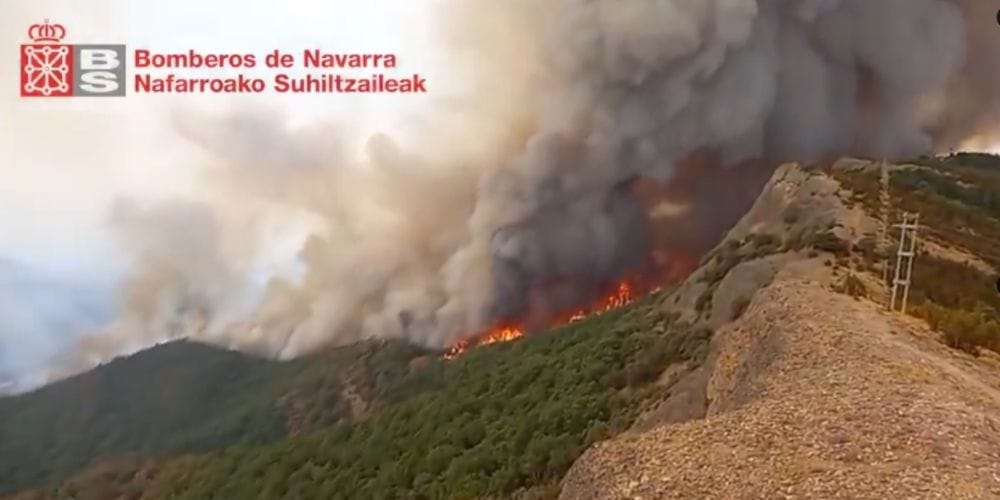
Historic artefacts have been evacuated from the New Monastery of San Juan de la Peña as the rapidly expanding Peñas de Riglos wildfire threatens one of Aragón’s most important cultural and historic sites.
Members of Spain’s Military Emergency Unit (UME) have helped remove pieces from the monastery and transfer them to the Museum of Huesca for safekeeping after flames advanced into the protected San Juan de la Peña landscape.
The emergency has deteriorated substantially on Thursday. The fire has now affected around 8,000 hectares. Meanwhile, 12 communities have been evacuated, and around 900 people have been directly affected by evacuation measures.
Flames reach San Juan de la Peña
The fire has crossed into the protected landscape surrounding San Juan de la Peña, dramatically increasing concerns for its forests, communities and historic monuments.
By Thursday evening, flames had reached the vicinity of the New Monastery, prompting emergency teams to concentrate resources on defending the complex.
The operation is particularly difficult because of the combination of high temperatures, difficult terrain and changing winds. Temperatures above 38C and southerly winds have complicated attempts to contain the most active parts of the fire.
Although crews have achieved greater stability on some sections, the main front and right flank remain of particular concern.
Historic artefacts moved to safety
Authorities have taken the precaution of removing historic pieces from the New Monastery rather than risk losing them if conditions deteriorate further.
UME personnel assisted with the operation, transferring objects from the monastery to the Museum of Huesca, where they can remain protected while the wildfire emergency continues.
The move represents a significant escalation in efforts to protect San Juan de la Peña. Earlier operations were focused on preventing the fire from entering the protected landscape; emergency teams are now defending the monastery complex itself.
San Juan de la Peña is closely associated with the origins and history of the Kingdom of Aragón. The complex includes the celebrated Old Monastery, dramatically constructed beneath an enormous rock overhang, as well as the later New Monastery higher on the mountain.
The surrounding landscape also has considerable environmental importance.
One CSIC biologist and former president of the area’s governing board has warned that mature forest destroyed by a major fire could take more than a century to recover fully, because restoring the ecosystem involves far more than the initial return of vegetation.
Twelve communities evacuated
The human impact of the fire has also increased significantly.
The latest evacuations include Santa Cruz de la Serós, Osia and Binacua, bringing the number of evacuated communities to 12. Authorities have also ordered residents in Puente la Reina and Santa Cilia de Jaca to remain indoors because of the developing emergency.
Around 900 people are now affected by the evacuations.
Several important roads have also been closed, including stretches of the A-132, A-1205 and N-240, as authorities attempt to keep routes available for emergency operations and prevent people from entering dangerous areas.
UME operation reinforced
More than 500 ground personnel and around 30 aircraft have been involved in Thursday’s operation as authorities attempt to contain the fire and defend threatened communities.
The UME presence has also been reinforced by personnel from battalions based at Torrejón de Ardoz and Bétera, adding to the military resources already operating in Huesca.
As darkness falls, aircraft must give way to an intensive ground operation.
Firefighters, UME personnel and other emergency teams are expected to continue working through the night, with defending San Juan de la Peña and threatened population centres among the priorities.
Arrest over suspected origin of fire
The dramatic developments around the monastery come on the same day that the Guardia Civil confirmed the arrest of a 28-year-old man as part of the investigation into how the Peñas de Riglos wildfire began.
Investigators are examining a possible connection with works taking place on the A-132, where the fire is believed to have originated.
Crucially, authorities have not said the wildfire was deliberately started. The investigation must establish exactly what caused the ignition and whether any criminal responsibility exists.
The arrest therefore remains a separate investigative strand while emergency crews concentrate on the immediate threat posed by the flames.
For San Juan de la Peña, Thursday night could prove critical. Historic objects have been moved out of harm’s way, hundreds of residents remain displaced and firefighters are attempting to prevent an already devastating wildfire from inflicting further damage on one of Aragón’s most treasured landscapes.