 Lorraine Williamson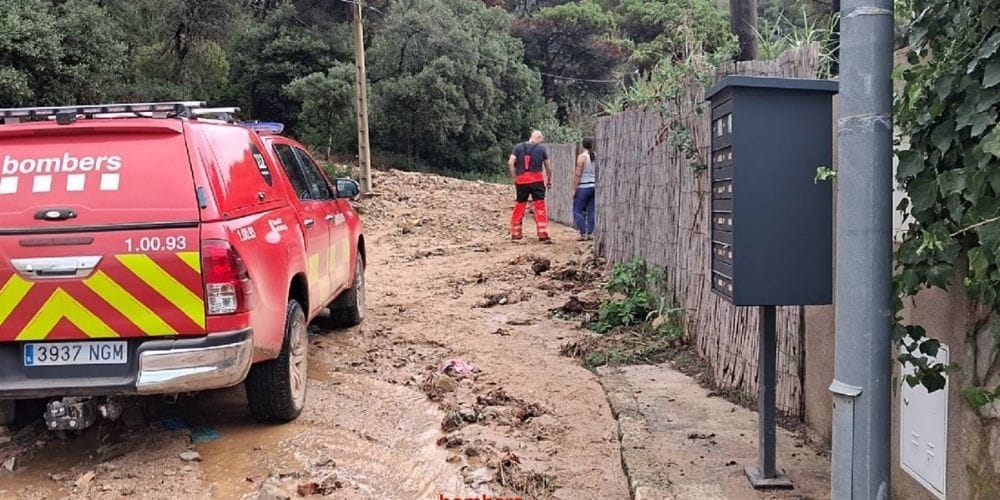
At least two people have died, and another is missing, after torrential rain caused severe flooding across Catalonia, with rivers reaching dangerous levels and emergency services responding to thousands of calls.
The focus of the weather emergency is now moving north-east towards Girona, where residents have received fresh emergency alerts over dangerously swollen rivers.
One of those killed was a 65-year-old man who died after a wall collapsed at a campsite in Tordera, Barcelona province. He had reportedly been trying to clear water when the structure gave way.
A second person died in Montornès del Vallès, according to Catalonia’s fire service. Emergency teams are also searching for at least one missing person around the riera at Pineda de Mar, where a vehicle was found overturned without its driver.
Thousands of emergency calls as flooding spreads
The scale of the emergency has continued to grow. By 12 noon on Sunday, Catalonia’s firefighters had handled 1,818 weather-related incidents, including 147 new calls between 11.00 am and midday alone.
Emergency medical teams have treated 237 people affected by the storm, although no serious cases were reported among those patients.
Hospitals have also been affected. Flooding disrupted normal operations at the Hospital General de Granollers in Barcelona province and the hospital in Blanes, Girona, prompting health authorities to advise patients to use alternative hospitals where possible.
Record rainfall in Barcelona
The storm has produced exceptional rainfall totals across Barcelona and its surrounding areas.
Meteocat director Sarai Sarroca said the Can Bruixa weather station in Barcelona’s Les Corts district recorded 213mm. This makes it the highest daily rainfall measurement for the city since records began in 1883.
The Raval recorded 193mm, while even higher totals were measured elsewhere in Barcelona province. Granollers received 248mm, Mataró 244mm, and Cabrils 232mm.
The rainfall has caused widespread flooding of streets, homes, and roads. In Pineda de Mar, the mayor said water had reached around a metre deep inside some properties as emergency teams worked to restore access through the town.
Besòs reaches dangerous level
Authorities have been particularly concerned about the Besòs River. At Santa Coloma de Gramenet, its flow reached around 903 cubic metres per second, with the water standing approximately 3.5 metres high.
Civil Protection sent emergency alerts to Barcelona, Montcada i Reixac, Santa Coloma de Gramenet, and Sant Adrià de Besòs because of the flood risk. People close to the river were told to stay away from its banks and avoid basements and ground floors, moving to higher levels if water approached their buildings.
Other waterways remain under close surveillance, including the Mogent at Montornès del Vallès and the Tordera at Fogars.
Emergency shifts towards Girona
While conditions have begun improving in parts of Barcelona and Tarragona, the most active part of the storm has shifted towards north-eastern Catalonia.
At 12.28 pm, Civil Protection issued another ES-Alert to areas of Girona because of concern over the Ridaura and Daró rivers. Residents were told to stay away from riverbanks and exercise extreme caution.
The Catalan Water Agency reported that the Ridaura at Santa Cristina d’Aro had reached around 300 cubic metres per second, exceeding a threshold associated with a once-in-100-years flow event. The riera de Gotarra at Campllong is another waterway currently considered to be at danger level.
Travel restrictions eased in some areas
Earlier restrictions have now been lifted in 12 comarques, including Barcelonès, Baix Llobregat, Garraf, Vallès Occidental, and several areas of Tarragona.
However, restrictions remained in place until 2.00 pm in eight areas where authorities expected the storm to continue having a serious impact: Alt Empordà, Baix Empordà, Garrotxa, Gironès, Maresme, Pla de l’Estany, Selva, and Vallès Oriental.
Rail travel has also been severely disrupted. Most Rodalies services were suspended from Saturday evening due to the dangerous weather, with only limited services operating.
High-speed rail between Barcelona and Tarragona, which had also been interrupted, resumed at around 12.33 pm on Sunday.
Air travel has also been badly affected. At Barcelona-El Prat airport, 138 flights had been cancelled and another 53 delayed by late Sunday morning as the severe weather disrupted travel across Catalonia.
Authorities urge continued caution
Catalan president Salvador Illa confirmed the second death on Sunday and expressed his condolences to the victim’s family. He said the situation “continues to be complicated” and thanked firefighters, emergency services, and other public workers responding to the storm.
The severe weather is part of a wider episode affecting Spain. AEMET has warned of strong or very strong showers and thunderstorms across other parts of the country throughout Sunday, although Catalonia has experienced the most serious consequences.
With the storm now concentrated further north-east, authorities are continuing to monitor rivers and flood-prone areas closely. Anyone in affected areas is being urged to avoid unnecessary travel, stay away from swollen waterways, and call 112 in an emergency.