 Lorraine Williamson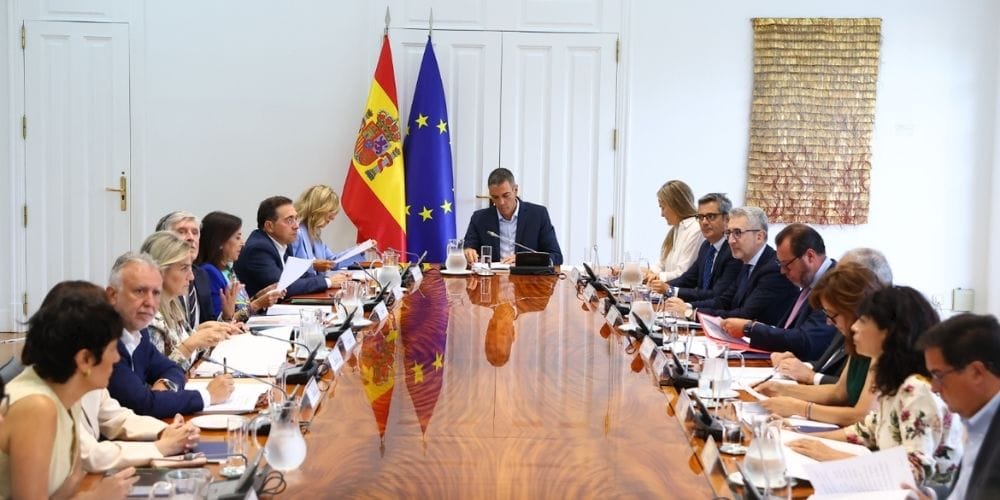
Spain is escalating its response to the crisis in Ceuta by declaring it a situation of interest for national security, the first time the mechanism has been activated since it was created under the 2015 National Security Law. A new single command, headed by Territorial Policy Minister Ángel Víctor Torres, will coordinate the state response as the Government moves into a new phase of managing the aftermath of July’s mass border crossings.
The move marks a significant step beyond the emergency meetings, additional funding, and health measures announced over recent days. It places the response within Spain’s National Security System and provides for reinforced coordination between the authorities dealing with the crisis.
The Council of Ministers met at Moncloa on Tuesday morning after the National Security Council considered the situation in Ceuta. The Government is using the legal mechanism provided for situations whose seriousness, urgency, and complexity require greater coordination between the authorities.
What does the national security declaration mean?
The measure is established under Article 23 of Spain’s National Security Law. It is designed for a crisis that can still be managed using the ordinary powers of public administrations, but requires a more integrated national response.
Crucially, it is not a state of alarm or emergency and does not allow the suspension of fundamental rights or public freedoms. The Government can, however, appoint a functional authority to direct and coordinate the response and mobilise the necessary public and private resources.
The declaration must be made through a royal decree setting out the nature of the crisis, the geographical area covered, its duration, and any possible extension. Congress must be informed of the measures taken and how the situation develops, although parliamentary authorisation is not required.
Ángel Víctor Torres to coordinate Ceuta response
Territorial Policy Minister Ángel Víctor Torres will head the new command structure. A specialist committee will bring together representatives of the Ceuta government, the Government Delegation, relevant ministries, and the Centro Nacional de Inteligencia, with advice from the National Security Department.
The Government says the structure is intended to improve coordination across issues that extend well beyond border security. These include returns, the situation of unaccompanied minors, international protection applications, pressure on public services, and Ceuta’s economic recovery.
The move follows repeated calls from Ceuta’s authorities for a more coordinated national response following the mass arrivals at the end of July.
From emergency response to longer-term recovery
The Government’s latest action comes after weeks of measures addressing the consequences of the crisis.
On Monday, First Deputy Prime Minister and Economy Minister Carlos Cuerpo announced an extraordinary expansion of Ceuta’s Integral Socioeconomic Development Plan. The existing programme has mobilised more than €180 million, with the expanded measures intended to reinforce security, improve the management of returns, strengthen public services, and support the city’s economy.
The Government is also proceeding with an extraordinary €25 million allocation for unaccompanied migrant children who arrived in Ceuta. That measure forms part of a wider response involving health, accommodation, and the redistribution of responsibility for minors.
Health authorities have separately agreed to make 45,000 vaccine doses available to Ceuta as a preventative measure following pressure on local health services.
Ministers face questions over handling of the crisis
The political scrutiny surrounding the Government’s handling of the events is also continuing.
Defence Minister Margarita Robles was due to appear before an extraordinary session of the Congressional Defence Committee on Tuesday to explain her department’s actions following the events of 30 July and the days that followed.
Further ministerial appearances are expected as Parliament examines the Government’s response to one of the most serious crises to affect Ceuta in recent years.
For Ceuta, however, Tuesday’s decision represents a clear change in how the situation is being managed. What began as an immediate border and humanitarian emergency is now being dealt with through Spain’s national security framework, with one minister responsible for coordinating the different arms of the state´s response.