 Lorraine Williamson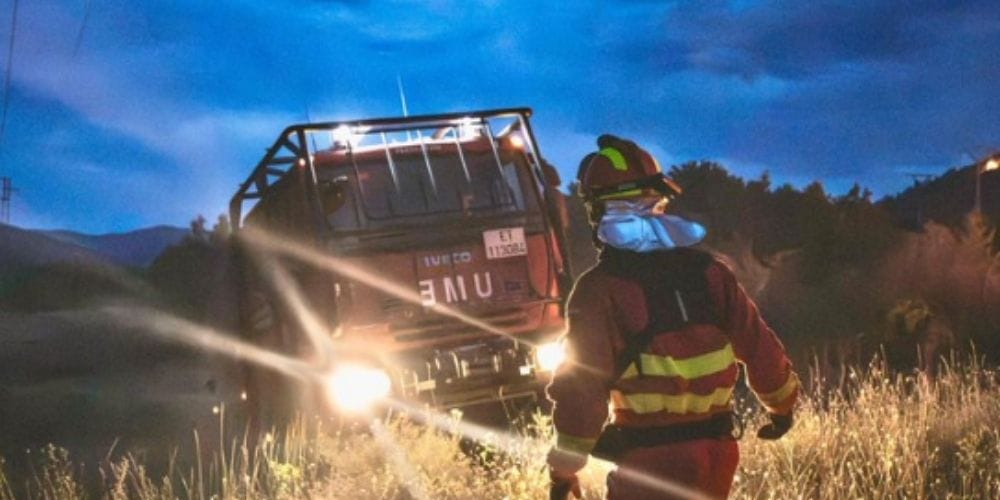
The Las Peñas de Riglos wildfire in Huesca is evolving more favourably on Monday night, allowing authorities to begin preparing for the gradual return of residents evacuated from 19 population centres.
The fire has affected an estimated 17,500 hectares and has a perimeter of about 100 kilometres. Aragón’s government said much of that perimeter had been stabilised over the past two days, while around 1,000 personnel and 42 aircraft worked across the affected area on Monday.
The improving conditions do not mean the emergency is over. The fire remains active, and 1,046 people from 19 settlements, two campsites, and a camp were still evacuated on Monday evening, although Santa Cilia de Jaca and Puente la Reina de Jaca have been released from confinement.
Authorities are now inspecting electricity supplies, telecommunications, drinking water, and roads before allowing residents back. Telecommunications have been restored, and electricity was expected to be almost fully re-established on Monday, while health officials are testing water supplies in affected villages.
Firefighting operation marked by UME death
The improvement comes after a tragic weekend for the emergency operation.
Corporal Javier García Sancho, a member of the Unidad Militar de Emergencias’ BIEM IV battalion based in Zaragoza, died on Sunday, 16 August, while taking part in the firefighting operation. The water tanker in which he was travelling overturned on a muddy track in a strategically important sector of the fire near Peña Oroel. The circumstances of the accident remain under investigation.
Three other UME personnel were injured in the accident. Aragón’s government confirmed on Monday that all three had since been discharged from medical care.
Aragón declared official mourning from midday on Monday until midday on Tuesday in García Sancho’s memory. Flags on public buildings are flying at half-mast, and a minute’s silence was held at the 112 Aragón emergency centre.
Hundreds of emergency workers remain deployed overnight
Despite the more favourable situation, a large overnight operation remains in place.
INFOAR is maintaining 11 ground crews, 11 fire engines, and eight bulldozers, while the Ministry for Ecological Transition has a BRIF unit and six helicopters deployed. The Ministry of Defence continues to provide four UME sections involving around 160 personnel, supported by Army bulldozers.
Other Spanish regions are also contributing resources, while France has deployed 61 firefighters and 22 vehicles through the EU Civil Protection Mechanism. Guardia Civil patrols, emergency health teams, and Civil Protection volunteers remain involved in the operation.
Roads remain closed but rail services resume
Several roads remain closed because of the fire, including sections of the A-1205, A-132, N-240, and A-1603, together with local access roads to Rasal, Javierrelatre, and Atarés.
There was one important improvement on Monday afternoon: conventional rail services between Sabiñánigo and Ayerbe were restored at 4.10 pm after being suspended because of the wildfire.
Emergency inspections are continuing on roads affected by the fire. Aragón has warned that emergency repair work will be required on sections of the A-1205 and A-1603 before they can reopen.
Residents wait for the all-clear
The focus is now shifting towards getting people home safely, but Aragón has stopped short of giving a firm timetable.
Authorities are assessing each settlement individually, checking water, electricity, communications, and road access before approving any return. A convoy accompanied by Civil Protection and the Guardia Civil allowed 47 residents to enter Santa Cruz de la Serós temporarily on Monday to collect belongings.
For now, the fire remains active, and crews are continuing to consolidate the sections brought under greater control. But after several days of rapid spread, mass evacuations, and the loss of a UME soldier, Monday night has brought the clearest signs yet that the emergency may finally be moving towards a more stable phase.