 Else Beekman
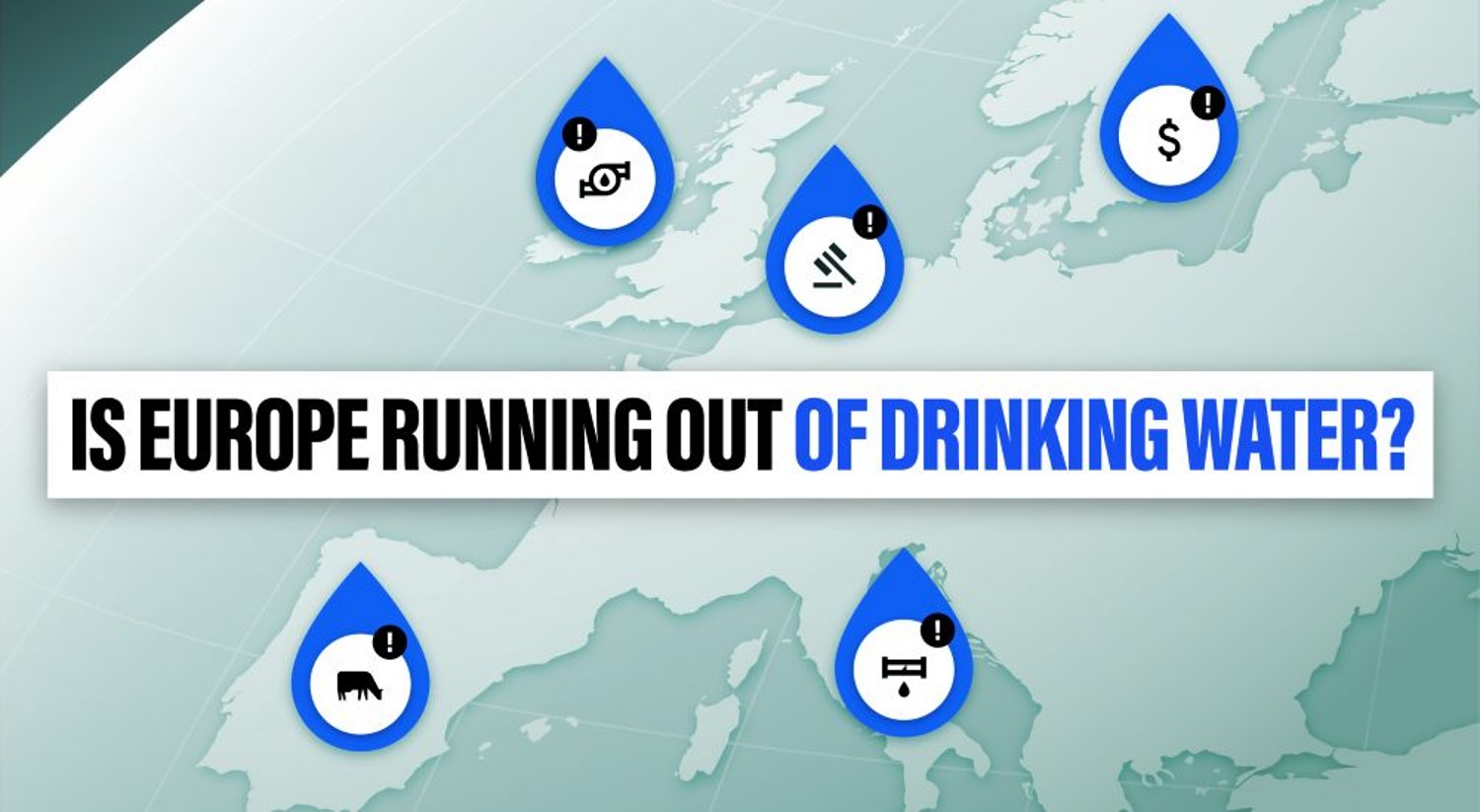
Despite sound EU water laws, the drinking water supply system in the European Union is showing serious cracks in several regions. In Spain and Italy these cracks are already causing heartbreaking situations. In northern Europe problems are looming. Water-rich countries, such as Sweden, Ireland and the Netherlands, need to take urgent action to safeguard access to clean drinking water. This investigation discloses different issues in these five EU Member States and finds that good water governance and law enforcement are crucial.
The European water sector is like a kaleidoscope with dazzling, different colours. Each Member State has its own landscape, from snowy mountains and green meadows to extensive deltas and near-deserts. Every country has its own water politics, and drinking water services are organised differently across Europe. River basins cross international borders and rivers flow through areas with different regulations. Implementing unified water laws to save our drinking water in this complicated landscape requires a high level of political commitment and action by all authorities, politicians, companies and citizens. And that is precisely what is lacking, to varying degrees, in the five countries examined, each facing its own water-related challenges, further exacerbated by the effects of climate change.
Polluted drinking water sources in Spain

Miguel Aparicio from the platform Unidos por el Agua points to a slurry discharge outside of Pozoblanco – image: Else Beekman
In the the north of the rural province of Córdoba in Spain, the reservoir La Colada, a reserve source of drinking water, has been polluted for decades with pure manure from livestock farms and overflows from wastewater treatment plants. Three years ago, due to drought, the pollution in this reservoir led to a drinking-water crisis of unprecedented proportions.
“I was pregnant and, without knowing it, I put myself and my unborn child at risk for a month by drinking this heavy polluted water. For a year, we showered with our eyes and mouths closed and I had to wash my newborn with bottles of drinking water,” says Elena, a resident of Pozoblanco who does not want her last name mentioned in any publication. Thanks to the rain last winter drinking water now comes from another reservoir, but the problems with La Colada are still far from being solved.
Mayor Juan Díaz of the small Spanish town of El Viso, is standing on a large recreational area that borders La Colada reservoir, the drinking-water reserve. Someone from the regional government of Andalusia has just put up a forbidden-to-swim sign. “The water in the lake is even too polluted to swim in, and it’s not the first time. The reservoir is 90 per cent full, but we can’t do anything with the water,” Díaz says.

Mayor Juan Díaz of El Viso in front of the polluted La Colada reservoir – image: Else Beekman
“Pure manure has been discharged here for years and it is still flowing into the lake. Everyone knows about it and nobody does anything,” adds Miguel Aparicio, coordinator of the platform Unidos por el Agua (United for Water). In 2023, after eight months of brown, foul-smelling water coming from the taps and desperation over the authorities’ inaction, Aparicio and three others from the platform went on hunger strike to demand a solution for the water crisis.
However, in the summer of 2026, the problems are still not solved. The responsible authorities are all, if they even respond, pointing to each other for solutions and there is a complete lack of enforcement of national and EU laws, like the Water Framework Directive and the Drinking Water Directive. If it does not rain abundantly over the coming winters the citizens in the region Zona Norte will face the same problems again in two years’ time. “The Andalusian regional government and the provincial council remain silent despite repeated complaints, reports of pollution and questions from the platform Unidos por el Agua.
European water laws
The European Water Framework Directive, the Drinking Water Directive, the Urban Wastewater Treatment Directive and the Nitrates Directive are designed to safeguard water availability and water quality across the EU. But are these directives still sufficient? European Commissioner Jessika Roswall is facing many challenges and is preparing changes in the Water Framework Directive to facilitate mining. The water sector is concerned that the upcoming changes will reduce water quantity and quality in Europe.

For a year, contaminated water came out of the taps – image: Unidos por el Agua
In 2023, the current EU vice-president Teresa Ribera visited the region in her role as minister for Ecological Transition and Demographic Challenge (MITECO), but after she left the national government has not stepped up to solve the problems in Zona Norte. According to Marleen van Rijswick, professor of European and national water law, the response to the water crisis in Zona Norte makes clear that ‘political will is lacking to solve the water crisis in this rural region’.
Unfortunately, the situation in Zona Norte is far from being an isolated one. Elsewhere in Spain, pollution is also placing considerable pressure on water quality. An analysis of SINAC data, the national information system of Spain’s Ministry of Health, by investigative outlet Datadista shows that in October 2026, 183 municipalities exceeded the legal limit for nitrates. A further 1.115 municipalities were at a critical level, while nitrate measurements were missing for 428 municipalities. In total, this affects more almost two million people. The interactive map shows that nitrate problems in drinking water are not confined to a few hotspots but occur across large parts of Spain, particularly in rural areas.
Italy loses 42% of drinking water through leakages

Massimo Tatone and other protagonists of the protests in front of the water tanks installed in a home in the Villa Torre district (municipality of Ortona) – image: Cecilia Fasciani
In Italy citizens are facing a different type of problems. In the Terravecchia neighbourhood, in the centre of the city Ortona the buildings, mostly built in the 1960s, overlook the sea and the region’s largest port. Here, many families have long been living with a lack of drinking water. “Not knowing when it will happen, as soon as the water comes out of the tap, we have to fill the bins and canisters. We have four basins in the bathroom, always full pots for cooking, and bottles for drinking,” says Cristina Colonna, who is more than eighty years old.
Her daughter, Luisa Orlandi, an archaeologist, lives with her. “A few years ago, a car would drive by with a megaphone to warn us of the closure, but not anymore: they only post online, and sometimes not even that. But not everyone has Facebook. I realize something’s happening because the flow is slowing down. For about four years, the situation has worsened. We spend entire days without water, and not just at night. Apartments often don’t allow for the installation of pressure tanks. “No one comes here, they don’t provide tankers. We make do by refuelling ahead of time.”
Public water management in the administrative region of Abruzzo is divided into six sub-areas. The Chieti area is managed by SASI, the Abruzzo Integrated Water Service Company, which comprises 87 municipalities. “Water management reform began a long time ago, in 1994, with the Galli Law,” explains Luigi Di Loreto, president of Ersi, the regional agency for integrated water services. “The aim was to eliminate the fragmentation of management, previously the responsibility of municipalities, by creating more efficient area managers. Just maintaining a water treatment plant requires millions that municipalities didn’t have. So much so that in Central and Southern Italy, approximately 70 percent of water infrastructure was built thanks to the governmental programme to combat poverty in Cassa del Mezzogiorno.”

Image: Leon de Korte
Italy isn’t a water-poor country, but it wastes enormous quantities. According to the June 2026 report “Too Much or Too Little” by the Italy for Climate think tank, it is the country that consumes the most water in Europe (36 billion cubic metres withdrawn in 2023), despite having one of the lowest per capita availability to water. Much of that water never reaches the tap: an average of 42 percent is lost along old and inefficient networks, a figure that rises to 51 percent in the south. This waste comes at a cost, which the Mestre-based CGIA estimates at €9.8 billion per year. These figures stem from decades of neglect. A pipe should be replaced every twenty or thirty years; if you don’t replace it for fifty or sixty years, the leaks only get worse.
Dublins growth threatens drinking water supply

River Liffey in Dublin – Shutterstock
But not only ageing infrastructure is a problem. Due to climate change and a growing population water demand in the Greater Dublin Area in Ireland “is on a knife edge”, Maria O’Dwyer, director of infrastructure delivery with the public water utility company Uisce Éireann, told a government committee. She warned that Ireland’s water supply, is coming under sustained and increasing pressure. “In May of this year, we saw record water demand levels in the GDA, which reached 685 million litres in a single day. In practical terms, the system is operating beyond capacity and with limited resilience.”
While Ireland gets 1,118 mm a year of rainfall, the majority falls in the less populated west while Dublin, in the east, is expanding rapidly. In the 2022 census there were 2.08 million people in the Greater Dublin Area, which equates to 40% of Ireland’s population. Estimates published by the Central Statistics Office suggest that the population of the GDA will reach 2.4 million by 2026. And, according to the EU’s statistics agency, Ireland could be home to 6.5 million people by 2060 — a 46% increase on 2010 levels.
Climate change and a growing population could lead to significant water shortages in the medium to long term. As a result, “measures to reduce demand should be implemented” states the Environmental Protection Agency, a government body. Uisce Éireann also plans to build a 170-kilometre-long pipeline to transport up to 300 million litres of water daily from the River Shannon to Dublin. The estimated cost is €4.6 billion but this could, under a worst-case scenario, potentially increase to €10bn.

The majority of rain falls in the less west while Dublin, in the east, is expanding rapidly. A new pipeline is planned to provide Dublin with drinking water. Image: Leon de Korte
The environmental organisation Friends of the Irish Environment is against the new pipeline along with many local councillors. During dry periods when ecological systems are under the greatest stress, the proposed abstraction would remove one-quarter to nearly two-fifths of the river flow. “This is the critical planning reality that average-flow metrics obscure,” says Elaine Doyle from the River Shannon Protection Alliance (RSPA). “In 2018 there were 74 days when the Ardnacrusha power station took no water. So, for those 74 days, in order to preserve the statutory flow in the old Shannon, the pipeline would not have been able to take any water! Given that we are due droughts every two years this is a huge concern.”
Big differences in water prices in Sweden

Gotland in Sweden – image: Shutterstock
On Gotland, a popular touristic destination in Sweden, locals on the island pay more than average for their municipal water supply. But the real cost of the water shortage is not only visible on the bill. During the summer, citizens are confronted with irrigation bans, a ban on filling pools and periodically reduced water pressure. In addition to old pipes and large investment needs, the people of Gotland also face a challenge that large parts of Sweden have so far been relatively spared from – clear limitations on the raw water itself. The region has therefore built two desalination plants and is investigating a third for Visby. During the summer, precisely when water availability is at its worst, the population grows rapidly.
The situation has prompted Region Gotland to start discussing a different tariff model. Susanne Bjergegaard Pettersson, senior expert in water and sanitation at the Department of Water and Waste at Region Gotland, tells more about it on a park bench on a dry summer’s day in Almedalen. “Differentiated tariffs are about shifting a larger part of the cost to the period when the load on the water supply system is highest. Therefore, the proposal is that the tariff is higher in the summer and lower in the winter,” she says. The idea is not that a permanent resident should automatically pay more over an entire year, but that the fees only fluctuate over the seasons.

Image: Leon de Korte
Sweden has very large geographical price differences. Dense municipalities with many apartment buildings can distribute the infrastructure among many people. A sparse municipality, an archipelago municipality or a municipality with difficult geology can have significantly more metres of pipeline per water user. Despite the different conditions, it is taken for granted that each local water and sanitation collective should bear its own costs.
As David Nilsson and associate professor of industrial economics Pär Blomkvist recently wrote on Svenska Dagbladet’s debate page, the price of water and sewage differs by a factor of four between different municipalities. “Who would accept such geographical price differences for other necessities? Would it be okay to pay 60 kronor per litre for milk in Trosa, when it costs 15 in Fagersta?” So far, the water issue has sparked relatively little political conflict. “One reason is that it’s still not expensive enough to really hurt. It’s starting to get expensive, but it’s still within the bounds of decency in most places,” says David Nilsson, associate professor of technical history and former director of the KTH Water Centre, at Slottsbacken in Stockholm.
Failure against cost recovery principle
The EU has several laws that contribute to ‘good water governance’ and adequate water pricing. One important principle in the Water Framework Directive is the ‘Cost Recovery Principle’ (Article 9). This means that investments in water infrastructure should be reflected in the price of water. From that perspective many authorities or regulators in different European Member States are not charging enough for clean and safe drinking water. Current tariffs are insufficient to finance investments in infrastructure and additional treatment, needed for pollutants like pharmaceutical residues and PFAS.
“If you look at the Cost Recovery Principle you need to be clear about what is included in investments. Are we talking about infrastructure, nature-based solutions, energy neutrality and maintenance?”, questions Executive Director Milo Fiasconaro from Acqua Publica Europea (APE), a European organisation of public water companies.
“All Member States should have received an infringement letter from the European Commission because they are not complying with the Cost Recovery Principle, says EurEau President Pär Dalhielm. “In our latest report, we found drinking water prices had increased by only 5%. That is not even enough to keep up with inflation and falls far short of the investment needs in the sector. If this trend continues, we foresee increasing disruptions to the water supply, which in turn will affect productivity across industries, small businesses, and households.”
“Enforcing the Polluter Pays Principle is an important part of keeping water services affordable,” says Pär Dalhielm. “Water services need sustainable financing to maintain and renew critical infrastructure and to meet growing demands. Investing early is essential to maintain safe and reliable services and avoid higher costs in the future. Water remains affordable for European households, with the average household spending around 1% of its income on water services. We need to maintain that affordability while ensuring that water services have the resources they need to invest for the future.”
Law changes needed in the Netherlands

The Afsluitdijk, Dutch dike that enclosed the Zuiderzee in 1932, between the Wadden Sea and Lake IJssel – image: Shutterstock
These disruptions are already taking place in the Netherlands for some industries and are foreseen in the near future for newly built urbanisations. On the Dutch dike that enclosed the Zuiderzee in 1932, between the Wadden Sea and Lake IJssel, there is water everywhere you look. On one side of the 30-kilometre-long dyke, the turbulent Wadden Sea laps against the flood defence, while on the other lies the vast expanse of Lake IJssel. Today, Lake IJssel, with its remarkable history, is also known as the Netherlands’ national rainwater reservoir.
For many Dutch people, it is unthinkable, but drinking water in this water-rich country, is at risk of running out. National water management and new drinking water sources need a major overhaul to prevent this. According to Dutch law, drinking water has to be produced from fresh water sources. The drinking water law needs to be changed to allow drinking water production from brackish groundwater and sea water. The Ministry of Infrastructure and Water Management is currently working on an amendment to the Environment and Planning Act to enable abstraction from other sources. Minister Karremans of Infrastructure and Water Management acknowledges the risks and says he will take charge at national level.
New water initiative

Ursula von der Leyen – Shutterstock
The urgency to act is also felt in Brussels. European Commission President Ursula von der Leyen introduced a new water initiative during the State of the Union (SOTEU) on Wednesday 16 September. The main objectives of this new water initiative are to reduce leakage and address the growing gap between economic losses caused by climate-related disasters and the share covered by insurance. According to Von der Leyen this summer some 12 million tonnes of crops were lost due to drought and water scarcity. “Key rivers like the Danube, the Rhine and La Garonne are disappearing before our eyes,” she stated.</p>
European Commissioner Jessika Roswall, responsible for environment, water resilience and a competitive circular economy, introduced a water resilience strategy just last year with the main objective being to preserve clean water for everybody. Roswall acknowledges that in some regions, the access to drinking water is coming under growing pressure. “Rural areas and vulnerable communities can face particular challenges. EU laws, especially the Drinking Water Directive and the Water Framework Directive, give Member States a strong basis for protecting water sources, ensuring the safety of supplied water, and preparing for future risks. Even so, in some parts of the EU, access to safe drinking water is clearly under strain so we need stronger prevention, investment, monitoring, and enforcement.” As the problems highlighted in Spain, Italy, Sweden, Ireland and the Netherlands clearly demonstrate.
Rural areas and vulnerable communities can face particular challenges. EU laws, especially the Drinking Water Directive and the Water Framework Directive, give Member States a strong basis for protecting water sources, ensuring the safety of supplied water, and preparing for future risks. Even so, in some parts of the EU, access to safe drinking water is clearly under strain so we need stronger prevention, investment, monitoring, and enforcement.” As the problems highlighted in Spain, Italy, Sweden, Ireland and the Netherlands clearly demonstrate.
Strengthening enforcement
“The Drinking Water Directive establishes the level of drinking water safety that must be achieved but leaves the institutional organisation and a large part of water governance to the Member States,” says Roswall. The EU Commissioner for water resilience is carrying out structured dialogues with all Member States on the enforcement of existing water legislation because of the existing implementation gaps. “Strenghtening implementation and enforcement is a big priority. When persistent problems are found, including in areas such as pollution or the protection of drinking water, the European Commission can take enforcement action. At the same time, effective enforcement depends heavily on the inspection and control systems put in place by Member States themselves,”
says Roswall.
“As a first step, affected citizens can document the problem, contact the relevant water, health and environmental authorities, request access to environmental information, take part in consultations and, where appropriate, bring the matter before the national courts as the citizens in Córdoba Spain are trying for years now to end their problems. If they believe EU law is being breached by a Member State, they can then also submit a complaint to theEuropean Commission,” declares Roswall. It must be said that the chance that the European Commission will start an infringement procedure after a complaint submitted through the reporting page of the European Commission is very low. In 2022 the European Commission pursued fewer than 5% of the complaints further by launching investigations, the website of the European Commission states.

Professor of European and domestic water law Marleen van Rijswick. Photo: Angeliek de Jonge
This is why Professor of European and domestic water law Marleen van Rijswick always advises citizens and non-governmental organisation to start proceedings before a national court. “They can argue that there is an infringement of EU law requirements. The national court should then let EU law prevail. Access to safe drinking water in all Member States is a governance issue. It is about the proper implementation of existing legislation, but even more importantly, the enforcement of national and EU legislation. This also requires political will and courage from politicians at the regional or local level. Water governance is crucial for the effectiveness of water management. However, Member States all have their own design of water governance. EU law just requires that it should be effective in the sense that each Member State should meet the EU water goals.”
Urgent action is needed

Water now! – image: Unidos por el Agua
Across the five countries investigated, the challenges differ, from pollution and leaking infrastructure to rising demand and insufficient investment. What connects them is the growing pressure on drinking water supplies and the need to turn existing European commitments into effective action through accountable governance and strong enforcement. Europe has to step up to prevent Member States from running out of drinking water.
UN Right to drinking water
The United Nations officially recognised the human right to water and sanitation in 2010. In 2015 the European Parliament voted in favour of requiring EU Member States to ensure that access to water is guaranteed for all. All suppliers should provide safe drinking water and improve sanitation. The recognition of the Right to Water was the result of a public campaign of Right2Water. After gaining 1.9 million signatures the topic was placed on the political agenda.
The UN General Assembly recognized the right of every human being to have access to enough water for personal and domestic uses, meaning between 50 and 100 litres of water per person per day. This is not just drinking water in the literal sense. It covers water needed for drinking, food preparation at home, personal hygiene, sanitation, washing clothes and household hygiene. The water must be safe, acceptable and affordable. Water costs should not exceed 3 per cent of household income. Moreover, the water source has to be within 1,000 metres of the home and collection time should not exceed 30 minutes.
InSpain.news is publishing a crossborder and expert reviewed investigation of an international team of journalists supported by Journalismfund Europe. More information about the project and the team can be found here.
