 Lorraine Williamson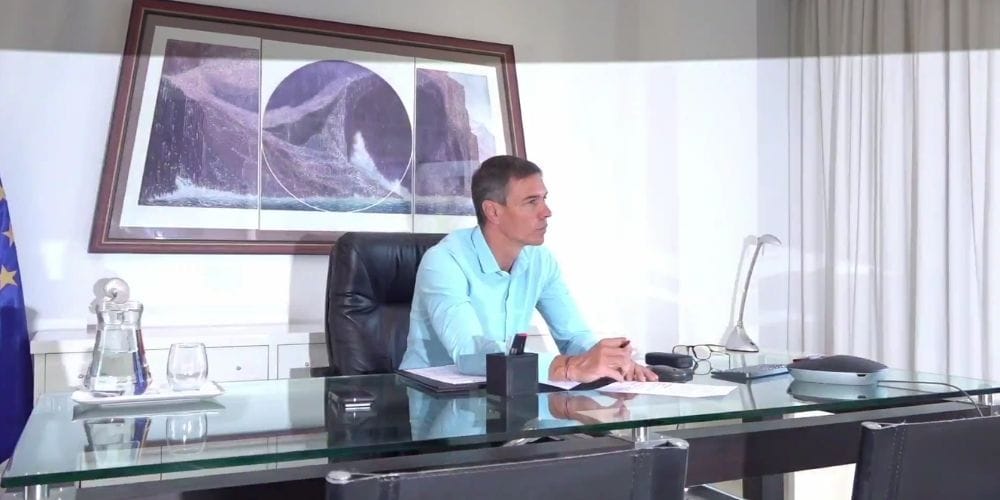
Ceuta’s president Juan Jesús Vivas has given Spain’s national government 30 days to respond to the autonomous city’s demands over the continuing migration crisis, warning that he will take the matter to court if Madrid fails to act.
The ultimatum marks a significant escalation in the dispute between Ceuta and the central government, more than two weeks after the mass arrivals that overwhelmed local services. Vivas accused Madrid on Monday of failing to provide an adequate response and said Ceuta could no longer continue carrying what he described as an unsustainable burden.
Vivas said the city would formally require the Spanish government to comply with what Ceuta considers its legal responsibilities. If there is no satisfactory response within 30 days, the autonomous government intends to begin legal proceedings through Spain’s administrative courts.
His intervention came on a day when Prime Minister Pedro Sánchez chaired a second videoconference with ministers to assess the situation. The meeting included ministers responsible for migration, defence, foreign affairs, interior, health, and territorial policy as Madrid continued to coordinate its response.
Temporary accommodation planned for 1,500 people
The central government announced on Monday that it will establish temporary humanitarian reception facilities in Ceuta with a capacity for around 1,500 migrants.
Migration Minister Elma Saiz said the new spaces would provide temporary accommodation and basic assistance. Madrid says the measure forms part of its response to the pressure facing the autonomous city following the mass arrivals at the end of July.
The government is also working on transferring people from Ceuta to the Spanish mainland. The objective is to relieve pressure on accommodation and essential services in a territory of just 18.5 square kilometres.
The latest measures follow days of disagreement over whether Ceuta has received sufficient support from Madrid and how quickly the central government responded after the unprecedented crossings.
Vivas questions Madrid’s response
Vivas significantly hardened his language on Monday, saying there were three possible explanations for what he considers the government’s failure to respond adequately: “ineptitude, irresponsibility, or lack of firmness towards Morocco”.
He argued that Ceuta should not be expected to absorb the consequences of a situation involving Spain’s external border with Morocco and called for greater involvement from the state.
The dispute has increasingly moved beyond the immediate humanitarian response and into questions about border management, relations with Morocco, and responsibility for providing accommodation and public services.
The Partido Popular has also registered a parliamentary proposal demanding immediate action in Ceuta and further explanations from the government over its handling of the crisis. Defence Minister Margarita Robles is due to appear before the Senate on Tuesday to discuss the government’s response during the mass crossings on 30 and 31 July.
Health services caught in political dispute
Pressure on Ceuta’s health system has also become part of the increasingly bitter disagreement.
Health Minister Mónica García visited the autonomous city and said on Monday that the situation required continued coordination between administrations. She said it was unacceptable that, 17 days after the crisis began, some migrants still lacked a suitable physical space where they could be safely accommodated.
Vivas subsequently criticised García’s intervention, accusing her of coming to Ceuta to give “lessons in humanity” and describing her conduct as inappropriate. The exchange illustrates how what began as an emergency at the border is increasingly developing into a confrontation between the national and autonomous governments.
Morocco reinforces the border
The situation at the frontier remains sensitive. Moroccan authorities have reinforced security close to Ceuta following social-media messages encouraging another attempt at a mass crossing.
Additional fencing has been installed in some areas and Moroccan security forces have increased their presence near the border. No new crossing on the scale seen at the end of July has materialised, but authorities on both sides continue to monitor the situation closely.
The political dispute is also likely to continue this week. Robles is scheduled to face senators on Tuesday, while Interior Minister Fernando Grande-Marlaska has again been called to appear on Thursday over the government’s management of the crisis.
For Ceuta, however, Monday’s ultimatum introduces a new deadline. Unless the national government and autonomous city reach an agreement, a crisis that began at the border could now move into Spain’s courts.