 Lorraine Williamson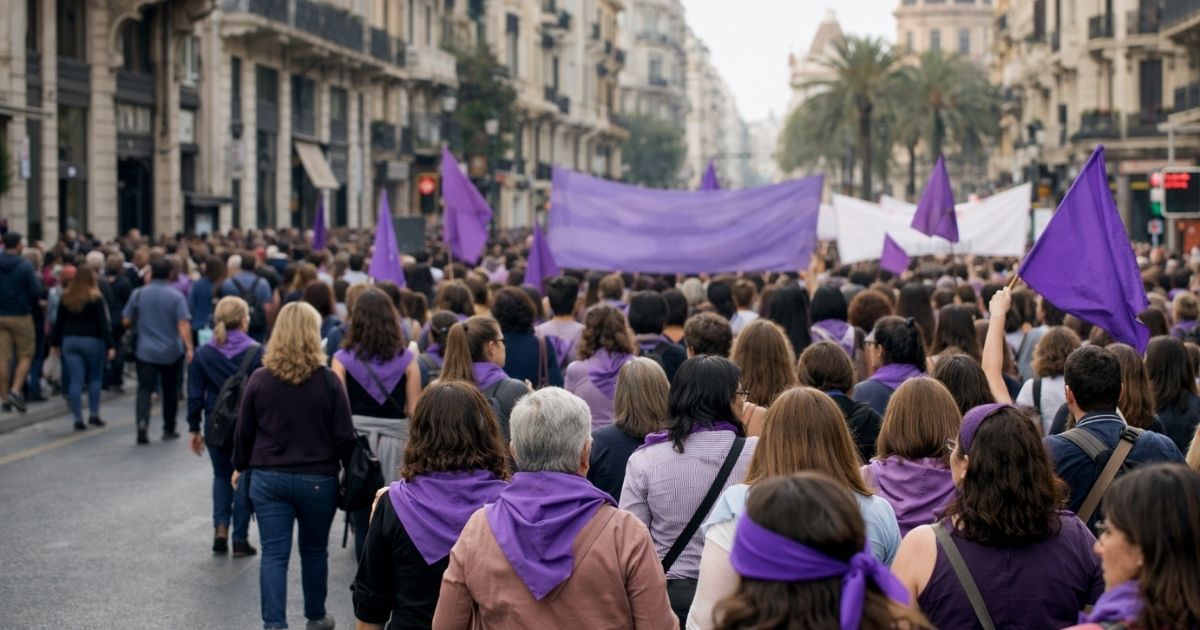
The streets of Valencia turned into an early stage for Spain’s 8M weekend today, as students walked out ahead of International Women’s Day to protest against machismo, gender violence, and war. The march, called by the student union, began at the Faculty of Geography and History at the University of Valencia and moved through the city centre to Plaza de la Reina, bringing a younger, louder edge to the feminist mobilisation building across Spain before March 8.
What made the Valencia demonstration stand out was the way it tied local feminist demands to a broader political mood. Protesters denounced sexism in education, work, and daily life, while also chanting against war and linking women’s rights to the international crisis around Iran. According to local coverage, organisers argued that hatred towards women has grown sharply and said feminist resistance could not be separated from wider anger over violence and militarisation.
A student-led warning before the main marches
Friday’s action was not the main 8M demonstration in Valencia, but it was a clear sign of the tone heading into the weekend. Across Spain, feminist organisations have again called marches in every autonomous community, with Valencia among the cities preparing for a major turnout on Saturday evening. National coverage shows that, as in other recent years, some cities will see more than one feminist call, reflecting internal divisions over issues including sex-based rights, prostitution, and the shape of the movement itself.
That broader backdrop matters because 8M in Spain is never only about one march. It is a rolling mobilisation that often builds over several days through student strikes, neighbourhood events, assemblies, and union-backed actions. Valencia’s student protest, therefore, fits into a wider pattern: younger activists setting the tone before the larger demonstrations fill the streets.
Street anger meets official messaging
While students were marching in Valencia, the government was also working hard to frame this year’s equality message. At the official International Women’s Day event on 4 March, Prime Minister Pedro Sánchez said violence against women had found “a new stronghold in the digital space” and argued that online harassment must now be treated as part of the same misogyny women face elsewhere in society. He also used the event to defend feminism openly, warning against the reactionary backlash and insisting Spain would continue to call feminism by its name.
Sánchez also introduced a more international note that helps explain why the Valencia protest language resonated. Referring to the crisis in the Middle East, he said women’s rights and the freedoms of people should never be used as a pretext for wars serving other interests. That line did not come from the student protest itself, but it mirrors the way some activists are now connecting feminist demands with wider opposition to conflict and geopolitical violence.
Elma Saiz pushes the labour angle
Elma Saiz, meanwhile, has leaned into another of 8M’s recurring themes: economic equality. Speaking after Tuesday’s Council of Ministers and in the government’s employment briefing, she pointed to the fact that Spain ended February with around 10.3 million women registered with Social Security, marking 13 consecutive months above the 10 million level. Women now make up 47.3% of all registered workers, and the government says the gender gap in employment has continued to narrow since 2018.
That message gives the institutional side of 8M a more optimistic frame than the one heard on the streets. Ministers want to present progress: more women in work, a smaller labour gap, and stronger official backing for equality measures. Protesters, especially younger ones, are stressing what still feels unresolved — harassment, fear, misogyny, violence, and the sense that rights can still move backwards.
Why Valencia matters this year
Valencia is not just another stop on the 8M calendar. It has become one of the cities where the tensions inside Spanish feminism, and between institutions and activists, are easier to see. This year, there has already been controversy over the scheduling of local events around March 8, while the city council is also running its own municipal 8M campaign focused on women in music and cultural visibility. That contrast — official celebration on one side, sharper activist protest on the other — helps explain why demonstrations in Valencia often carry extra symbolic weight.
For readers in Spain, that makes Friday’s march more than a local student story. It was an early snapshot of the arguments likely to dominate the weekend: how far equality has come, how much anger remains, and whether governments can keep control of the narrative when the streets begin to speak for themselves.
What to watch on March 8
The main Valencia 8M mobilisation is expected on Saturday evening from Porta de la Mar, while major demonstrations are also planned in Madrid, Barcelona, Seville, Bilbao, and dozens of other cities. That means Friday’s student march should be read as a curtain-raiser, not the main event. Still, it has already done what these pre-8M actions are meant to do: sharpen the message, raise the pressure, and remind Spain that International Women’s Day here is not a symbolic date but a political one.