 Lorraine Williamson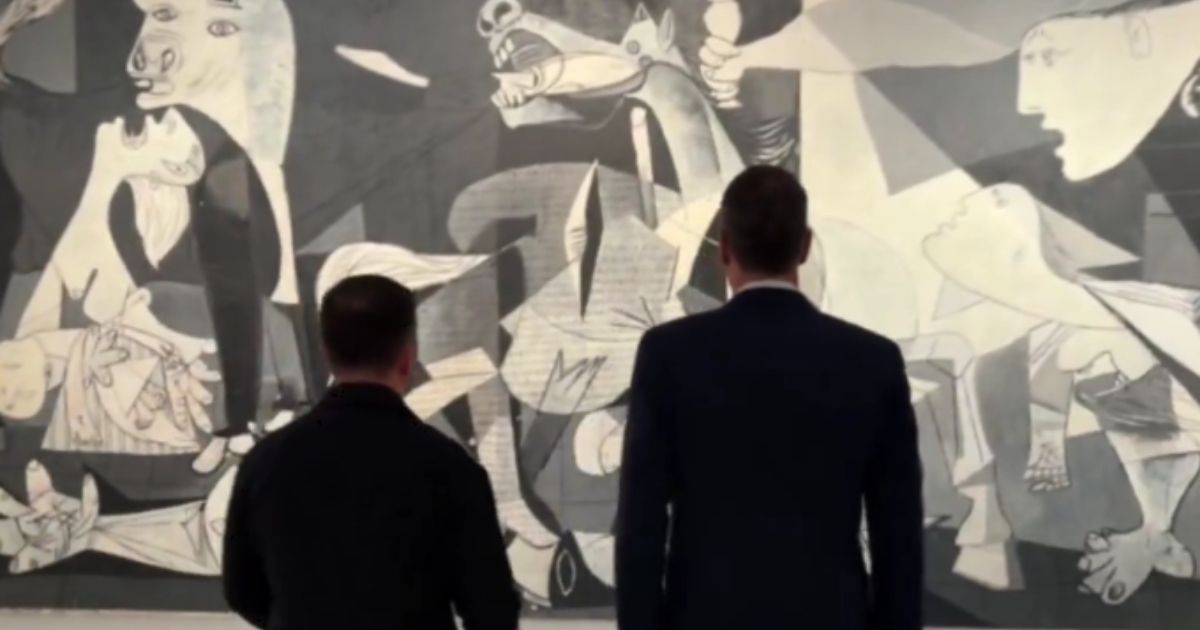
Spain’s most powerful anti-war image took centre stage on Tuesday as Volodymyr Zelenskyy walked through the Museo Reina Sofía to stand before Pablo Picasso’s Guernica. The Ukrainian president was in Madrid for a one-day visit packed with diplomacy, defence agreements and messages aimed far beyond Spanish borders. Yet it was his quiet pause before the painting — a monumental vision of civilian suffering — that defined the symbolism of the day.
Zelenskyy arrived in Madrid at a critical moment in Ukraine’s war, with winter approaching and fresh appeals for European support. His first stop was La Moncloa, where he and Spain’s prime minister, Pedro Sánchez, presided over the signing of new bilateral agreements. Both leaders later appeared before the press, reaffirming shared commitments on security and humanitarian assistance.
But the visit to Guernica provided the emotional core. Surrounded by the painting’s fractured forms — a mother screaming for her dead child, a horse collapsing in agony, a bull looming over the devastation — the two leaders stood side by side for photographs released shortly afterwards.
Sánchez posted the images on X with a message that captured the mood: “Contra la crueldad de la guerra. Por la justicia y la paz. Estaremos con Ucrania, siempre.”
Against the cruelty of war. For justice and peace. We will stand with Ukraine, always.
Why Guernica still speaks to today’s wars
Painted in 1937 after the bombing of the Basque town of Gernika by Nazi and fascist Italian aircraft, Guernica became the defining artistic condemnation of aerial terror. Its monochrome palette echoes newspaper photographs of the day, while its jagged geometry conveys shock, chaos and grief. For decades, it has symbolised the human cost of war — a reminder that civilian lives become the first casualties when bombs fall.
Zelenskyy has referenced the painting repeatedly since Russia launched its full-scale invasion. In April 2022, speaking remotely to the Spanish parliament, he evoked the parallels between Ukrainian families sheltering underground and the horror Spain experienced in the 1930s. “The reality in Ukraine is as if it’s April 1937,” he said then, linking one European tragedy to another.
A global symbol with a long list of pilgrims
The potency of Guernica has long drawn world figures to the Reina Sofía. Barack Obama visited in 2018 during a trip that included a meeting with King Felipe VI. Writer Salman Rushdie stood before it after losing sight in one eye in a knife attack — a poignant encounter with a work steeped in violence yet rooted in defiance. Diplomats in New York also pass a tapestry reproduction outside the UN Security Council chamber, where Russia sits as a permanent member.
For Zelenskyy, the painting’s message is more than historical. It mirrors a contemporary Europe in which cities such as Mariupol, Bucha and Kharkiv have become synonymous with destruction.
Spain’s support in focus
Spain’s backing has increased over the last year through military aid, training programmes and political alignment within the EU. Tuesday’s agreements underline Madrid’s intention to maintain that trajectory, even as European unity faces strains from elections and shifting domestic debates.
The powerful image of Zelenskyy and Sánchez before Guernica is likely to resonate across Europe: a reminder of why support for Ukraine is framed not just as foreign policy, but as a commitment to peace, democracy and the protection of civilians.
History urges action
The symbolism woven into Tuesday’s visit will echo through upcoming diplomatic discussions, especially as Ukraine seeks sustained European solidarity. With Picasso’s warning from the past looming behind them, both leaders used the moment to anchor today’s war within a broader moral landscape — one where history urges action rather than indifference.
Sources: Associated Press, El Diario