 Else Beekman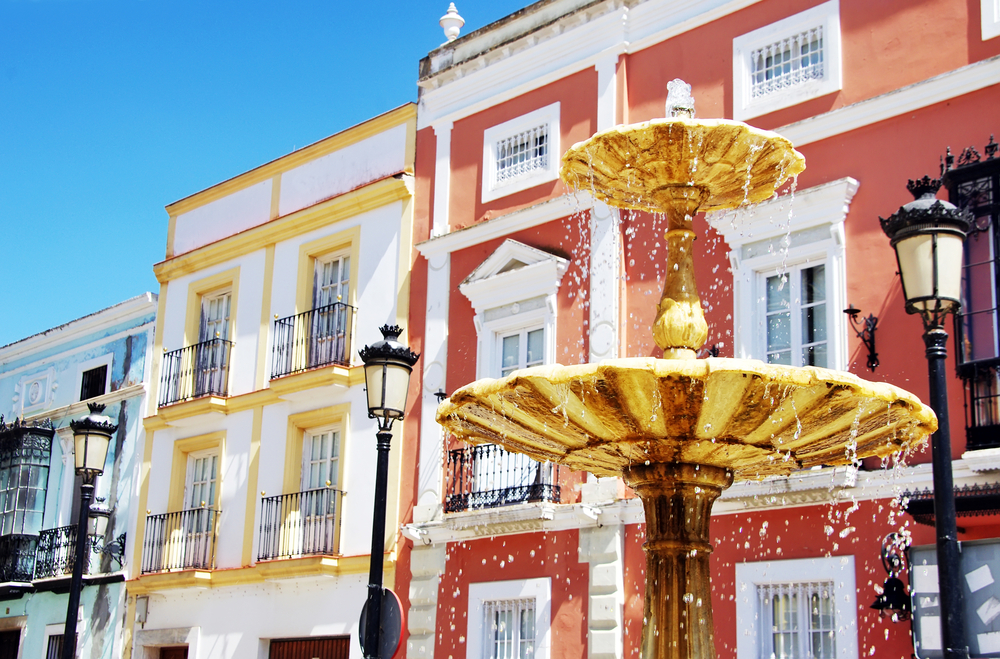
InSpain.news headed to Extremadura to discover this little-known region of Spain. This five-part series explores the region’s main towns and cities. In part 4, we’re in Zafra and Badajoz, contrasting towns with one thing in common – beautiful architecture.
I arrived in Zafra in the middle of downpour, scuttling past puddles and into the haven of my hotel nestled in the town walls close to the Puerta del Cubo.
After a revitalising glass of local red wine (Paiva, from nearby Almendralejo), the rain had eased, and I set out to explore a town that sits on the edge of the old Roman Via de la Plata.
Zafra’s enchanting plazas

The narrow streets, lined with old-fashioned shops, traditional houses draped with bougainvillea and geraniums, and baroque churches took me on a meandering walk towards two of the most seductive plazas in Extremadura.
Plaza Chica, quaint with shaded porticoes, would ordinarily be dotted with tables from the bars and restaurants that line it. However, that day a few solitary bar stools huddled next to large barrels serving as tables. It did allow for the beauty of the square to shine – it’s central cross standing proud among the decorative cobbles.
Through the Arquillo del Pan arch with an altarpiece dedicated to the Virgen de la Esperancita and the Plaza Grande stretched in front of me. Also porticoed, the 15th century buildings give the square a charming feel and it is not difficult to imagine the markets that would have taken place there in medieval times.
Modernist architecture and medieval castle
Plaza Pilar Redondo has an altogether different architectural vibe. The ayuntamiento (town hall) sits at the wide end of the plaza’s wedge – an elegant patio hidden behind the walls. Lining the other sides are the Conde de la Corte Palace and modernist houses, the colours of the latter echoing Cuba’s Havana.
A short stroll and the Alcazar de los Duques de Feria stands imposingly within the Plaza Corazón de María. The fortress, originally designed to defend the town, is now a Parador hotel. The interior underwent numerous transformations as the Feria family rose up the hierarchical ladder.

The shell symbol of the pilgrimage route to Santiago de Compostela is evident in the pavement. Pilgrims of another kind head down to Calle Sevilla, where commercial and traditional brands line a street where a bite to eat and good wine are temptingly on offer.
As the rain came down again, I retreated to the hotel for more delightful wine and tender pork. The following day, I headed to Badajoz along the scenic route, taking in the sight of Castillo de Nogales perched on a hilltop.
The Alcazaba at Badajoz

After the interesting countryside, the outskirts of Badajoz left me wondering whether I’d made a mistake. The new town is industrial and unprepossessing, but then as a I rounded a bend my worries dissipated.
Glowing in the morning sun was the Moorish fortress, a honey-coloured stone wall punctuated with towers encircling it on the hillside. This was what I was here for.
Built in the 12th-century, the 8-hectare Alcazaba is the largest in Spain. Standing tall, the symbol of the fortress and town is the Torre de Espantaperros (Scare-Dogs Tower). Below it is the Plaza Alta which was reminiscent of an Italian piazza with its bold, deep-red-and-white patterns. However, it is in fact the Moorish-inspired Casas Coloradas. Built in 1681, the plaza is the perfect place for a morning coffee.
Within the Alcazaba, in the Palace of the Counts, is the Archaeological Museum of Badajoz. Created in 1867 it houses archaeological finds from the province of Badajoz. Climb to the top of the towers and enjoy amazing views across the old town, the Guadiana river and to the Portuguese border.
Cathedral and town centre

Badajoz cathedral dominates the Plaza de España in which it stands. Also known as Saint John the Baptist Cathedral, work started on it in the thirteenth century. The bell tower is its most outstanding feature.
A short stroll takes you to Plaza de Cervantes with its ancestral homes. But is there a statue to the venerable writer in its midst? No. Instead there is one dedicated to the artist Zubarán. However, to make things all the more confusing, the square is known locally as Plaza de San Andrés due to the small church dedicated to the Saint Andrew that stands there. All of this goes to explain why locals also call it plaza de las tres mentiras, or the square of the three lies.
Continue, plaza by plaza, to the Paseo de San Francisco. Remodelled in the 19th century, its aged palm trees and remaining Fernando VII style street lamps evoke a time past.
River Guadiana
The Guadiana river is international, defining a long stretch of the Portugal-Spain border, separating Extremadura and Andalucia from Alentejo and Algarve in Portugal. At Badajoz, it is crossed by two bridges, Puente Real for cars and Puente de Palmas for pedestrians.
Foot and cycle paths run alongside the river, also a popular place for a paseo in the warm evenings. A number of bars and restaurants line the riverside, ideal for an evening (or afternoon) cocktail.
Puente de Palmas is the oldest bridge in Badajoz over the Guadiana. Built in 1460 from granite ashlars it has suffered damage by multiple floods over the years. On the left bank is one of the old gates of the Badajoz wall, the Puerta de Palmas; today a symbol of the city. On the right, a bastion gave protection to the abutment of the bridge from possible attacks by armies from nearby Portugal.

At night it is a beautiful sight, its lit arches reflecting in the river beneath. Having exhausted myself with museums and climbing towers, to watch the ebb and flow of the river, and dream of the history that had gone before, was a wonderful end to my time in Badajoz.
The final part of the Extremadura series is Plasencia, the perfect mix of culture and nature. In the meantime, why not enjoy a taste of Cáceres, Mérida and Trujillo.


