 Lorraine Williamson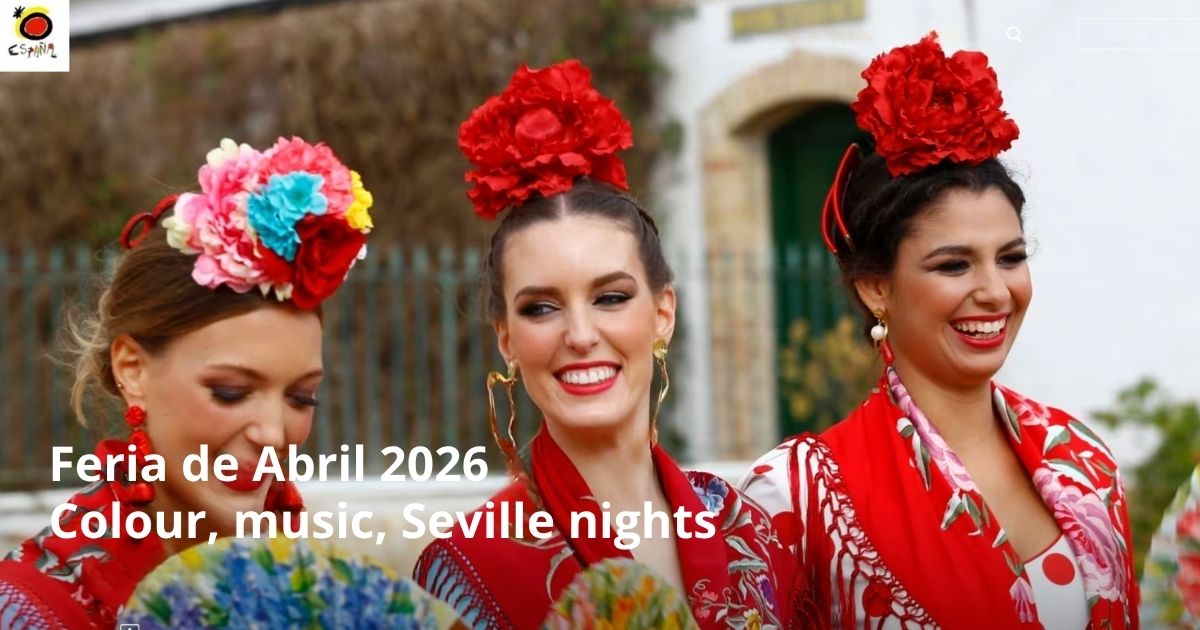
SEVILLE – There are some moments in Spain when a city seems to change its skin. In Seville, Feria week is one of them. Streets that feel warm and ordinary by day suddenly lead towards a blaze of lanterns, music and movement, where horses clip-clop past the feria ground, women in bright flamenco dresses sweep through the dust, and the air carries that familiar mix of perfume, fried food, sherry and spring heat.
That is the pull of Feria de Abril 2026, which officially runs from Tuesday, 21 April to Sunday, 26 April. However, for many people, it really begins the night before, when the great illuminated gateway flickers into life and the city seems to exhale into celebration.
When the city starts to glow
The official dates are clear enough, but anyone who knows Seville will tell you that Feria starts with the mood long before it starts on paper. The key opening moment comes on the night of 20 April, when the alumbrado switches on the Portada and thousands of lights throw colour across the Real.
This year’s entrance also has a distinctly Sevillian touch. Local reporting says the 2026 Portada takes inspiration from the Pavilion of Portugal from the 1929 Ibero-American Exposition and from the Cenador de Carlos V in the Real Alcázar, giving the gateway a design rooted in the city’s own visual history.
More than a festival, less simple than it looks
From a distance, Feria can seem like one giant open-air party. In reality, it is more layered than that. Most of the casetas are private, belonging to families, organisations or social groups, so first-time visitors often arrive expecting easy access everywhere and quickly realise that is not how it works. Spain’s official tourism guidance notes that public casetas do exist, and visitors can be directed towards them at the entrance information point.
That does not make the experience any less magical. Even without a private invitation, the feria ground itself is open, and much of the pleasure comes simply from being there: the rows of striped tents, the lanterns strung overhead, the passing carriages, the burst of sevillanas from inside a caseta, the sound of laughter rising from tables late into the night.
The colours by day, the rhythm by night
One of the best things I love about the Feria is that it changes character as the hours pass. During the day, it feels bright, theatrical and full of movement. Horses and carriages thread through the Real, children run between families, and the colours are at their sharpest under the spring sun — reds, creams, polka dots, embroidered shawls, flowers pinned into hair.
By night, the fair feels different. The lights take over, the music spills out more loudly, and the energy becomes thicker and more intense. What was elegant by afternoon can feel electric after dark. This is the version of Feria many outsiders imagine first, but it is only half the picture.
Then there is Calle del Infierno, the stretch of fairground rides, games and food stalls that bring a more playful, noisy edge to the week. It is one of the easiest parts of the feria for casual visitors to enjoy, and one of the clearest reminders that Feria is not just about tradition, but about fun too.
What is new for 2026
This year’s edition comes with a few practical updates as well. Seville City Council says 11 new casetas have been incorporated through renewals and reallocations, while a new pedestrian connection from Pascual Márquez to Juan Pablo II is designed to improve circulation, access and safety around the Real.
That may sound like background detail, but anyone who has ever tried to leave a crowded feria ground late at night will know these changes matter. Events like this live or die partly on atmosphere, but also on how easily people can move through them once the crowds build.
The Feria is such a vast social and cultural event
Part of the reason Feria endures is that it still feels tied to Seville itself, rather than staged purely for visitors. Spain’s official tourism site notes that it began in 1847 as a cattle fair, before slowly evolving into the vast social and cultural event it is now.
That older history still lingers beneath the colour and spectacle. Feria is glamorous, yes, but it is also deeply local. For many Sevillanos, it is bound up with family, memory, routine and identity. That is why it feels different from a festival dropped into a city for a week. It belongs there.
The best way to experience it
The smartest way to approach Feria de Abril 2026 is not to treat it like a checklist. Go for the atmosphere, to watch the city dress up. Go to hear the music drifting out into the night. And also, go for the swirl of colour, the lantern-lit avenues and that strange, unmistakable feeling that Seville has stepped sideways into another version of itself.
And that, really, is why Feria continues to draw people back. Not just because it is famous, but because for a few spring nights each year, Seville becomes a place of light, sound and colour that feels almost impossible to imitate anywhere else.
Spain ferias and fiestas 2026: the big guide to Spain’s best celebrations month by month