 Lorraine Williamson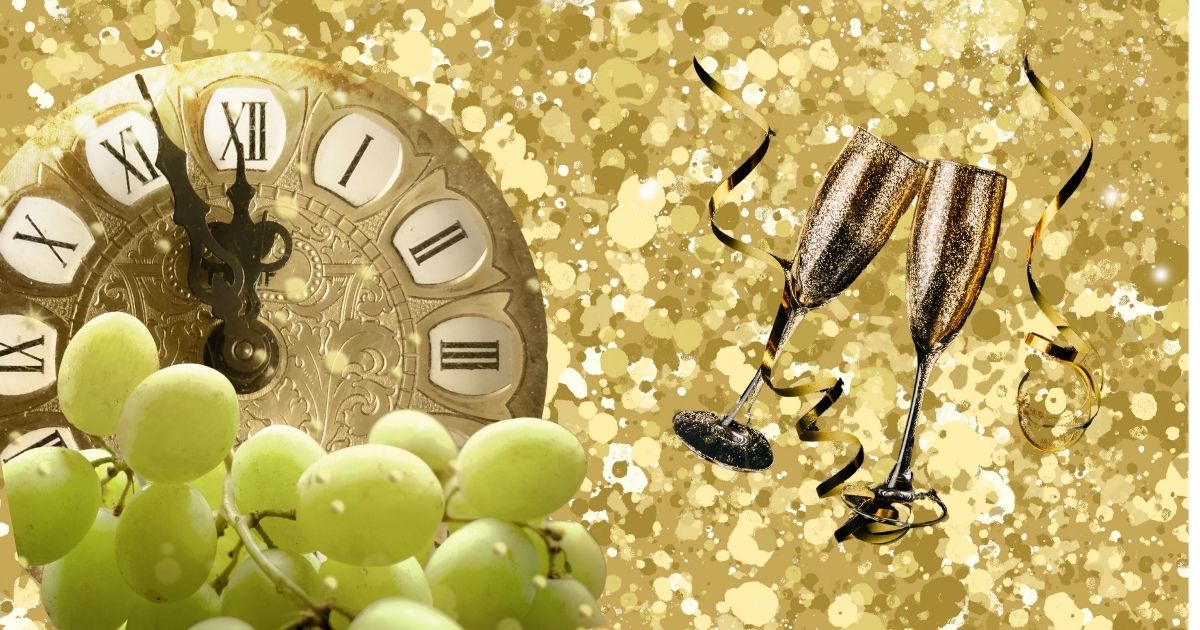
Spain doesn’t just celebrate New Year’s Eve. It performs it, in a set sequence that has been repeated for generations. The rituals are so familiar that many people follow them without thinking — the grapes, the TV bells, the Cava toast, the lucky colour hidden under party clothes.
Yet once you begin asking why Spain does it this way, the traditions become far more interesting. Nochevieja is not simply a party. It is a cultural handover: a moment shaped by superstition, shared timing, and the country’s love of doing important things together.
The midnight grapes: a ritual of luck and rhythm
The most iconic Spanish New Year tradition is also the one most likely to go wrong in real time. At midnight, as the clock strikes twelve, one grape is eaten with each chime.
The grapes symbolise good fortune across the twelve months ahead. Some historians link the custom to early 20th-century campaigns to popularise grapes. Others point to older European ideas about eating seasonal fruit for luck. Whatever its exact origin, the ritual has become a national habit.
And it isn’t just about luck. It is about rhythm. The chimes are quick. The country moves together. For a few seconds, everything narrows to one shared task.
Pro tip – buy seedless grapes – they are easier to eat with the chimes!
Why the grapes are harder than they look
Most people don’t realise that the bell chimes at Puerta del Sol don’t begin evenly. There are four slower preparatory chimes (los cuartos), followed by twelve rapid strikes. It’s those final chimes that count.
This is why many families peel and deseed their grapes in advance, or buy special New Year’s Eve packs sold each December. It’s less about appetite — and more about keeping up.
Why Spain watches one clock
The bells that matter come from Puerta del Sol in Madrid, broadcast live across Spain. It is a tradition that turns New Year’s Eve into a coordinated national moment.
There is something almost ceremonial about it. Families arrange grapes on plates. People hush the room. The TV becomes a kind of public square. Even those celebrating out at bars often pause for the broadcast.
Spain has many regional identities, but on Nochevieja the country chooses unity — one clock, one countdown, one midnight.
Red underwear: superstition dressed up as fun
Red underwear is often described as a joke tradition, but it survives because it fits a familiar Spanish approach to luck: playful, half-believed, rarely dismissed entirely.
The colour symbolises passion, energy and good fortune. Many people still follow the “rules” even if they claim not to: it should be new, and some say it should be a gift. Whether it is worn for love, luck, or simply because “it’s what you do”, the custom is part of the season’s shared script.
It also says something about Spain’s relationship with superstition. Modern life and tradition are not in conflict here. They coexist easily.
Cava at midnight, not always fireworks
In many places, Spain’s midnight moment is quieter than visitors expect. The emphasis falls on the toast, not the noise. Cava is poured. People hug and kiss. Wishes are exchanged. Messages start arriving.
Fireworks exist in some cities, and some families step outside after the grapes, but New Year’s Eve is still largely home-centred. Spain saves its biggest public spectacle for other dates — especially Reyes.
The long dinner that carries the night
Dinner on Nochevieja is not a warm-up. It is the main event.
Families sit down late and stay there. Courses arrive slowly. Conversation stretches. Children drift in and out of the room. The night is built around food and time, not rushed entertainment.
Only after midnight do many younger people head out, often much later than in northern Europe. Spain’s New Year runs deep into the night, and the streets only truly come alive in the early hours.
Regional twists you might not know
The grapes are almost universal, but Spain still makes room for local variations.
In some areas, families add sweets, small traditions or personal “good luck” gestures. On the coast, a midnight walk or symbolic moment by the sea is common. On the Canary Islands, the celebrations follow local time — which means the mainland chimes can feel like a rehearsal rather than the main event.
The details shift, but the purpose stays the same: a clean crossing into the year ahead.
Why these customs endure
There is a reason Spain keeps returning to these rituals. They offer certainty at a moment defined by uncertainty. They create a shared story. Also, they give people something small and familiar to do when the year changes, even if the world does not.
In a country where festivals and traditions still shape the calendar, New Year’s Eve is less about reinvention than continuity. You don’t reinvent yourself at midnight. You begin again, together.
A Spanish start to the year
On 31 December, Spain doesn’t race into the new year. It times it, tastes it, toasts it, and quietly asks luck for a favour.
And then, once the grapes are gone and the messages have been sent, the festive season continues — because in Spain, the real ending still belongs to Reyes.
Festive Traditions