 Lorraine Williamson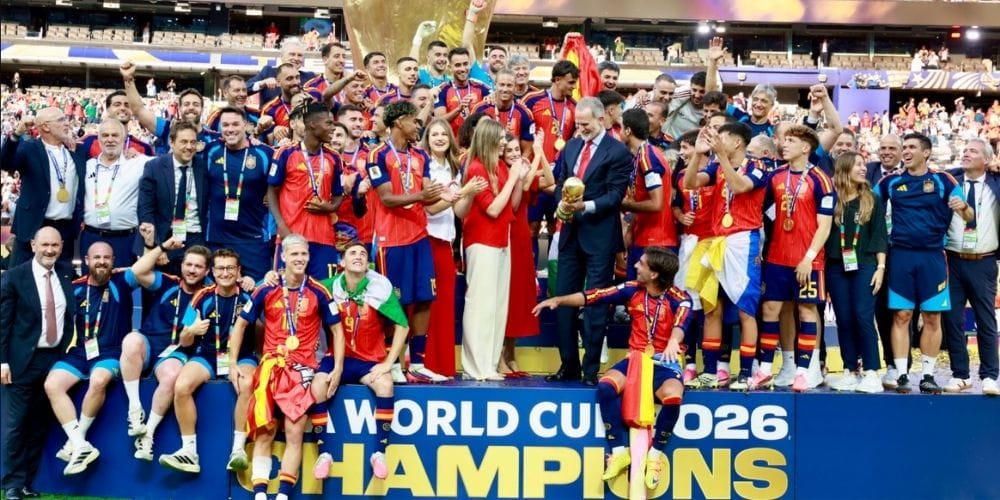
Spain are world champions for the second time after defeating Argentina 1–0 in an ill-tempered final that will be remembered as much for its controversial refereeing decisions and post-match confrontations as for Ferran Torres’s extra-time winner.
Luis de la Fuente’s side dominated long periods of Sunday night’s match in New Jersey, but had to overcome a disallowed goal, persistent Argentine aggression and a chaotic finish before finally lifting the trophy.
Torres scored the decisive goal in the 106th minute, shortly after Argentina had been reduced to ten players following the dismissal of Enzo Fernández. Spain then survived a late response from the defending champions to add a second star to the one earned in South Africa in 2010.
Spain controlled the match but struggled to find the breakthrough
The Spanish side entered the final as the more composed and tactically settled side, and that was reflected in the pattern of the match. De la Fuente’s players controlled possession, moved Argentina across the pitch and created the clearer opportunities, while Lionel Scaloni’s team frequently relied on physical challenges to interrupt Spain’s rhythm.
Argentina goalkeeper Emiliano Martínez repeatedly kept his side in the contest as Spain’s pressure grew. The European champions registered 20 attempts before Argentina managed their first meaningful effort, but the breakthrough remained elusive until extra time.
Spain’s control did not produce a calm final. Tackles became increasingly late, confrontations followed several routine challenges, and referee Slavko Vinčić struggled to prevent the match from becoming more hostile as the evening progressed.
Why Nico Williams’s goal could not be reviewed by VAR
The most controversial refereeing moment arrived when Nico Williams appeared to score for Spain, only for the goal to be ruled out because of an alleged foul by Mikel Merino on Nicolás Otamendi during the build-up.
Replays suggested the contact was minimal, with Merino appearing to step close to or on the defender’s foot before the ball reached Williams. Spanish refereeing analyst Iturralde González argued that the challenge did not justify a foul and that the goal should have stood.
The timing of the referee’s whistle was crucial. Vinčić stopped play before Williams completed the move and put the ball in the net, which meant VAR could not simply review the incident and award the goal retrospectively. Once the whistle had sounded, the ball was technically no longer in play, and the subsequent finish could not be treated as a valid goal.
Had the referee allowed the attack to finish before making his decision, VAR would have been able to examine the alleged foul and recommend an on-field review. Instead, the early whistle removed that possibility and left Spain without a goal that many observers believed should have counted.
Argentina’s physical approach tests the referee
Argentina’s aggression had been a concern before the final, with De la Fuente publicly calling for the laws of the game to be applied consistently. Those fears appeared justified as the defending champions repeatedly attempted to disrupt Spain through tactical fouls and increasingly forceful challenges.
Enzo Fernández was eventually dismissed after receiving a second yellow card for a late challenge on Pau Cubarsí shortly before the end of normal time. The decision left Argentina with ten players as the match moved towards extra time, and was widely regarded as a straightforward second booking.
Greater controversy surrounded Leandro Paredes, who had already been cautioned but continued to commit fouls and become involved in confrontations. Several incidents prompted questions over how he had avoided a second yellow card during the match, particularly when other players had been punished for less sustained behaviour.
The referee’s reluctance to dismiss Paredes earlier allowed tension to continue building. By the final whistle, the match had moved beyond ordinary physical competition and into an open confrontation between players from both sides.
Ferran Torres delivers Spain’s winning moment
Spain finally made their superiority count 37 seconds into the second period of extra time. A loose ball inside the Argentine penalty area fell to Torres, who reacted quickest and drove the decisive finish beyond Martínez.
The goal was Spain’s 20th attempt of the match and rewarded a performance built on patience rather than panic. Even after having the earlier effort disallowed, Spain continued moving the ball and trusted that another chance would arrive.
Argentina attempted to respond during the closing stages but struggled to create a clear opportunity against a Spanish defence that had been outstanding throughout the tournament. Spain conceded only one goal across eight matches, setting a new defensive standard for a World Cup-winning team.
Final whistle sparks further confrontation
The tension did not end when Spain’s victory was confirmed. Immediately after the final whistle, Nahuel Molina appeared to strike or shove Spain captain Rodri near the halfway line, triggering a wider confrontation involving players and members of both benches.
Eric García initially attempted to calm the situation, but Paredes then became heavily involved. Footage showed the Argentine midfielder grabbing García around the neck before turning his attention towards Gavi, who was pushed to the ground during the disorder.
Members of Argentina’s coaching staff eventually intervened to restrain Paredes, who was shown a red card after the match had ended. FIFA is expected to examine the footage, and further disciplinary action could follow depending on the referee’s report.
The scenes were an ugly conclusion to a match in which Argentina’s frustration had become increasingly visible. Spain’s players largely attempted to move away from the confrontation and begin celebrating a victory they had earned through control, discipline and persistence.
Argentina players criticised during trophy presentation
Argentina’s conduct remained a talking point during the post-match presentation. After collecting their runners-up medals, several players appeared to turn their backs or leave the presentation area as Spain’s individual awards and trophy ceremony continued.
The behaviour attracted criticism because losing finalists traditionally remain in place to acknowledge the champions. Rodri received the Golden Ball as the tournament’s best player, Unai Simón collected the Golden Glove and Pau Cubarsí was recognised as the best young player before Spain lifted the World Cup.
Some Argentina players remained visibly devastated, with Lionel Messi in tears after what may have been his final World Cup appearance. Lamine Yamal crossed the pitch to console him, offering one of the evening’s few gestures of sportsmanship amid the hostility.
However, the decision by other Argentine players to turn away or head towards the tunnel was widely described as disrespectful to the winners. It compounded the negative impression left by the fouls, dismissals and confrontation after the final whistle.
Refereeing debate should not overshadow Spain’s performance
The disallowed Williams goal, the handling of Paredes and the accumulation of physical challenges will ensure the referee’s performance remains part of the discussion. Spain could reasonably argue that the early whistle denied VAR the chance to correct what may have been a serious error.
Yet those controversies should not obscure the central fact of the final: Spain were the better team. They produced more chances, controlled possession and maintained their shape while Argentina increasingly allowed frustration to dictate their behaviour.
De la Fuente’s team refused to become involved in the type of match Argentina appeared to want. They continued playing through midfield, trusted their substitutes and waited for the breakthrough rather than abandoning their approach.
Torres’s goal provided the decisive reward, but Spain’s victory was the result of a collective performance stretching far beyond one moment. They completed the tournament unbeaten and added the World Cup to the Nations League title won in 2023 and the European Championship secured in 2024.
Spain add their second star
Spain’s second men’s world title arrives 16 years after Andrés Iniesta’s extra-time goal defeated the Netherlands in Johannesburg. Once again, the winning moment came beyond the 90th minute, but this victory belonged to a new generation led by Rodri, Yamal, Williams, Cubarsí and a squad that combined youth with tournament experience.
Argentina’s players will return home as runners-up after coming within one match of retaining the trophy won in Qatar. Their run to the final demonstrated resilience, but the manner of their defeat and their conduct afterwards will form an uncomfortable part of the tournament’s closing story.
Spain, meanwhile, return to Madrid with the trophy and a second star. The final may have descended into controversy, but the identity of the deserving champions was never seriously in doubt.