 Lorraine Williamson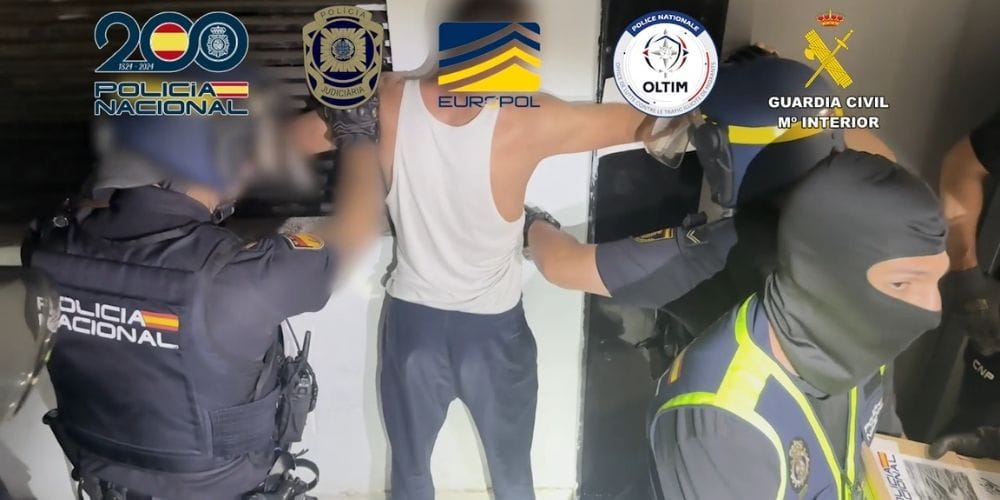
Spanish police have dismantled what the Interior Ministry describes as the largest Algerian criminal network dedicated to smuggling people across the Mediterranean, following an investigation that began in 2023. A total of 78 people have been arrested, 77 in Spain and one in Algeria, with 27 remanded in custody.
The operation was carried out jointly by Policía Nacional and Guardia Civil with support from Europol and police forces in France, Portugal and Poland. Investigators say the network was responsible for at least 64 sea crossings in which more than 2,000 migrants were brought irregularly to Spain, generating profits of more than €24 million.
The group used high-speed boats to move synthetic drugs such as MDMA from Spain to Algeria, then used the return journeys to transport migrants towards the coasts of Almería, Cartagena, Murcia, Alicante and Ibiza. According to Interior, some migrants were charged as much as €12,000 each, with up to 50 people carried on a single journey.
High-speed boats, weapons and encrypted communications
Investigators say the organisation operated through separate but closely coordinated structures in Andalucia, Murcia, the Valencia region and the Balearic Islands, with further links in France, Portugal, Italy and Poland.
The network had access to high-powered boats, transport and surveillance vehicles, safe houses, encrypted communications, satellite phones, GPS systems and an international logistical network. Police seized 18 high-speed vessels valued at more than €5 million during the investigation.
Seventeen searches were carried out in Almería, Murcia, Cartagena and Alicante. Officers recovered €26,675 in cash, 15,000 MDMA tablets, 61kg of hashish, 500g of cocaine, 40g of methamphetamine, a .38 calibre revolver, ammunition, four vehicles, 725 litres of fuel and specialist communications equipment.
Migrants allegedly exposed to extreme danger
Interior said the sea crossings organised by the group were exceptionally dangerous. Migrants were allegedly transported at high speed, often in rough seas and at night, with many travelling without life jackets and in severely overcrowded conditions.
In some cases, police say passengers were tied down to prevent them falling overboard. Many had already travelled long distances through Africa before reaching the Algerian departure coast, where some were housed in overcrowded and unsanitary accommodation while waiting for the crossing.
Investigators also allege the organisation used serious violence against both its own members and the migrants under its control. Interior refers to threats, coercion, assaults, kidnappings and intimidation, and says some boat pilots were instructed to confront law enforcement if necessary.
EU seeks tougher border response after Ceuta crisis
Arrests stretched across Spain
The arrests were spread widely across the country, including 36 in Almería, 13 in Murcia, 11 in Alicante, six in Ibiza and smaller numbers in Cartagena, Palma de Mallorca, Palencia, Huelva, Córdoba, A Coruña, Sevilla and Lugo. One further arrest was made in Algeria.
Those detained are being investigated for offences including membership of a criminal organisation, people smuggling, drug trafficking, arms and explosives offences, illegal fuel storage and transport, extortion, unlawful detention, contraband and money laundering.
El País reports that the first 59 arrests were made in mid-June, with the remaining arrests taking place last week, meaning the investigation predates the recent crisis in Ceuta. The newspaper also reports that Interior is presenting the operation to EU partners as evidence of Spain’s efforts against organised migrant-smuggling networks.
A network built around several criminal markets
What makes the case particularly significant is the apparent overlap between migrant smuggling and other organised crime.
The same boats were allegedly being used for different illicit activities depending on the direction of travel, allowing the network to earn money from drugs moving south and migrants moving north. Police also identified a financial structure that included a hawalader, responsible for moving and managing funds outside conventional banking channels.
Europol has repeatedly warned that migrant-smuggling networks operating into the EU are becoming increasingly transnational, often sharing logistics, transport routes and financial infrastructure with other criminal groups. Its latest reporting also highlights growing concern over the use of violence and the increasingly professional structure of such networks.
For Spanish investigators, Operation Salem appears to have exposed one of the most sophisticated examples yet of that model operating across the western Mediterranean, combining migration routes with drugs, weapons, fuel and cross-border finance.