 Lorraine Williamson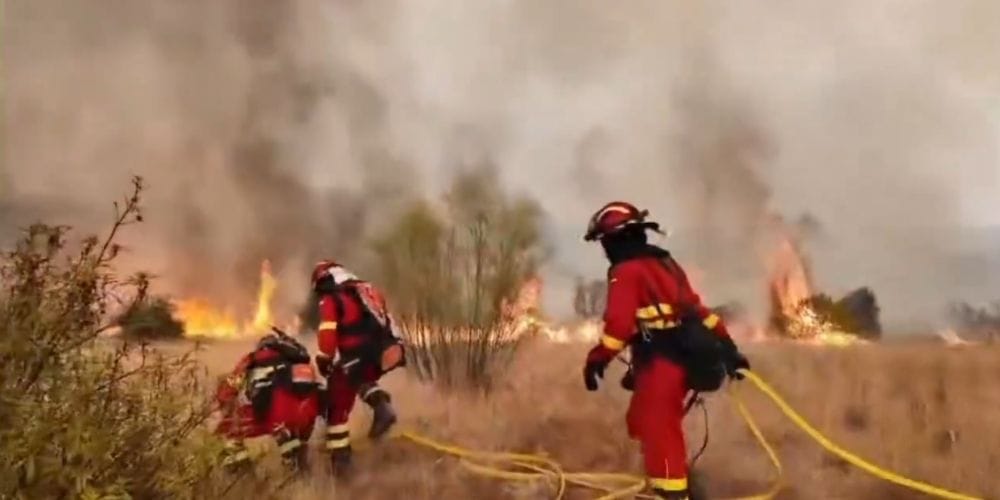
Spain’s fourth heatwave of the summer begins today, bringing another test for communities and emergency teams exhausted by days of destructive wildfires.
Temperatures are expected to rise through the second half of the week, with parts of inland Spain reaching between 40°C and 42°C. The heat will combine with dry vegetation, low humidity and locally strong winds, creating conditions in which a small spark can quickly become a fast-moving fire.
Yet the battle against the flames is no longer fought only with hoses, fire engines and water dropped from the sky. Above the smoke, aircraft, helicopters and drones are helping commanders understand what is happening across enormous fire zones — including after darkness restricts conventional aerial operations.
Where Spain will be hottest today
The sharpest rise in temperatures is expected across eastern and north-eastern Spain as the heatwave becomes established.
AEMET forecasts highs of between 40°C and 42°C in the Ebro Valley and the depressions of the north-east. Temperatures of 39°C to 41°C are expected in the main river valleys of the south-west, while parts of the northern plateau and Castilla-La Mancha could reach between 37°C and 39°C.
The heat will also intensify in the Canary Islands. Inland and elevated areas of La Palma, Tenerife and Gran Canaria will be particularly affected, with some valleys in Gran Canaria expected to exceed 37°C.
Conditions are forecast to become more intense towards Friday, when parts of inland southern Spain could also reach 40°C to 42°C. The episode is expected to continue until at least Sunday, 2 August, and may extend into the following week. AEMET’s special heatwave notice sets out the areas expected to face the highest temperatures.
A dangerous moment for Spain’s fire zones
The timing is particularly difficult.
Emergency teams have spent days creating control lines, cooling burned ground and defending communities across Madrid, Ávila, Toledo and Castellón. Rising temperatures can dry vegetation further, reduce moisture levels and increase the risk that hidden hotspots will flare up again.
The danger does not disappear when flames are no longer visible. Roots, tree stumps and layers of organic material can continue smouldering beneath the surface for days.
Wind may then expose that heat, carry embers beyond a firebreak or turn a small reactivation into another active front. Civil Protection has warned that the wildfire danger could reach extreme levels as high temperatures combine with low humidity and locally strong winds. The official alert says the heatwave is expected to last until at least Sunday.
This week’s weather will therefore test the control lines already established around major fires. Crews must hold the ground they have gained while remaining ready for new emergencies elsewhere.
Why water-bombing aircraft remain vital
The sight of an amphibious aircraft releasing thousands of litres of water over a fire front has become one of the defining images of Spain’s wildfire crisis.
The Canadair aircraft used by Spain’s 43 Group can collect water directly from the sea, reservoirs and sufficiently large rivers. Depending on the model, each can carry between 5,500 and 6,000 litres and release it in one major drop or several smaller discharges.
Their purpose is not necessarily to extinguish an entire fire from the air. A well-positioned drop can lower the intensity of the flames, slow an advancing front and create an opportunity for ground teams to move closer safely.
Aircraft can also help protect homes, roads and essential infrastructure when flames are advancing too quickly for firefighters to establish conventional control lines. MITECO details the capabilities of Spain’s amphibious firefighting aircraft.
Helicopters reach difficult terrain
Helicopters perform a different but equally important role.
Some carry water in suspended buckets, allowing them to work above steep slopes, narrow valleys and smaller areas that large aircraft may struggle to reach. Others transport firefighters, conduct reconnaissance or help locate and evacuate injured people.
Their ability to hover and manoeuvre at lower speeds makes them particularly useful around irregular fire fronts, ravines and isolated communities.
Spain’s 2026 wildfire campaign includes four helicopters supporting the UME, with capabilities covering reconnaissance, search, location and evacuation. Up to ten fixed-wing aircraft from the 43 Group are also positioned across eight operational bases during the summer campaign. The Ministry of Defence says the deployment is intended to shorten response times across Spain.
Drones reveal what smoke and darkness conceal
Drones are less dramatic to watch than a water bomber, but the information they provide can be just as important.
Fitted with thermal cameras, they can identify hotspots that are invisible to the naked eye. They also transmit images in real time, allowing teams at command centres to follow the behaviour of a fire without sending people unnecessarily into unstable terrain.
This becomes especially valuable after sunset. Conventional firefighting aircraft face significant restrictions at night, but drones can continue carrying out reconnaissance, mapping burned areas and searching for pockets of heat that could reignite before morning.
Thermal imaging can distinguish between ground that merely looks blackened and areas where dangerous heat remains beneath the surface. That information helps commanders decide where to send firefighters, machinery and water supplies first.
The UME has created a specialist drone unit with capabilities extending beyond ordinary aerial photography. Its work includes command and control, intelligence, intervention and the use of aerial, terrestrial and aquatic unmanned systems. The UDRUME unit is intended to become a national centre of expertise for drones used in major emergencies.
Technology supports the people facing the fire
Aircraft, helicopters and drones can transform the response, but they do not replace the people working in and around the fire zone.
Nor is the operation carried out by firefighters alone. Wildfire emergencies bring together forest-fire brigades, municipal fire services, the UME, pilots, drone operators, emergency coordinators, Civil Protection teams, forestry specialists, police, the Guardia Civil, healthcare workers, local authorities and logistics crews.
Each has a different responsibility. Some defend homes at the edge of the flames. Others evacuate residents, close roads, treat injuries, move equipment, assess changing weather or coordinate hundreds of people working across several provinces.
A water drop may briefly reduce the intensity of a fire, but ground teams must still enter the area, extinguish what remains and prevent the flames from taking hold again. A drone may locate a concealed hotspot, but somebody must assess the danger, identify the safest approach and decide whether personnel can be sent into the terrain.
Many of those involved work long shifts in extreme heat, surrounded by smoke and facing fire behaviour that can change within minutes. Every deployment carries risk, while every decision can affect the safety of colleagues and nearby communities.
The greatest strength of the response lies in that cooperation. Aircraft attack from above. Helicopters reach difficult ground. Drones provide a clearer operational picture. Command teams interpret the information, while personnel on the ground undertake the slow and dangerous work of securing the area.
Spain’s increasingly sophisticated technology deserves recognition. So do the people who operate it, coordinate it and repeatedly place themselves in harm’s way to protect others. The Ministry of Defence describes how UME teams are creating firebreaks, defending threatened homes and protecting both people and animals.
Heat advice without putting life on hold
Living through a heatwave does not necessarily mean remaining indoors throughout the day. It does mean reorganising normal routines around the conditions.
Shopping, sightseeing, outdoor work and exercise are better moved to the early morning or later evening. Even people accustomed to Spanish summers may struggle because the temperature will remain high over several consecutive days and nights.
Carry water before leaving home rather than relying on finding it later. Anyone driving through inland Spain should take more than they expect to need, particularly where wildfire restrictions or traffic disruption could lengthen a journey.
People staying in apartments or holiday accommodation should check whether bedrooms cool properly after sunset. A room that remains oppressively hot throughout the night can leave occupants more vulnerable the next day, even when they felt well during the afternoon.
Heat-related illness does not always begin dramatically. Unusual confusion, weakness, dizziness, nausea or an inability to cool down should not be dismissed as simple discomfort. Anyone who loses consciousness, becomes severely confused or has very hot skin may need urgent medical help through 112.
Older people, babies, pregnant women and those with heart, respiratory or other long-term conditions remain particularly vulnerable. Yet healthy adults can also become seriously unwell when strenuous activity, dehydration and prolonged heat combine.
Children, vulnerable adults and animals should never be left inside a parked vehicle, even briefly. The temperature inside a closed car can rise far more quickly than the surrounding air.
Travel plans may need to change quickly
The heatwave will not affect every part of Spain equally, and warning levels may change within hours.
People travelling through fire-affected regions should check both weather forecasts and road conditions before leaving. A road may be open in the morning and restricted later if smoke worsens or emergency vehicles require priority access.
Hiking and countryside excursions require particular caution. Dry vegetation, remote paths, limited shade and unreliable mobile coverage can turn an ordinary walk into a dangerous situation when temperatures rise above 40°C.
The same conditions also make accidental fires more likely. Barbecues, machinery, cigarette ends and vehicles parked over dry grass can all provide an ignition source.
Plans may need to be shortened, moved to a cooler part of the day or cancelled altogether. Changing an itinerary is inconvenient; becoming stranded in extreme heat or near an active fire is considerably worse.
The difficult days are beginning again
Spain’s emergency teams have made important progress, but the fourth heatwave is arriving before the country has fully recovered from the latest fires.
The coming days will show whether newly secured fire lines can withstand another period of extreme temperatures, low humidity and changing winds.
Water-bombing aircraft will remain the most visible part of the operation. Yet behind every flight, thermal image and water drop is a network of people making difficult decisions and working in dangerous conditions.
Spain’s wildfire response increasingly depends on sophisticated technology. Its true strength, however, lies in the skill, courage and coordination of the teams who face the emergency day after day.