 Lorraine Williamson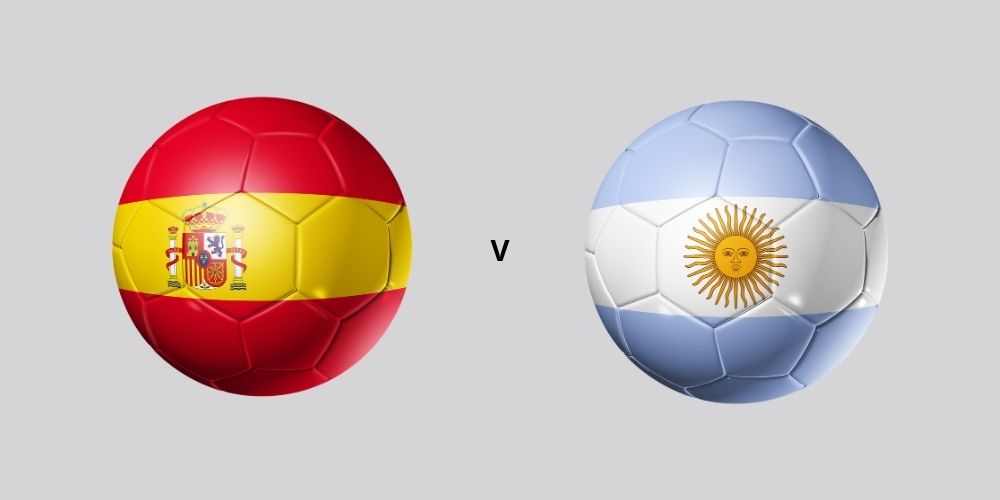
Spain stand one victory away from becoming world champions for the second time as they prepare to face defending champions Argentina in tonight’s World Cup final in New Jersey.
The match brings together the reigning European and South American champions, with Luis de la Fuente’s composed, possession-based team attempting to deny Lionel Messi and Argentina a second successive title.
The final begins at 9.00 pm Spanish mainland time, or 8.00 pm in the Canary Islands, at the New York New Jersey Stadium. It will be shown for free in Spain on La 1 and RTVE Play, with special World Cup programming running throughout Sunday before live coverage of the match.
Spain arrive after their most complete performance
Spain secured their place in the final with a controlled 2–0 victory over France, producing arguably their most complete performance of the tournament. They dominated possession with purpose, pressed quickly after losing the ball and prevented one of the World Cup’s most dangerous attacks from developing any sustained rhythm.
That semi-final reflected the qualities that have carried Spain through the competition. Their midfielders are comfortable receiving the ball under pressure, the wide players stretch opponents across the pitch, and the team rarely abandons its structure when pushing forward.
Spain completed their final training session on Saturday, with the squad preparing for the country’s first men’s World Cup final since lifting the trophy in South Africa in 2010. The RFEF described the team as ready for the decisive match, which will crown the winner of the expanded 48-team tournament.
Argentina have repeatedly found a way through
Argentina’s route to the final has been less controlled but no less impressive. They came through another tense encounter in the semi-finals, recovering from a goal down to beat England 2–1 with two late strikes.
Lionel Scaloni’s team have shown throughout the tournament that they do not need to dominate every phase of a match. Argentina are comfortable defending compactly, slowing the tempo and waiting for the moment when Messi, Lautaro Martínez or Enzo Fernández can turn a small opening into a decisive chance.
The holders are attempting to become the first country since Brazil in 1962 to retain the men’s World Cup. For Messi, now 39, the final offers another opportunity to define an international career that already includes the 2022 title.
Scaloni said Spain’s quality throughout the pitch was a concern, praising the work carried out under De la Fuente and joking that he would prefer Spain’s team bus not to leave the hotel. Beneath the humour was a clear acknowledgement that Argentina face the most tactically complete side they have met at this tournament.
Where the final could be decided
Spain will expect to have more of the ball, but possession alone will not be enough. The key will be whether they can move Argentina’s midfield out of position without leaving large spaces behind their full-backs.
Lamine Yamal will be one of Spain’s most important attacking outlets. His ability to receive wide, beat defenders and move inside onto his stronger foot could force Argentina to commit a second player to his side, creating room elsewhere for Dani Olmo and Spain’s central runners.
On the opposite flank, Nico Williams can stretch Argentina’s defence with pace and direct movement. Spain will want to switch the point of attack quickly rather than repeatedly attempting to play through a crowded centre.
Argentina’s priority will be to disrupt Spain’s rhythm. Rodrigo De Paul, Alexis Mac Allister, and Enzo Fernández are likely to press aggressively when Spain attempt to build through midfield, while Messi will look for space between the midfield and defensive lines.
If Spain push both full-backs forward at the same time, Argentina will try to attack the space left behind them. Martínez’s movement across the centre-backs could be particularly dangerous if Messi is allowed time to release an early pass.
Spain must manage Messi rather than chase him
Trying to mark Messi with one player for the entire match would risk pulling Spain out of shape. A more likely approach is for the nearest midfielder or defender to close him down while the remaining players protect the passing lanes around him.
England restricted Messi’s influence for much of their semi-final by crowding the central spaces, but Argentina remained patient. Once England dropped deeper during the closing stages, Messi found more room and supplied the decisive delivery for Martínez’s winner.
Spain must avoid the same trap. Defending a narrow lead by retreating towards their own penalty area would allow Argentina to move the ball around the edge of the box and increase Messi’s influence.
The better form of protection may be to continue controlling possession and pressing high enough to keep Argentina away from Spain’s goal.
England take third place after 10-goal thriller
England ended their World Cup with a bronze medal after beating France 6–4 in an extraordinary third-place play-off in Miami on Saturday night.
Bukayo Saka scored a hat-trick as England established a commanding first-half lead, with Declan Rice and Ezri Konsa also finding the net. France threatened an unlikely comeback after the interval, inspired by two goals from Kylian Mbappé, before England pulled clear again and Jude Bellingham completed the scoring.
The match offered a dramatic contrast to the caution often associated with third-place play-offs. Both teams rotated their line-ups and attacked freely, producing a ten-goal contest in which defensive organisation was regularly sacrificed for ambition.
For England, the victory secured their first third-place finish at a World Cup and their best result since winning the tournament in 1966. France finished fourth after entering the competition among the leading favourites, while Mbappé’s two goals strengthened his position in the race for the Golden Boot.
A final between two contrasting champions
Spain and Argentina share technical quality, but their routes to victory are different. Spain build control through collective movement, patient circulation and immediate pressure when possession is lost. Argentina are more comfortable allowing a match to become uneven, trusting their experience and individual quality to decide its defining moments.
Spain may enter the final as slight favourites because of the authority of their semi-final performance. They have looked more settled as a team and have shown they can control dangerous opponents without abandoning their attacking principles.
Argentina, however, have the experience of winning the previous World Cup and the confidence of a team that has repeatedly survived difficult moments. Any lapse in concentration could be punished.
The opening goal will be particularly important. If Spain score first, they can use possession to force Argentina to chase the match. If Argentina take the lead, they are capable of slowing the tempo, defending compactly and frustrating Spain.
Prediction: Spain to edge a close final
The final is unlikely to resemble England and France’s ten-goal contest. Both Spain and Argentina are too experienced to allow the match to become that open from the beginning.
Spain’s midfield control and ability to press as a unit could give them a narrow advantage, particularly if Yamal and Williams can stretch Argentina’s defensive shape. Argentina will still create opportunities, especially if Messi is allowed to receive the ball close to Spain’s penalty area.
Prediction: Spain 2–1 Argentina, possibly after extra time.
Whatever the outcome, the final brings together the two countries that have most convincingly combined tournament experience with decisive attacking quality. Spain are chasing the second star above their badge; Argentina are pursuing a fourth and the successful defence of their title.