 Lorraine Williamson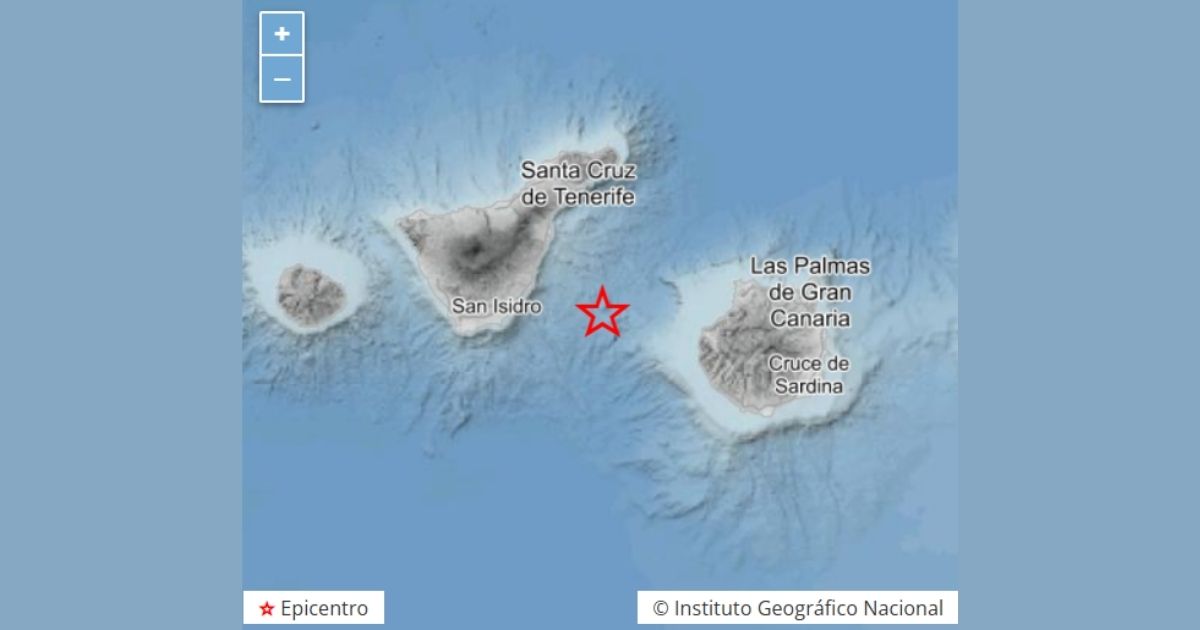
The tremor that rattled nerves in the Canaries this week was strong enough to be widely felt, but the latest expert commentary points in the same direction: this was a normal(ish) offshore quake for the islands, not the start of something bigger.
Spain’s Instituto Geográfico Nacional (IGN) recorded the earthquake at a magnitude of 4.1 in the sea between Tenerife and Gran Canaria, at a depth of around 10 kilometres, with a smaller aftershock shortly afterwards.
Where it happened, and why people felt it so clearly
The epicentre sits in a stretch of seabed often linked in headlines to the Volcán de Enmedio area — a zone where minor seismic activity is relatively frequent. The important point is what that label doesn’t mean: the presence of an “underwater volcano” name does not automatically imply an eruption risk.
Seismologists speaking to Canary Islands media stressed that this kind of offshore movement is consistent with the region’s geology, and they urged residents to stay calm and focus on verified information rather than social media rumours.
The Teide question: “Is this connected?”
This has been the dominant fear for many residents and visitors: Tenerife has recently seen heightened seismic activity around the Teide area, so the timing spooked people.
Today’s key update is reassurance. Reporting from Canarias Ahora (El Diario) says seismic activity in Las Cañadas del Teide has eased, with no new swarms in the last 48 hours beyond occasional low-energy events — described as the biggest pause in recent days.
Separately, Europa Press quoted the IGN’s spokesperson describing an “escenario de tranquilidad” in Teide terms, while again decoupling the 4.1 offshore quake from the Teide swarms.
In short, people felt the quake, but expert assessments continue to treat it as a separate offshore event.
Will Mount Teide erupt? Scientists warn of volcanic risk in Tenerife
What residents can do if they felt it
If you were among those who noticed the shake, the IGN’s public questionnaire matters more than many people realise. It helps scientists map real-world intensity reports and refine their understanding of how the quake was experienced across different municipalities.
If you want to contribute, use the IGN’s “Did you feel it?” reporting tool.
A familiar pattern in the Canaries, not a new one
Offshore seismicity between Tenerife and Gran Canaria is not rare. El País notes that the area can register hundreds of small quakes a year, and the same region has produced stronger events historically, including a notable earthquake in 1989.
That doesn’t make the experience any less unsettling, especially when it arrives on top of heightened volcanic monitoring headlines. But the most consistent message from seismologists this week has been bluntly practical: a felt earthquake is not, by itself, evidence of an eruption scenario.
What to watch next in the official updates
The next useful signals aren’t rumours — they’re the routine updates: the IGN’s event listings, and formal statements when scientific committees meet. For now, the latest reporting indicates a lull at Teide and no established causal link to Thursday’s offshore quake.